
The mountains, canyons and lakes of the southeast. The Aral Sea in the south. The Mangystau moonscapes of the far west near the Caspian Sea. Remnants of Soviet-era gulags in the north. The mausoleums of Islamic teachers across the country. The major cities of Almaty and Astana. Epic train rides through the endless desert steppe with little but Bactrian camels.
These magnificent highlights are all in a country far from finding a happy post-Soviet harmony, where colossal inequality is causing social and political tension, and there is stress between the restoration of Islam and the introduction of liberalism, symbolised by conflicted attitudes to vodka. A gigantic, fun and fascinating country hardly on the radar of international tourism where we had never-to-be-forgotten wonderful experiences each and every day. Salem.
This land was initially settled in the first millennium BC by ancient civilisations, such as Indo-Iranian nomads the Saka and the Scythians, who suffered defeat to Alexander the Great at the Battle of Jaxartes in 329 BC. The population was supplemented from the fourth century AD by various Turkic tribes, who were traders on the Silk Road. All these peoples have left burial mounds, petroglyphs and other archaeological evidence for us to explore.
Islam was brought by the Arabs in the eighth century, and it was established as a formal religion in 960 by the Karakhanid Dynasty, though it took centuries to embed among the nomadic tribes of the vast steppe.
Their territory was consumed in the thirteenth century by the Mongol Empire, initially led by Jochi, the eldest son of Genghis Khan, and later by the Turkic Golden Horde Khanate. After that disintegrated in the fifteenth century, a powerful confederation of nomadic tribes emerged to form the Kazakh Khanate, which developed a language and culture that frames national identity even today, centred on clan loyalty, steppe governance and Islamic traditions.
After years of balancing Tzarist Russia in the north with the Chinese Qing Dynasty to the east, the Kazakh Khanate finally accepted Russian suzerainty in 1731 in exchange for protection from rival hordes. The region was annexed into the Russian Empire in the 1840s and absorbed into the USSR in the 1920s. It was converted into the Kazakh Soviet Socialist Republic in 1936, from when Kazakhs suffered forced collectivisation and famine, political purges, mass deportations, and forced labour camps or gulags. In addition, Kazakhstan was secretly used to test Soviet ballistic missiles from the Baikonur Cosmodrome, which opened in 1955.
In 1986, Kazakhstan became the scene of the first public protests against Moscow that with hindsight signalled the coming collapse of the USSR. At the height of Mikhail Gorbachev’s attempted reforms through Glasnost and Perestroika, his appointment of a new non-Kazakh First Secretary of the Communist Party of Kazakhstan was taken as a national humiliation. Tens of thousands protested in Almaty and other major cities as part of the Jeltoqsan Uprising before they were repressed by Soviet forces.
As the USSR collapsed in 1991, before independence was declared on 16 December, tensions emerged, which remain today, between the two largest ethnic groups, Kazakhs and Russians. As was common at that time, the last president of Soviet Kazakhstan segued to become the first president of independent Kazakhstan. Nursultan Nazarbayev was initially elected unopposed, then he ruled by decree and constitutional amendments that kept him in office all the way to 2019, when he took the title Leader of the Nation as Chairman of the Security Council.
Central Asia’s largest economy is rich in oil, gas and minerals, accounting for almost 60% of the combined GDP of the five stans that comprise Central Asia. However, extreme inequality means 150 or so Kazakhs own 55% of the country’s wealth, while we came across young children begging in remote villages. Poverty and disenchantment triggered a wave of protests in 2022 that finally forced Nazarbayev to relinquish his final grubby hold on power.
A country disadvantaged by its geopolitical position and the behaviour of its rulers for decades, Kazakhstan has occasionally been in the global media spotlight in the twenty-first century, and not in good ways. Sacha Baron Cohen’s 2006 film, Borat: Cultural Learnings of America for Make Benefit Glorious Nation of Kazakhstan, caused uproar and was banned here and in Russia. Tony Blair’s multi-million-dollar contract in the 2010s advising Nazarbayev on how to modernise his country while he suppressed press freedom and human rights after police killed protestors in the 2011 Zhanaozen Massacre, did much to tarnish the former British prime minister’s reputation back home.
Since independence, the cultural differences between Russian and Kazakh groups have become clearer, adding to complications in relations between the two countries. In the capital Astana and the north, most people default to speaking Russian. In most of the rest of the country, the Kazakh language has been reclaimed so most people now speak both. Not many adults speak English, though it is now compulsory in schools.
The return of Islam, which was smothered by the Soviet Union, has also conflicted with attempts to instil liberal democratic ideals. Although Kazakhstan is not on the frontline of the Islamist struggle, it is officially an Islamic country and has suffered several terrorist attacks. Most notably, in 2016 there was a spate of killings of civilians and soldiers in Aktobe by Islamic State militants returning from Syria, then ten people were shot and killed in Almaty by a young former convict and Salafi Jihadist, Ruslan Kulikbayev. All that said, there are no security concerns at all for foreign visitors.
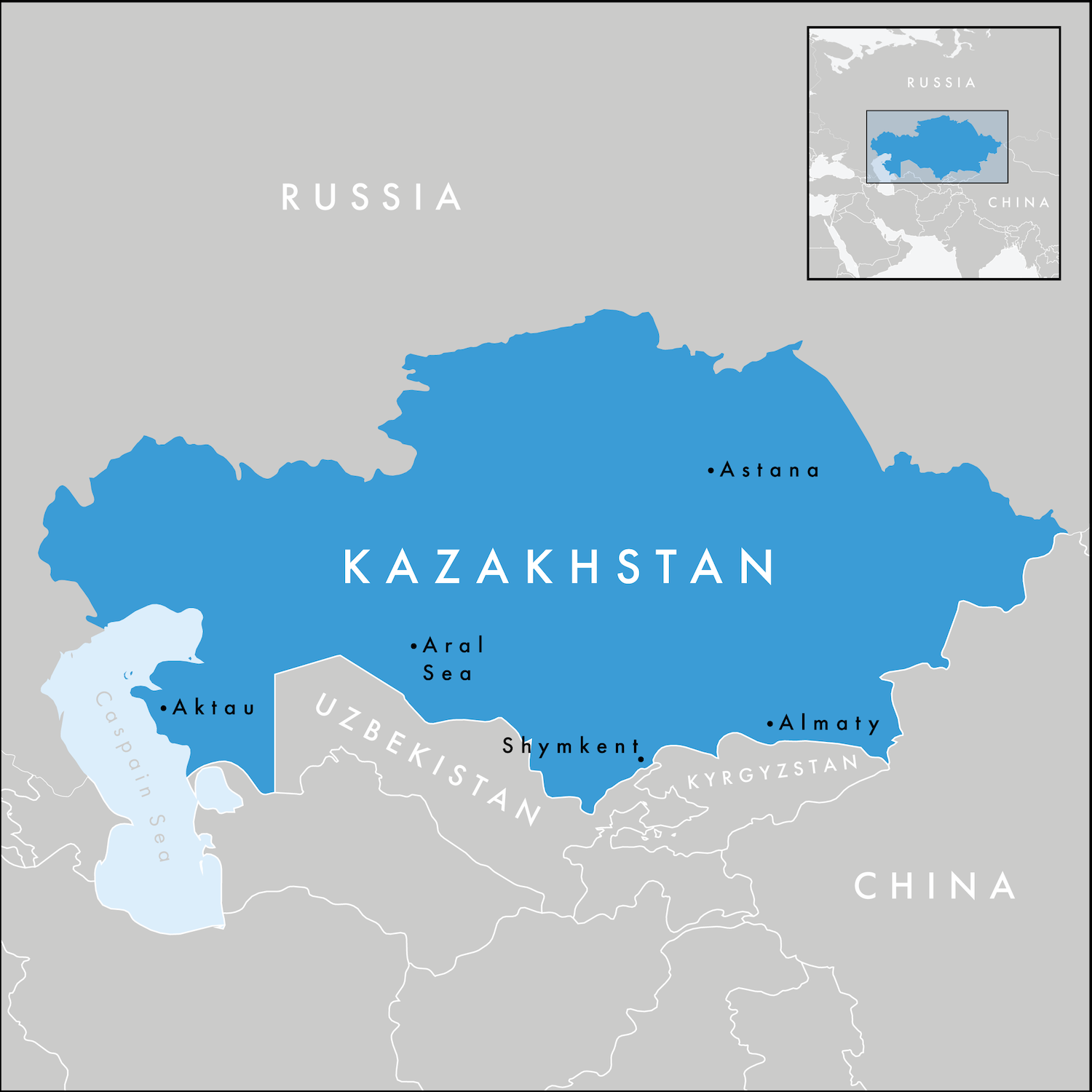
Encircled by Russia to the north, China to the east, the Caspian Sea to the west, and the other four stans in Central Asia to the south, Kazakhstan – often spelled here as Qazaqstan – is the ninth largest country on the planet, and the largest landlocked nation in the world, about the same size as Western Europe. Its challenging environment ranges from the glaciers of the east (similar to Kyrgyzstan) to the deserts of the west (like Uzbekistan), and of course the grassy steppe in between. Only 20 million people live here, and although the Ministry of Tourism claims there are 15m visitors a year, there are fewer than 200,000 come from outside the region, together accounting for just 1.6% of GDP.
Yet it is an easy country to visit independently. Citizens of more than eighty countries have visa-free entry for up to thirty days, and for most of them costs will be low. The minimum wage is 85,000 Tenge a month, and there are more than 500 to €1. Locals usually pay for everything, at toll booths and petrol pumps to ticket offices at attractions, by QR code through the Kaspi app, but most of the time foreigners will need to pay for such incidentals in cash.
Despite its size, Kazakhstan is also an easy country in which to travel about. There is a decent network of internal flights, with low-cost services available from Air Astana, and its subsidiary FlyArystan, as well as Qazaq Air and Scat Airlines.
Travelling across the steppe by train is one of the joys of this country. Between the major cities of Astana, Almaty and Shymkent there are excellent and cheap high-speed Talgos services with First Class cabins with double-decker bunks and WiFi. Trips across the desert are mostly on Soviet-era trains of Second Class cabins with four beds, which are fine, though there is minimal data connectivity in large swathes of the country, including the Aral Sea and the Mangystau desert. All trains have excellent restaurant cars. Tickets go on sale online forty-five days before the journey and sell out quickly so you need to book early.
For exploring the mountains, lakes and canyons around Almaty, the best way is to rent a Toyota Land Cruiser through Yandex. For shorter rides, the highly efficient ride-hail apps are inDrive for 2-3-hour trips between cities and Yandex Go for within cities.
It is worth flagging that the junctions in major cities, and also the country roads, are more frequently than usual decorated by bits of broken lights and twisted bumpers. This is testament to the fact that so many Kazakhs drive while using their mobile phones, weaving all over the road and breaking suddenly. You just need to be careful to second guess their next move.
It should also be noted that it is a national trait for everyone to look out for themselves, so whether driving or walking expect them to push in. Another national phenomenon is the personality type of the strong silent male. When our 4×4 broke down in the desert, a mechanic came to help and spoke not a word, not a hello, not a thanks when we tipped him. Yet we also came across some of the smileyest and funniest receptionists, waiters and guides who went way beyond the extra mile to help us.
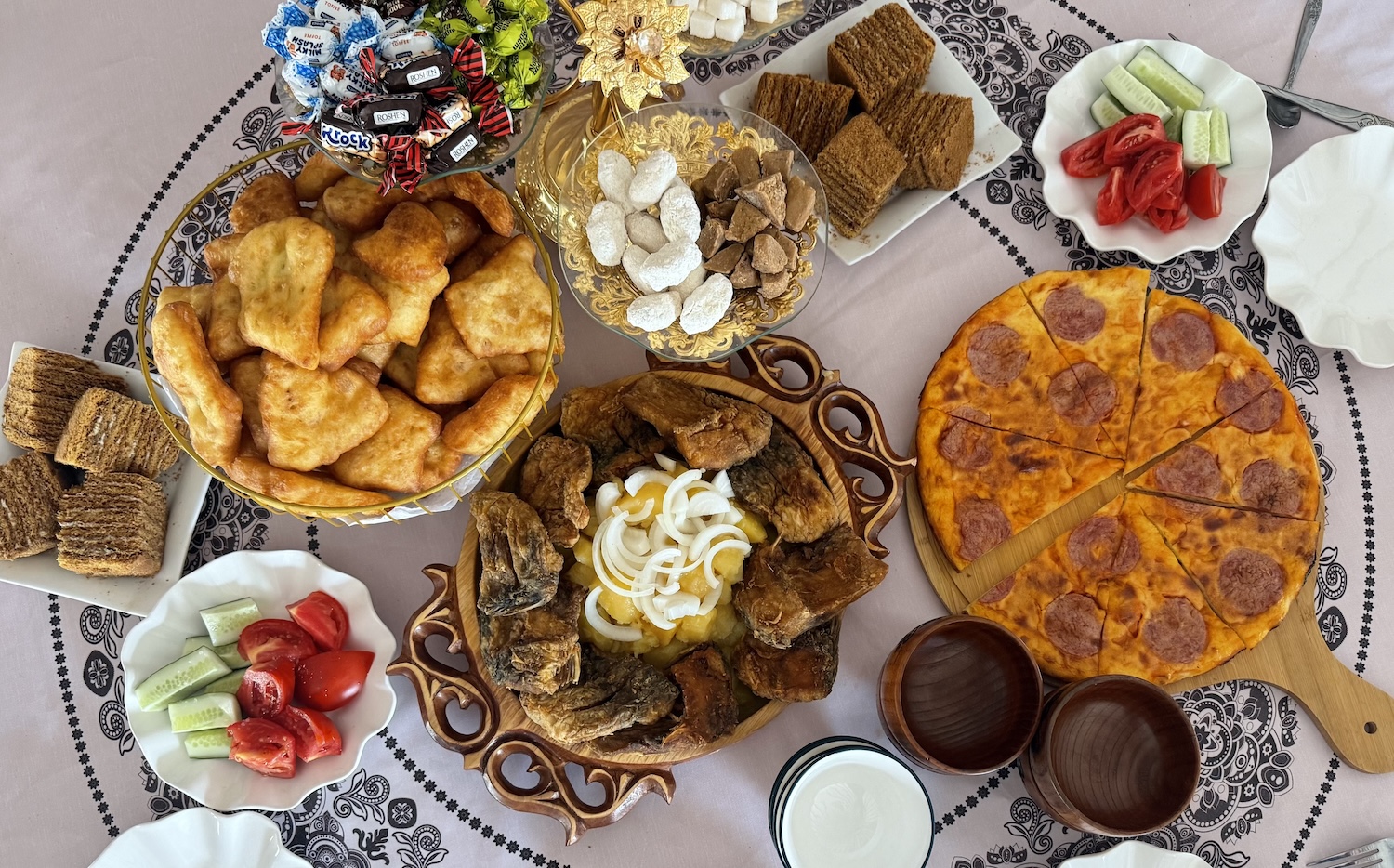
The national dish is beshparmek, a platter of horsemeat with thin pasta sheets in an onion broth that is eaten by hand. Other popular plates include lagman, spicy meat with chewy noodles, manti, steamed dumplings with minced meat, salo, cured horse fat, samsa, meat pasties, and sopa, a rich meat broth. Wider Central Asian favourites are also common, including borscht, plov and shashlik. Caviar from sturgeon eggs is also found in high end restaurants. Everything is usually highly salted, and oddly, it is very rare to be given a knife in the cutlery set. As bolsyn.
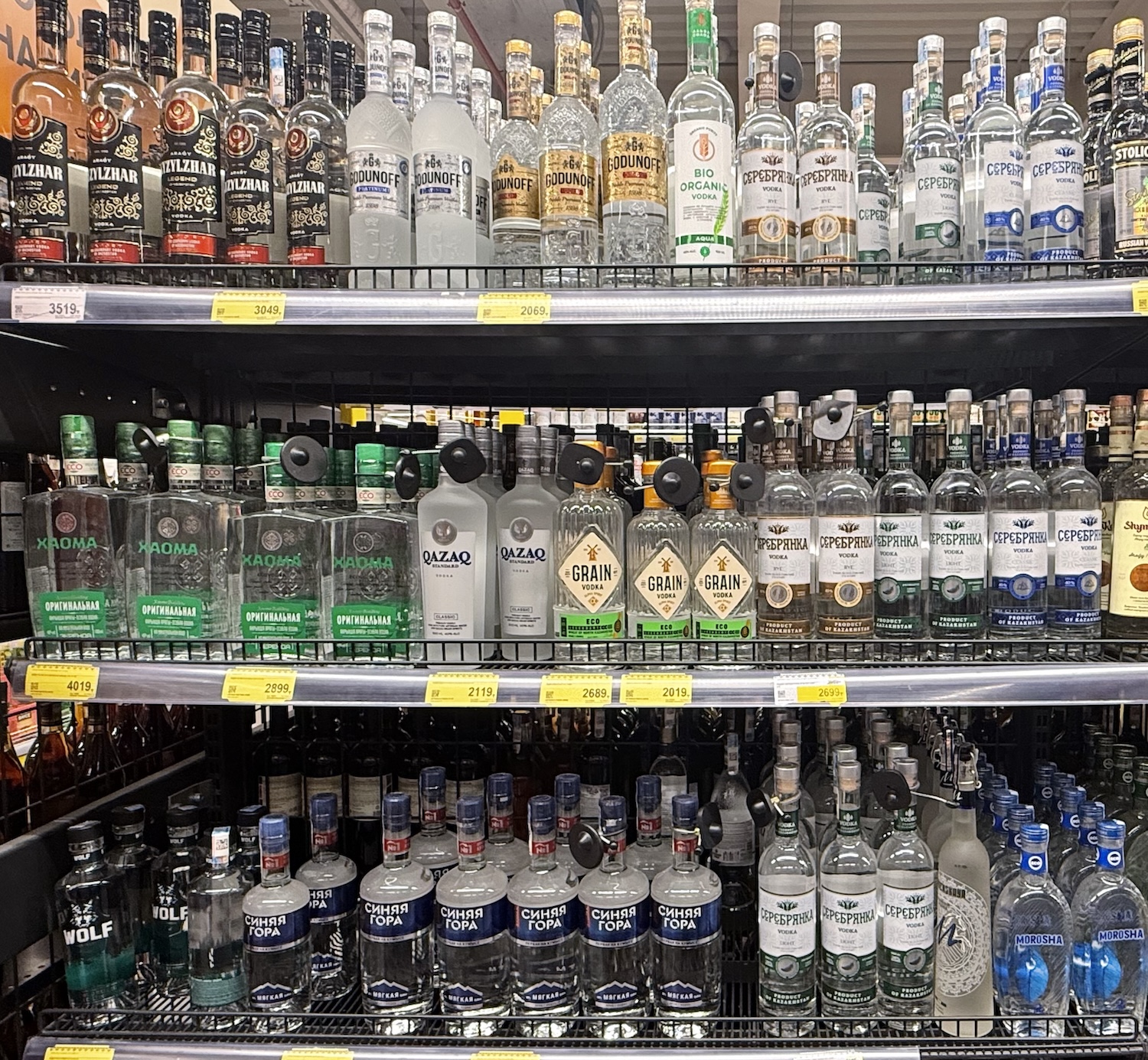
It can be said that there are two national drinks. Kumis, fermented mare’s milk, is found everywhere. Vodka feels like the watershed of a culture war, with older generations pickled in it from Soviet times while Muslims naturally disapprove. Hence, it is less prominent than across the rest of Central Asia these days.
There are, though, some terrific local brands. Xaoma Gold is a global award winner, and other leading bottles include Kyzylzhar Legend, Noble Burkit and Snow Queen. I tasted about thirty different types over three weeks just to be able to write that sentence. In addition, there are local cognacs and drinkable wines too. Alyp koiaiyk.
They say the best time to come to Kazakhstan is spring – May-June – and autumn – September-October – because the temperatures are comfortable. However, like us most people come in July-August, when it can certainly be warm but is easily manageable, but avoid November to April when the snow comes.
We started at Almaty in the south-east, flew west to Shymkent, then took the train from nearby Turkistan to the Aral Sea and again on to Aktau on the Caspian Sea before flying back east to Astana. If we had our time again, we would not change a thing about this route as we saw all the major sites and it was incident-packed all the way around.
Almaty
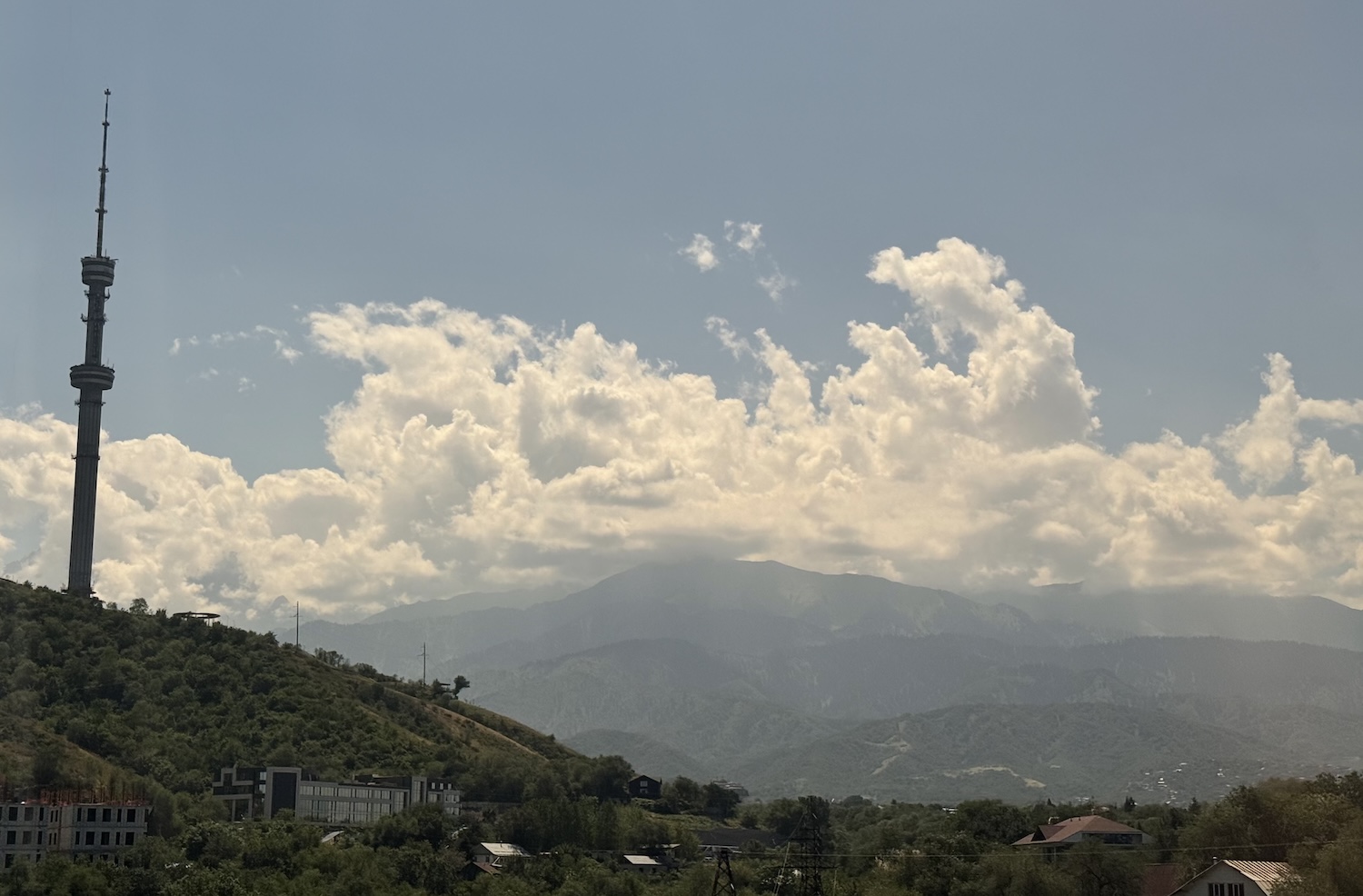
Almaty, with a population of about 2.5m, is the country’s largest city and principal economic and cultural centre. Its airport is just 15km north of the centre, at the start of the deserty-grassy steppes that stretch as far as the eye can see. To the south are the lush green Trans-Illi Alatau Mountains, where in the foothills is 1,100m-high Kok Tobe Hill, which is reached by cable-car.
This is a good place to get your bearings, because there are fine views, even though the look-out decks on the 372m-tall TV Tower are closed these days. Among the usual attractions built to entice visitors, such as a Ferris Wheel and a rollercoaster, is a monument to the Beatles. There are terrible statues of John, Paul, George and Ringo, near a bench where their songs play on a loop all day to honour their underground popularity as a symbol of resistance during the heavily censored Soviet period.
The first settlement here was a Silk Road caravanserai called Almatu, which was sacked by the Mongol invaders in the thirteenth century. Then the Russians established a frontier fortress here in 1854, around which grew the town of Verny, but that was mostly destroyed by the devastating earthquakes of 1887, 1889 and 1911.
Incidentally, friction between the Indian and Eurasian Tectonic Plates is of course still a concern today, with the most recent upheavals occurring in 1970 and 2003. Many hotel rooms contain a little leaflet explaining what to do in the event of a tremor, namely stay away from windows and chandeliers, cover your head with your hands, and do not panic. Wise words.
Following the Russian Revolution in 1917, the local Soviet Socialist Republic was established. It was initially headquartered at Kyzyl-Orda, but after the completion of the Siberia-Turkestan Railway in 1930, which opened the southern and eastern regions to trade, the capital was transferred to Verny, which was rebuilt and renamed Alma-Ata. Around this time, Trotsky was exiled to this city by Stalin, until he was expelled and fled the USSR. Many local leaders were later murdered in the Stalinist Great Purges of 1936-38.
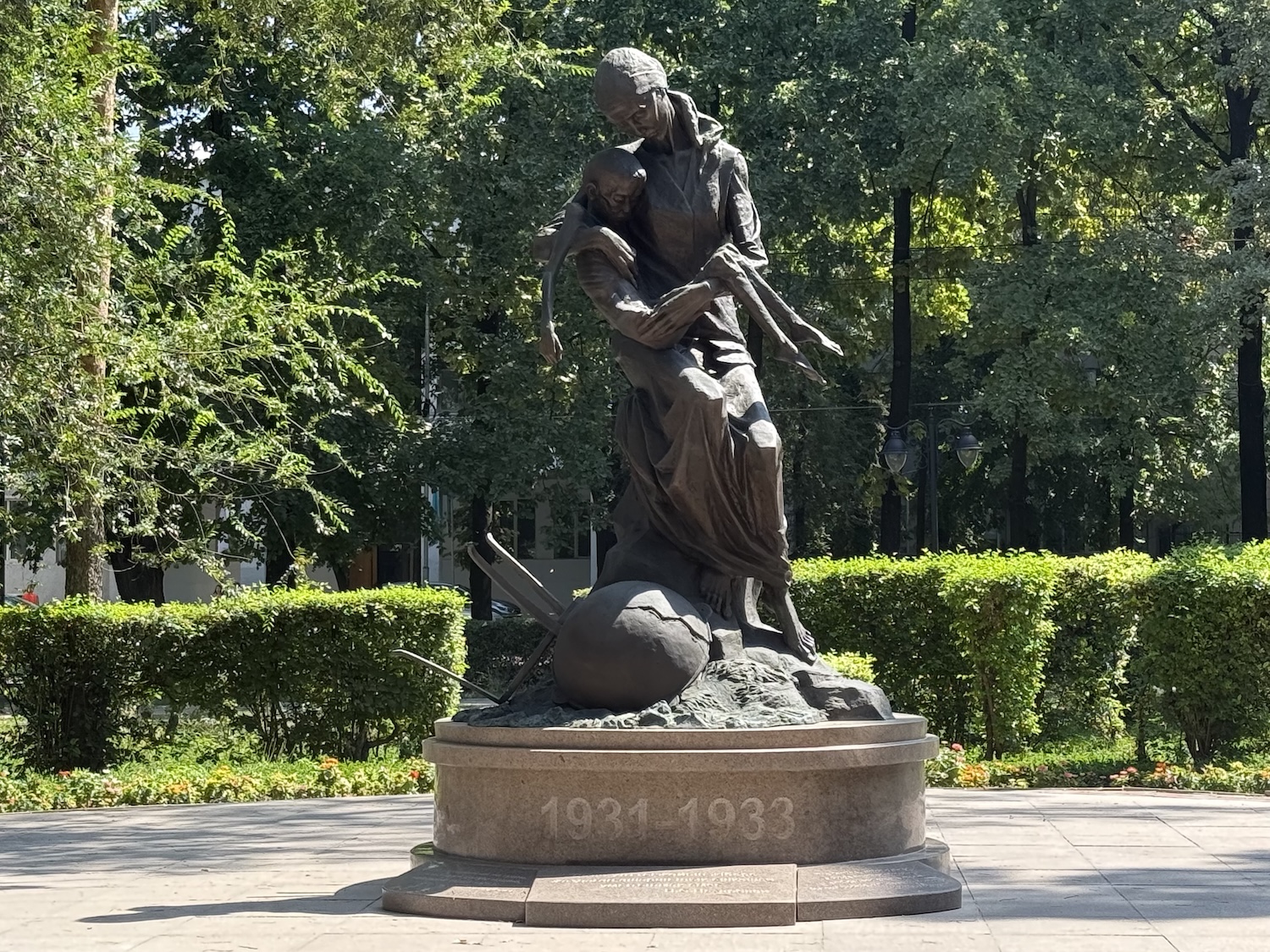
From 1931 to 1933, an estimated 3m Kazakhs – that is 50% of the population – were starved to death by forced collectivisation and confiscation of peasant livestock, which was designed to force Kazakh nomads to become settled famers in the cause of the Soviet Union. A further million fled the region as more or less everyone was forced to live off grass and the carcasses of famished animals during the Great Famine. There is a moving monument in Pine Park, a 3m-tall bronze statue depicting an emaciated mother cradling her dead child with an overturned cauldron at their feet. Every year, on 31 May, the Day of Commemoration of the Victims of Political Repression and Famine, political leaders gather here for a two-minute silence.
Even today, there are a couple of statues of Lenin tucked away in the suburbs, while the Zolotoy Kvadrat, the Golden Quarter, where apartments were reserved for the Soviet elite, has been transformed into a pleasant district of leafy boulevards where cafes and pubs and restaurants squeeze between imposing Soviet showpieces.
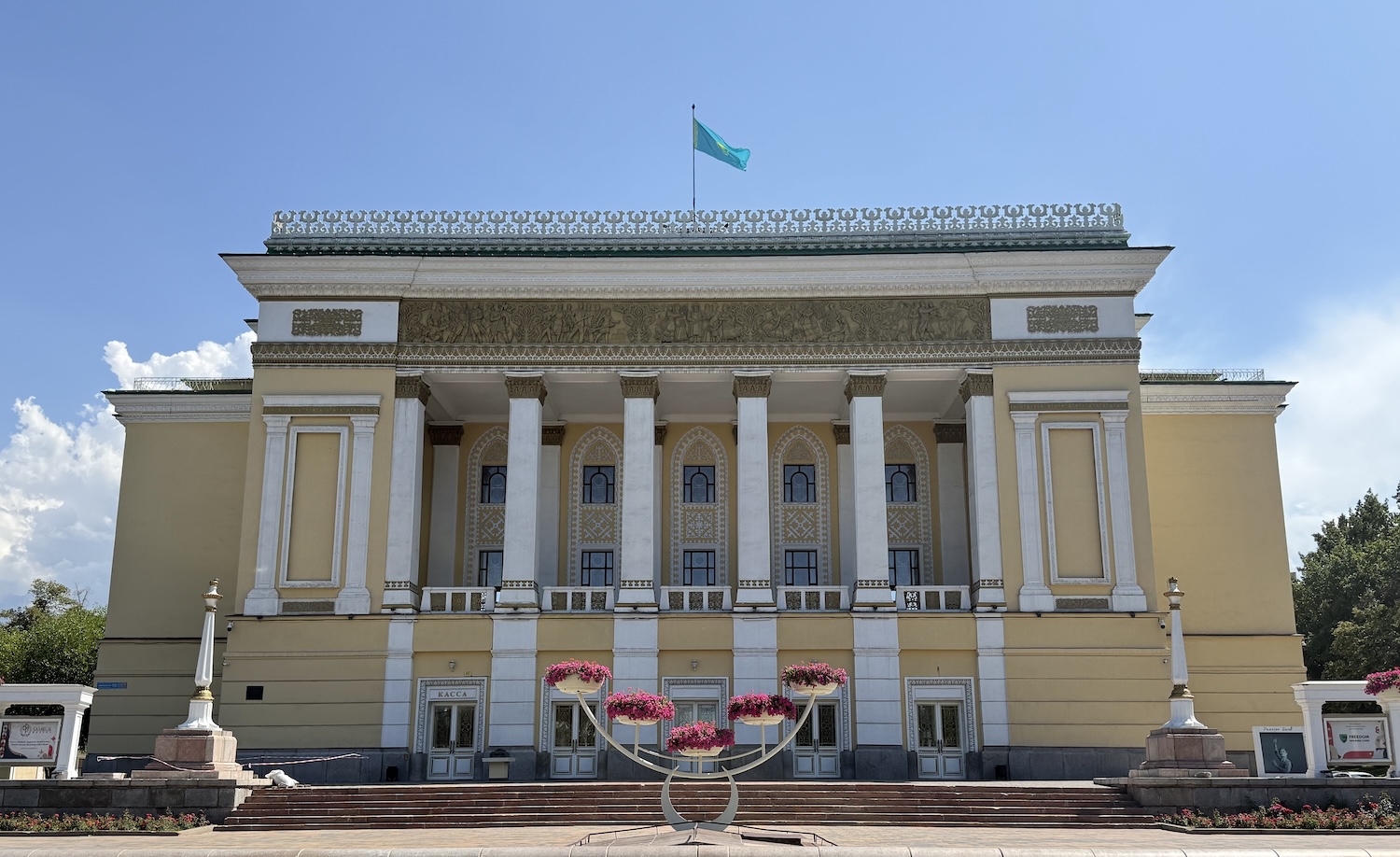
One of the best examples of that architecture is the National Opera and Ballet Theatre, built in 1934.
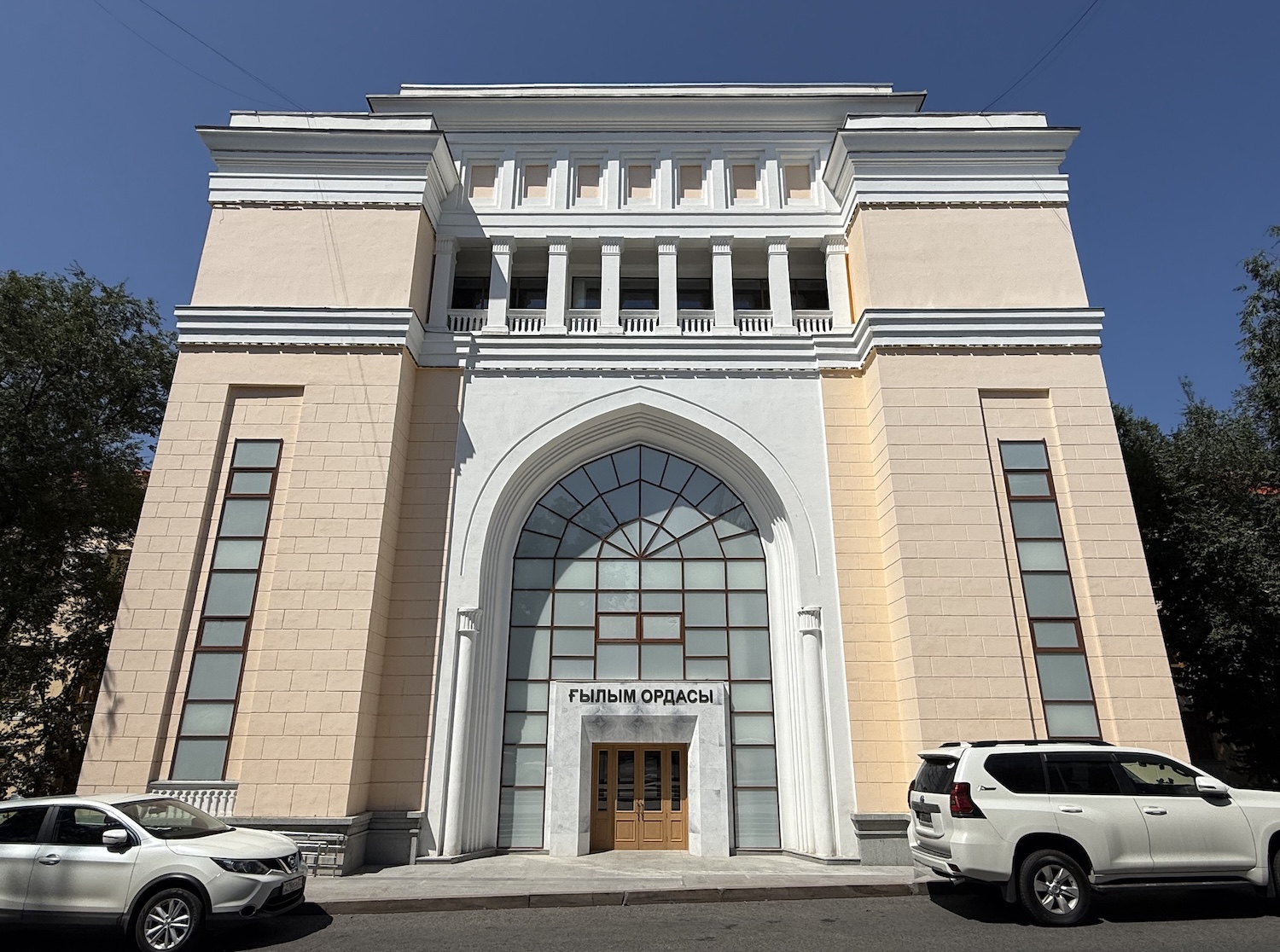
Another is the Academy of Sciences, dating from 1946.
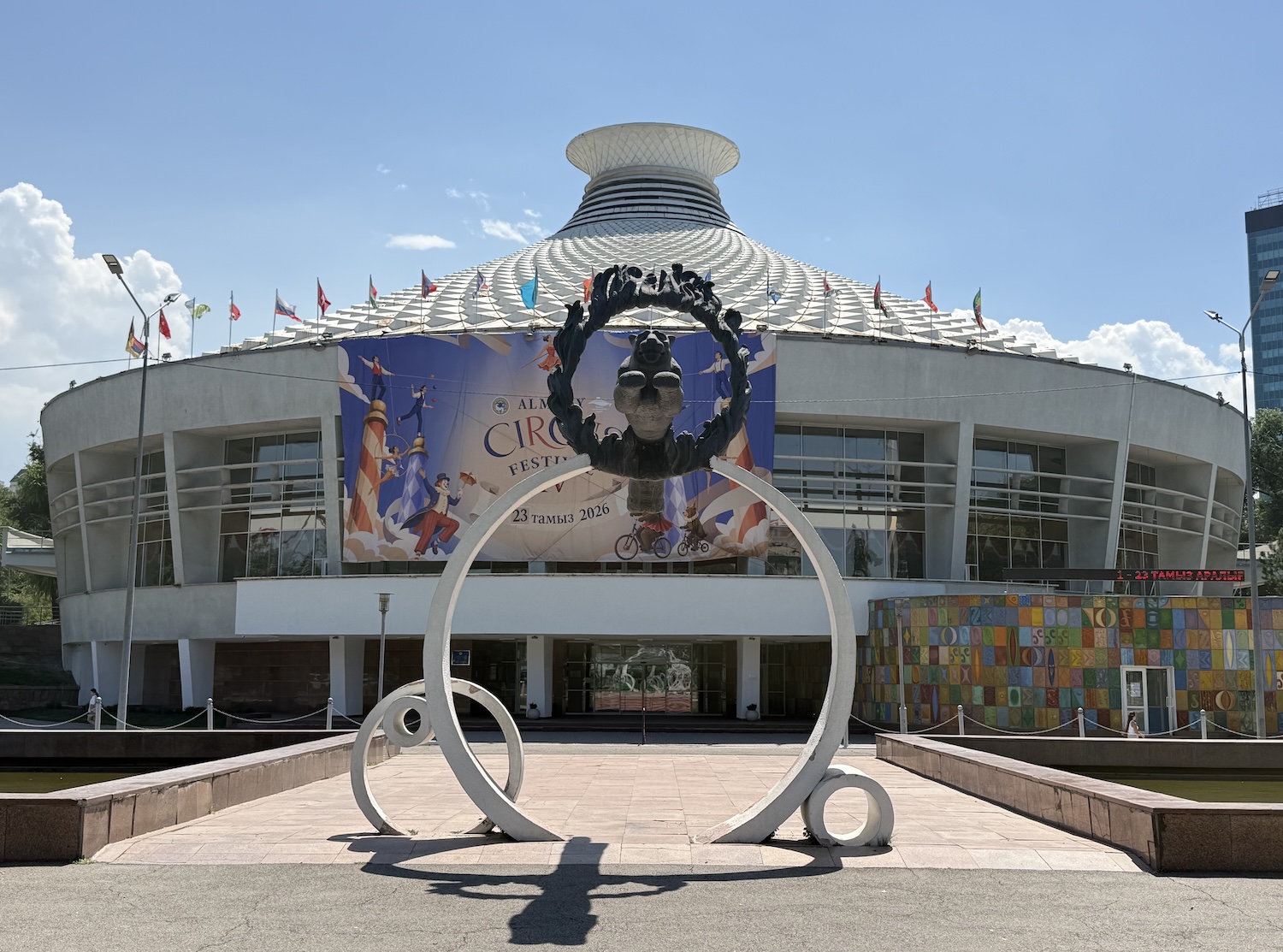
The State Circus, opened in 1970, still runs every night of the week.
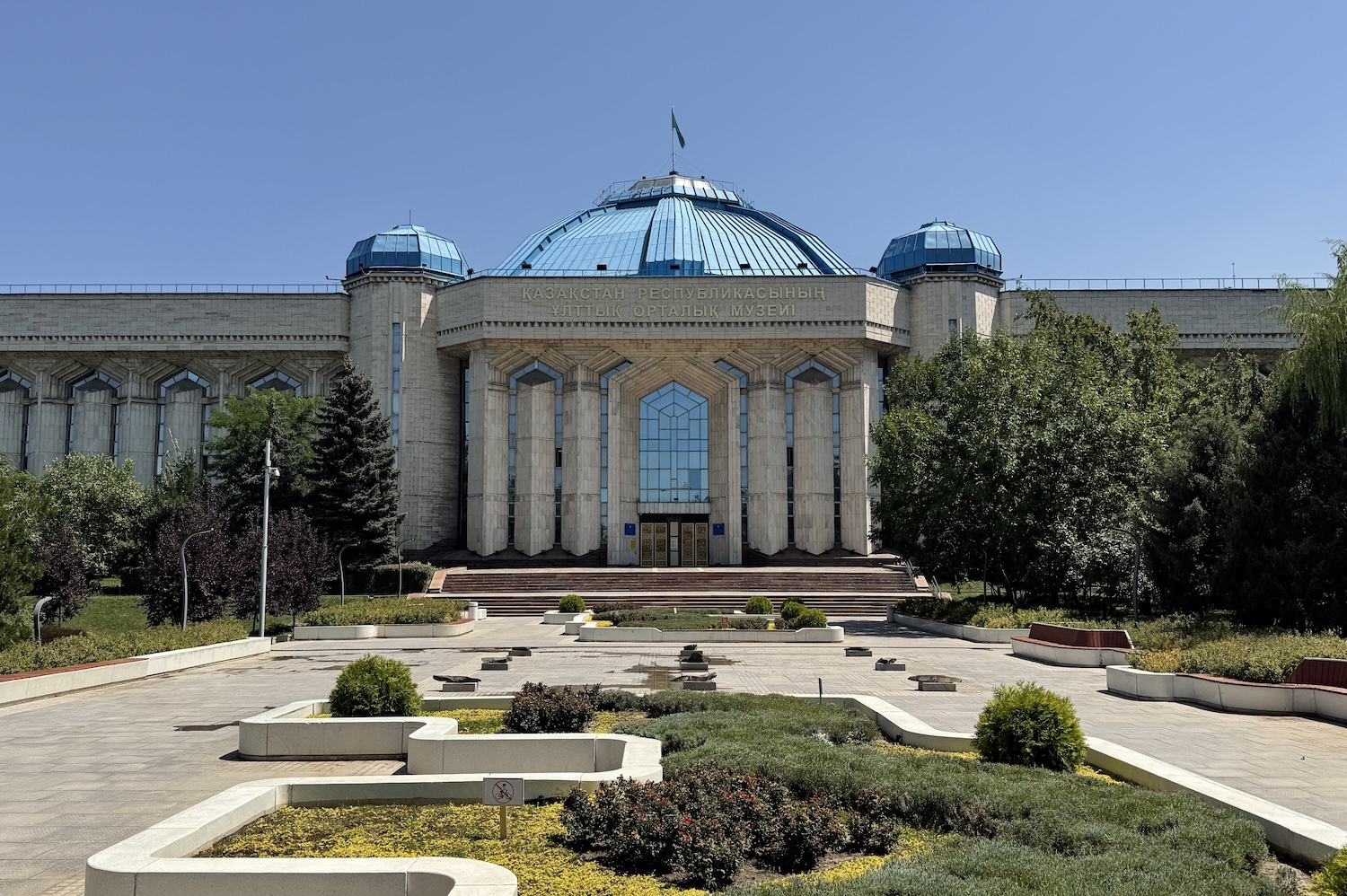
Most of what you will want to visit is either in walking distance from the Golden Quarter or no more than a ten-minute cab ride away. There is lots to see, and the city deserves a few days to soak up and explore properly. Among the obvious attractions are a series of world class museums and galleries, including the Kastaev Museum of Fine Arts (opened in 1976), the Central State Museum (1985), the Tselliny Centre of Contemporary Culture (2018) and the Museum of Arts (2025).
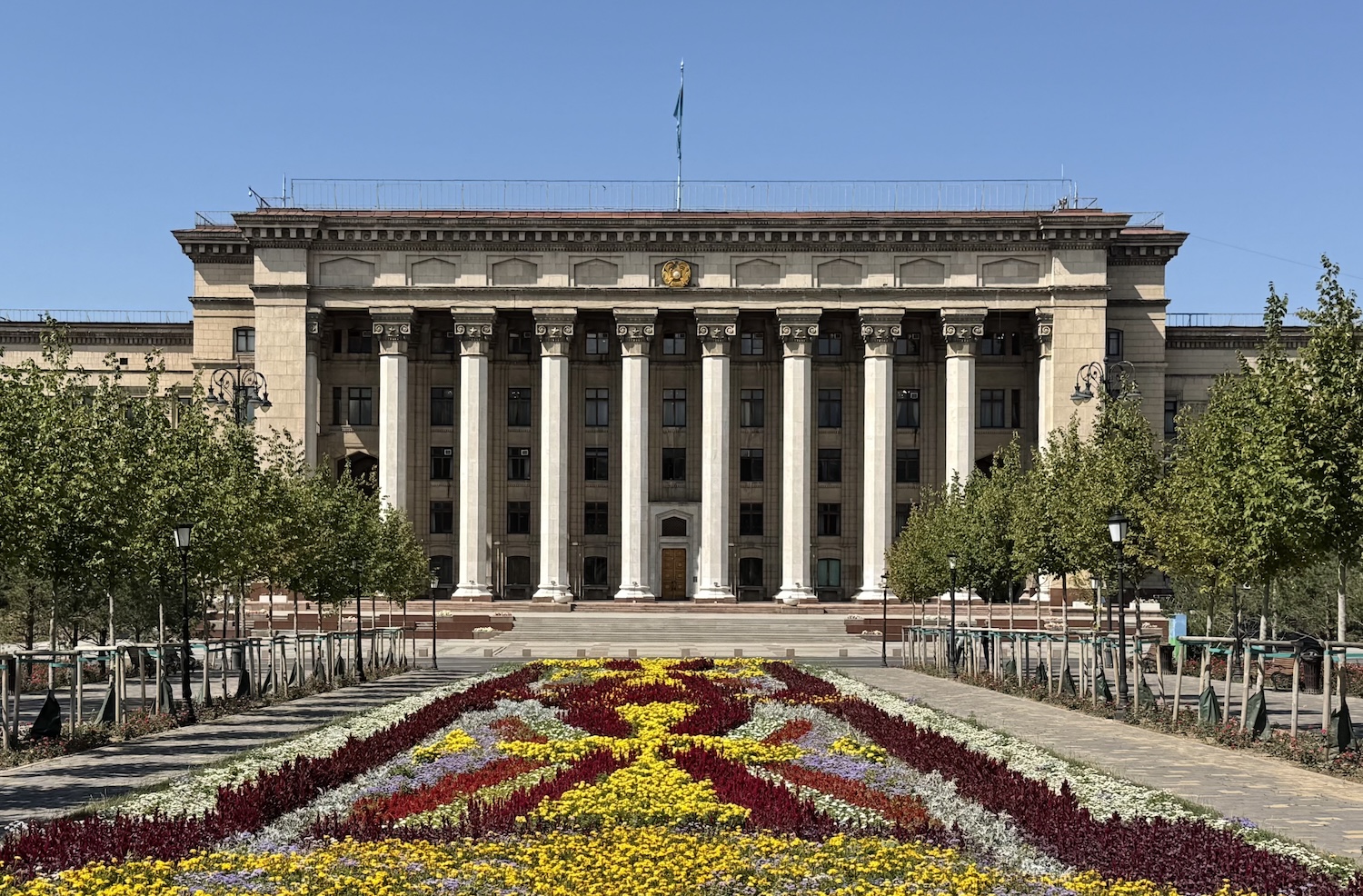
The Supreme Soviet and the Central Committee of the Communist Party were based in a suitably imposing building, put up in 1957. In 1991, this was where the Declaration of Independence was signed, and where the Parliament of the new country was convened. At that time, Alma-Ata was renamed Almaty. In 1997, the capital was moved to Astana, so this building was taken over by the less daunting Kazakh-British Technical University.
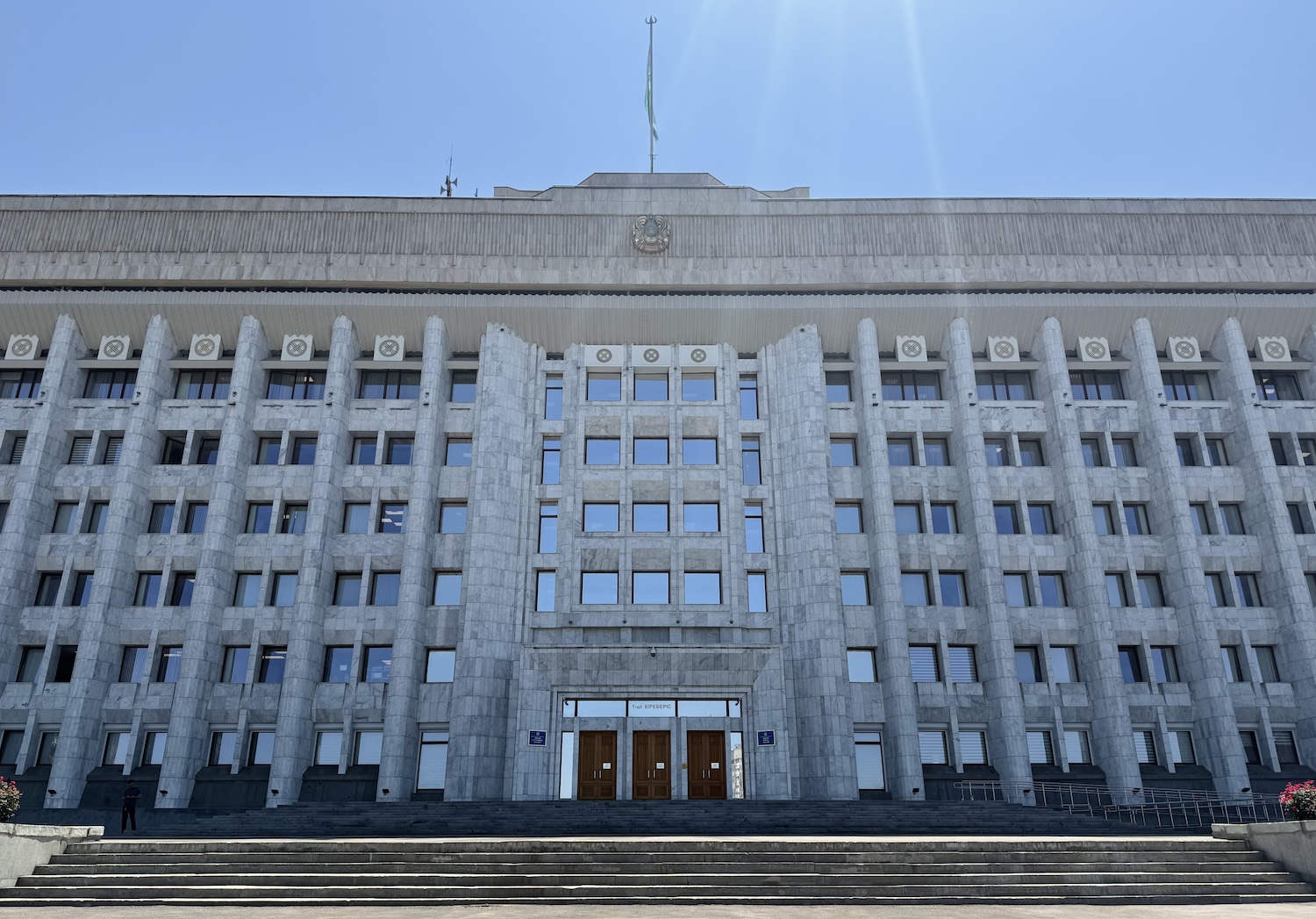
Nearby is the dominant structure on Respublika Alany, a major plaza with a freeway right through the middle. This is the impressively austere Maslikhat building, the City Hall.
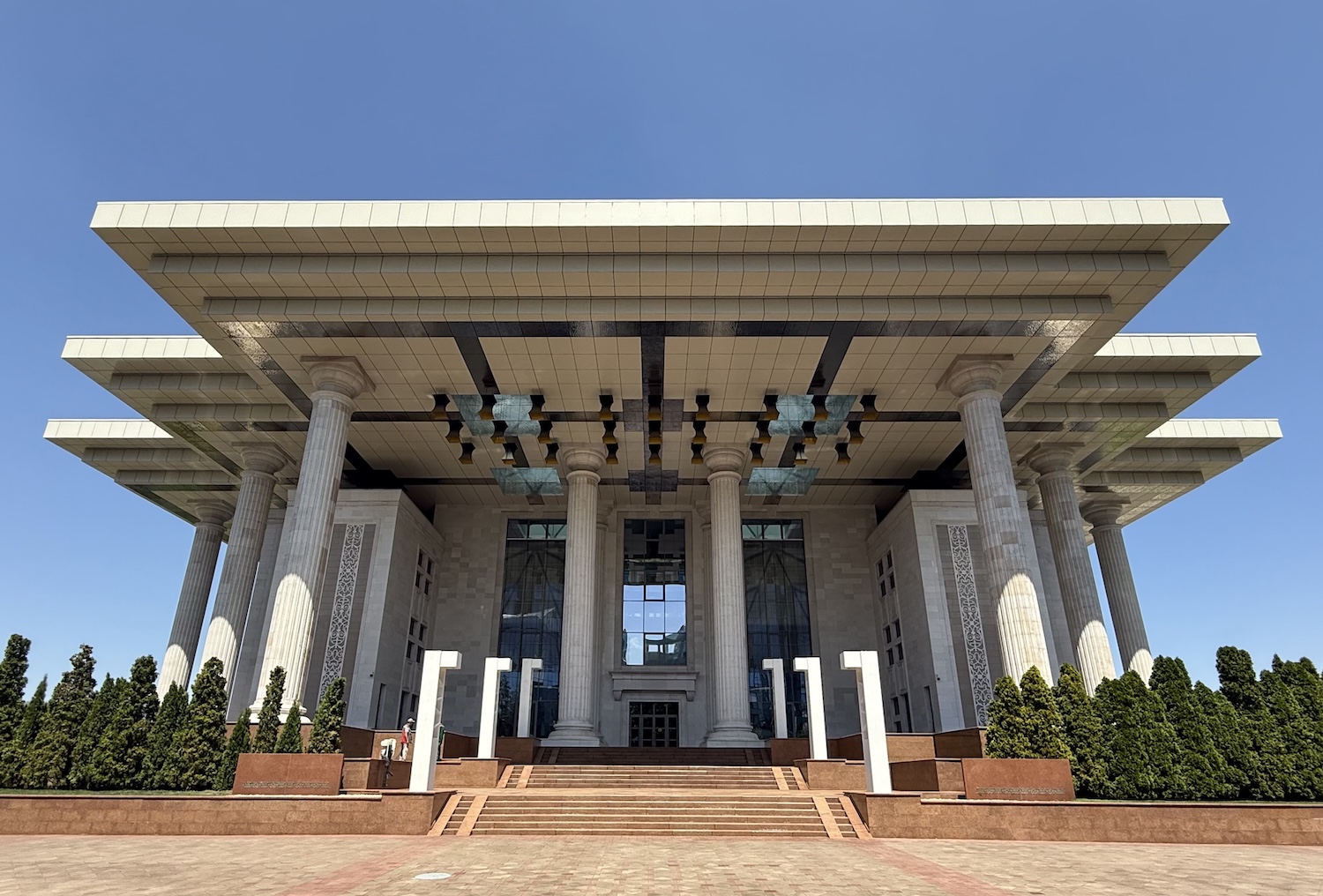
Around here is the showy State TV Centre, and an ostentatious Presidential Library under construction. Also here is the former residence of the president. Although that building is still standing, it is hidden behind a flashy new President’s Residence, used when the leader is in town from Astana. There are strictly no photos allowed. Ha!
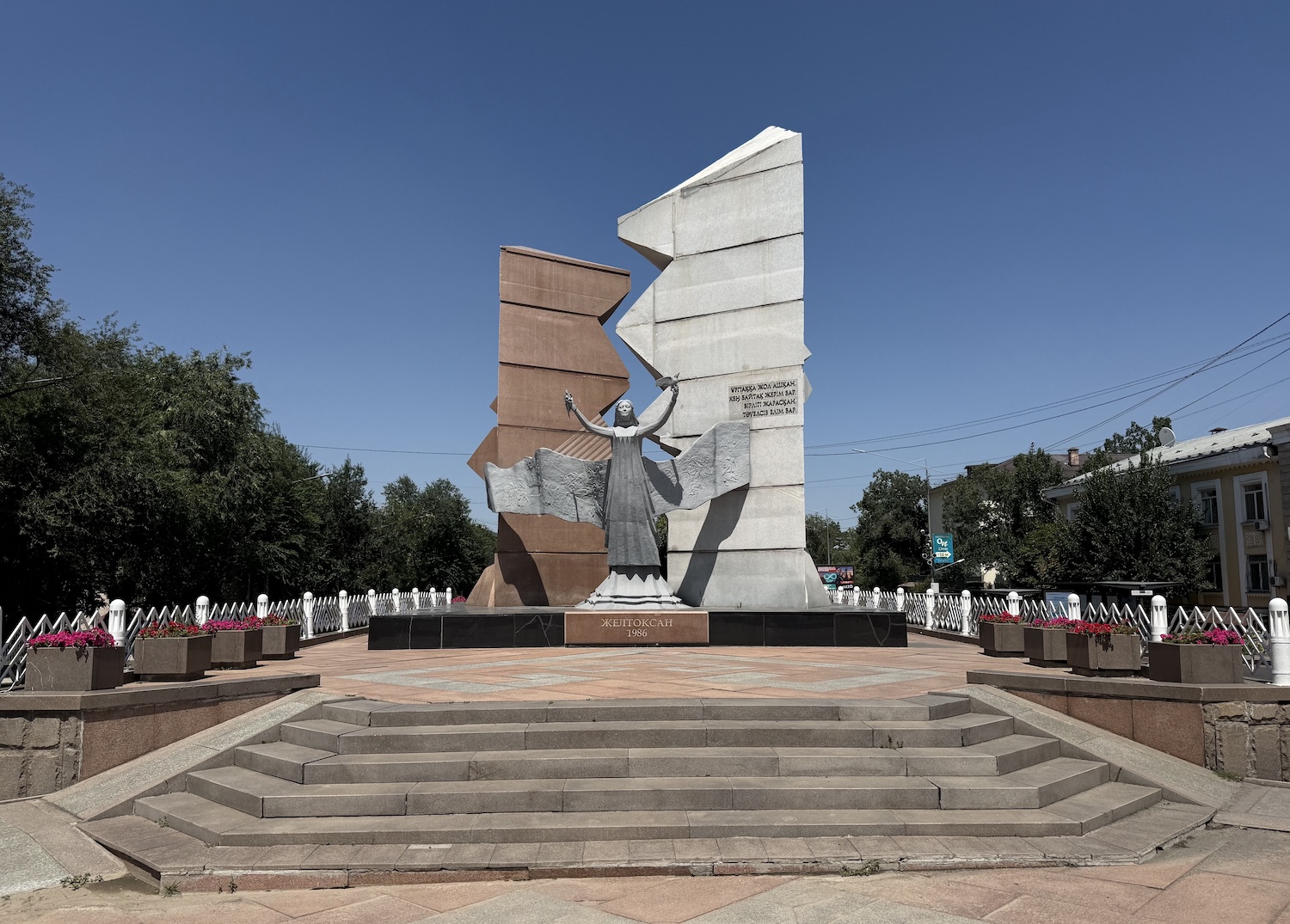
Back in 1986 this was called Brezhnev Square, and it was where the Jeltoqsan Uprising began, when Soviet forces attacked thousands of students demonstrating against Gorbachev appointing an outsider as de facto head of state. It is thought that as many as 200 were killed or executed soon after, and many more were sent to labour camps, in the first public protests in the USSR that presaged its coming collapse. These tragic events are marked here by the Tauelsizdik Tany or Dawn of Freedom Monument.
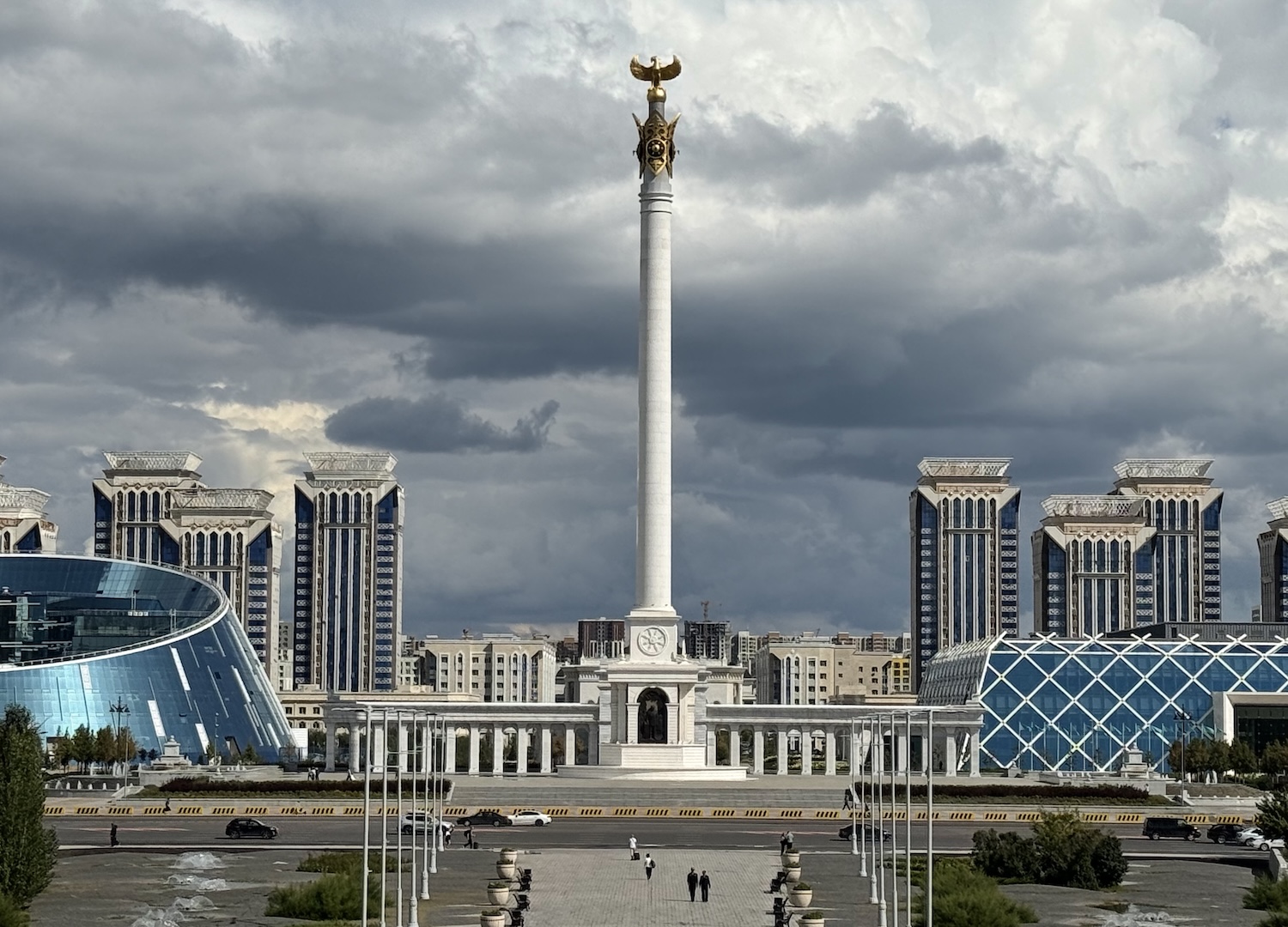
The most prominent memorial in Respublika Alany, an obelisk with a Golden Warrior at the top, is the Independence Monument, commemorating release from Soviet suffocation in 1991.
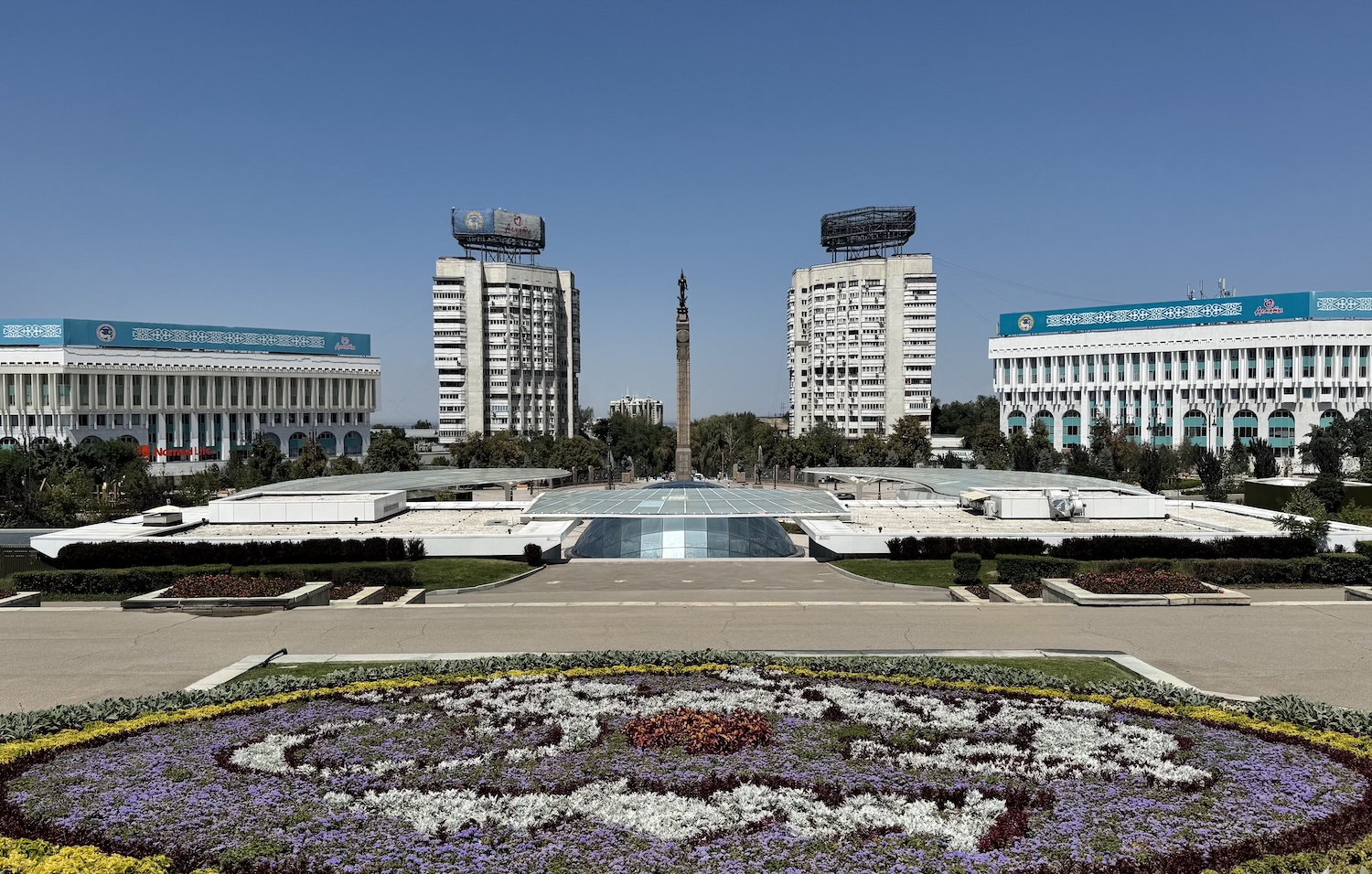
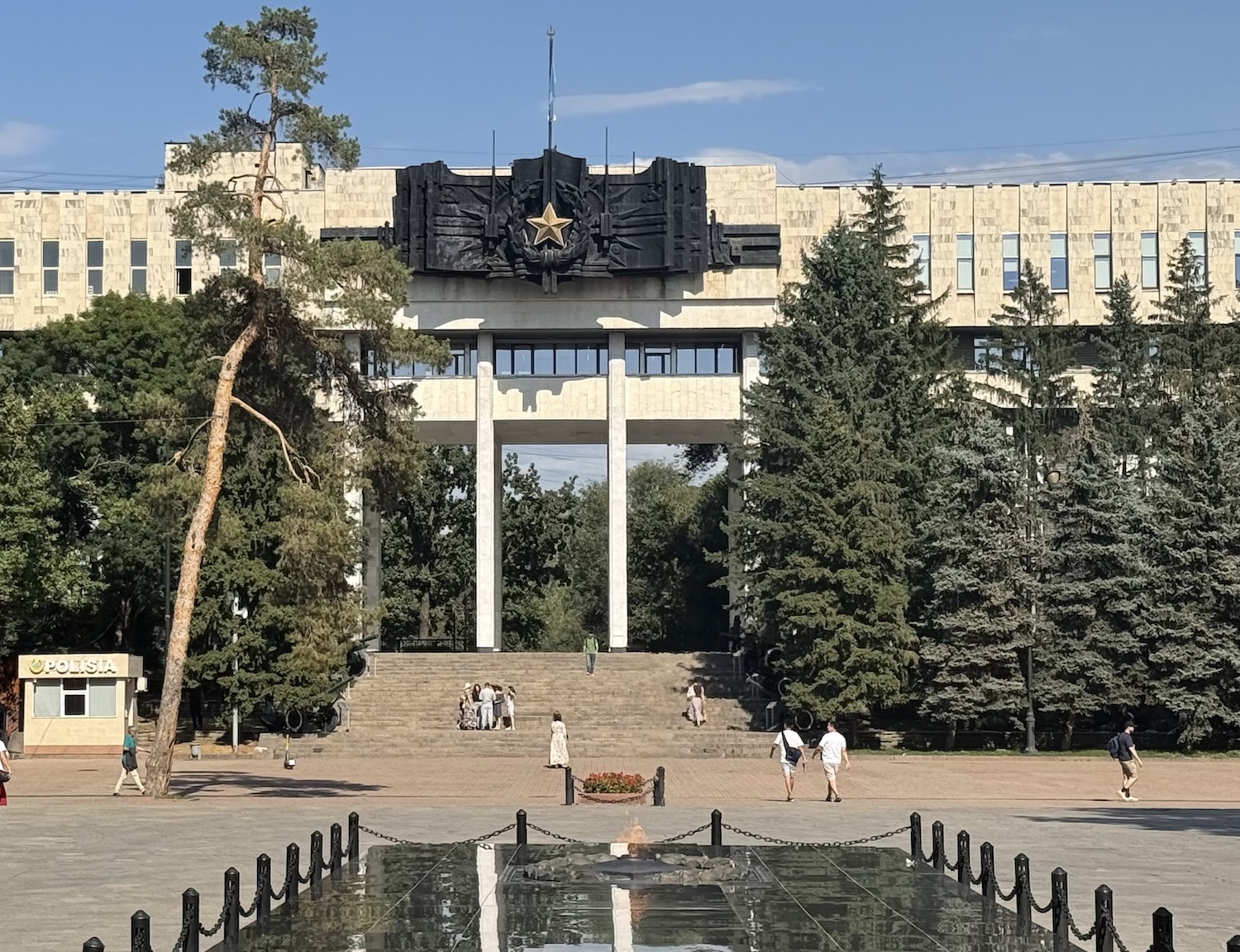
The main park in the centre of town is named after Ivan Panfilov, a Soviet General lauded for his defence of Moscow during the Second World War. In it, apart from his bust, are numerous war memorials. The Memorial of Glory. The Eternal Flame. Commemorations of those who died in 1917-1920 and in 1941-1945. Monuments to those who fought in Afghanistan. The Military History Museum.
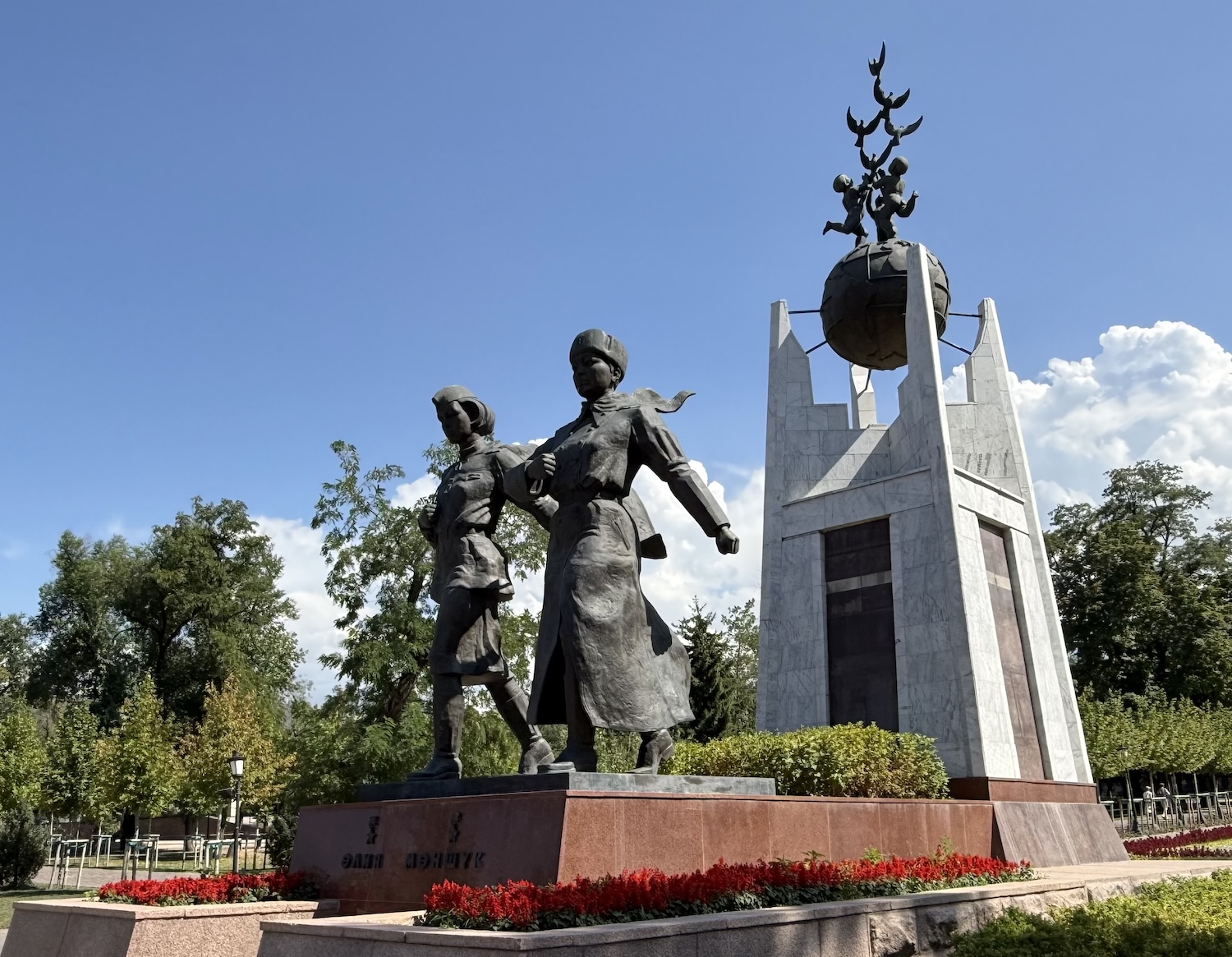
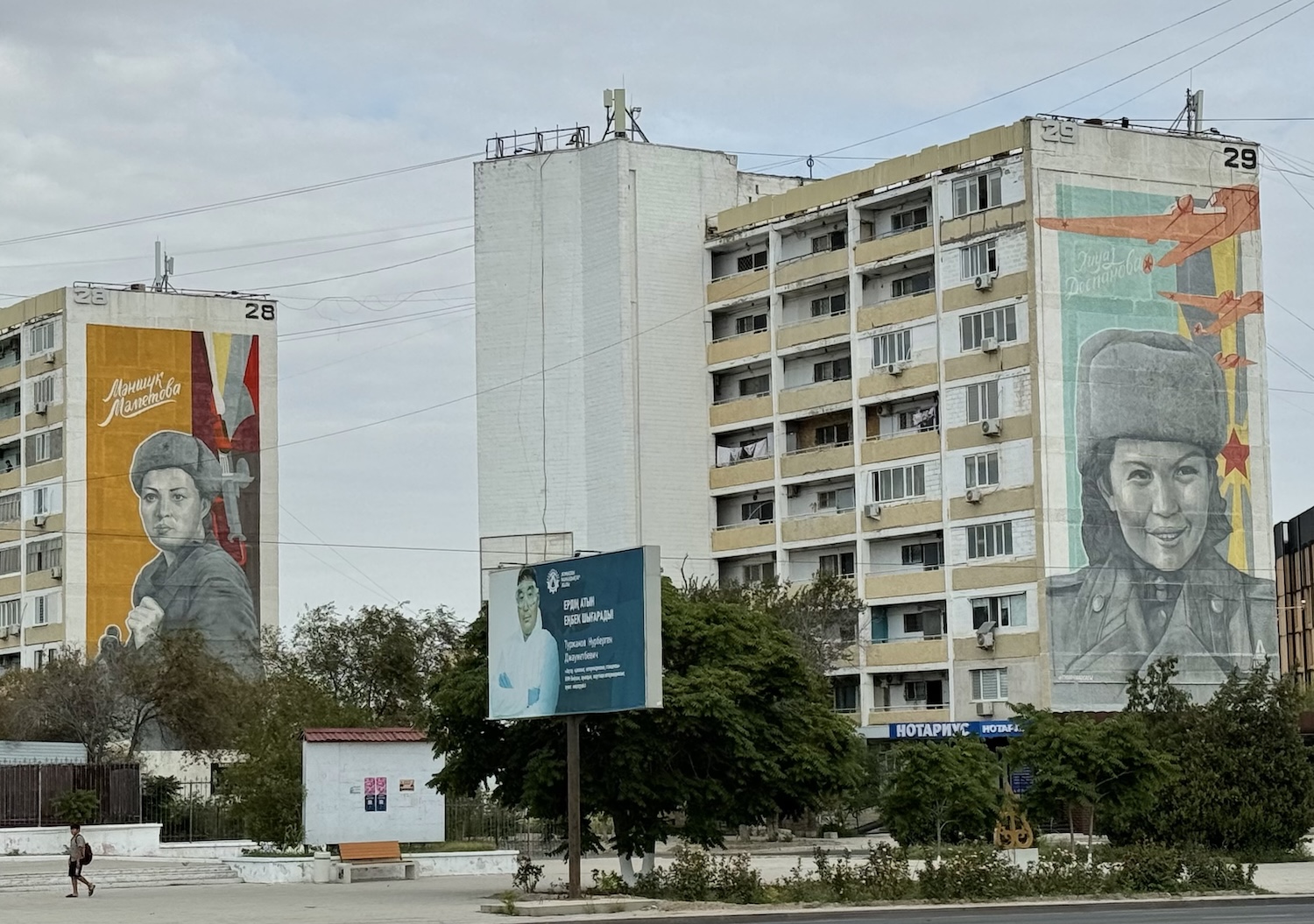
Nearby in Astana Square is a 1997 Memorial to Aliya Moldagulova and Manshuk Mametova, young women who did not know each other, but who gave their lives fighting the Nazis.
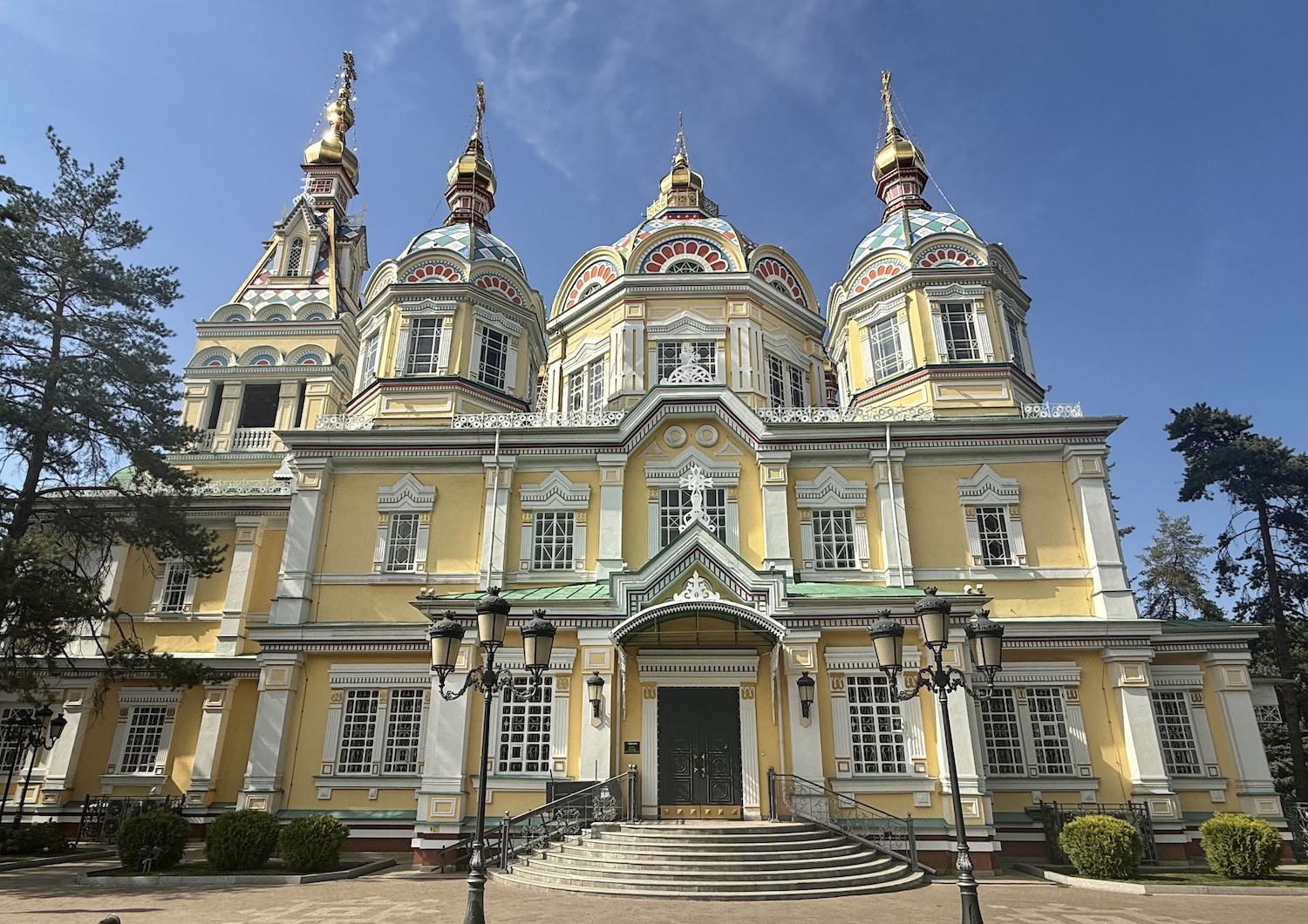
Religion was inevitably squashed during the Soviet period, though it has been given a new lease of life over the past thirty years. About one in five Kazakhs are Christians, mostly Russian Orthodox. In Panilov Park is the Zenkov or Ascension Cathedral, the tallest – and surely the brightest – wooden orthodox church in the world. Built in 1904 with no nails, it somehow survived the 1911 earthquake and the 1917 Russian Revolution, after which it was used to house the state museum, before it returned to its intended purpose in 1995.
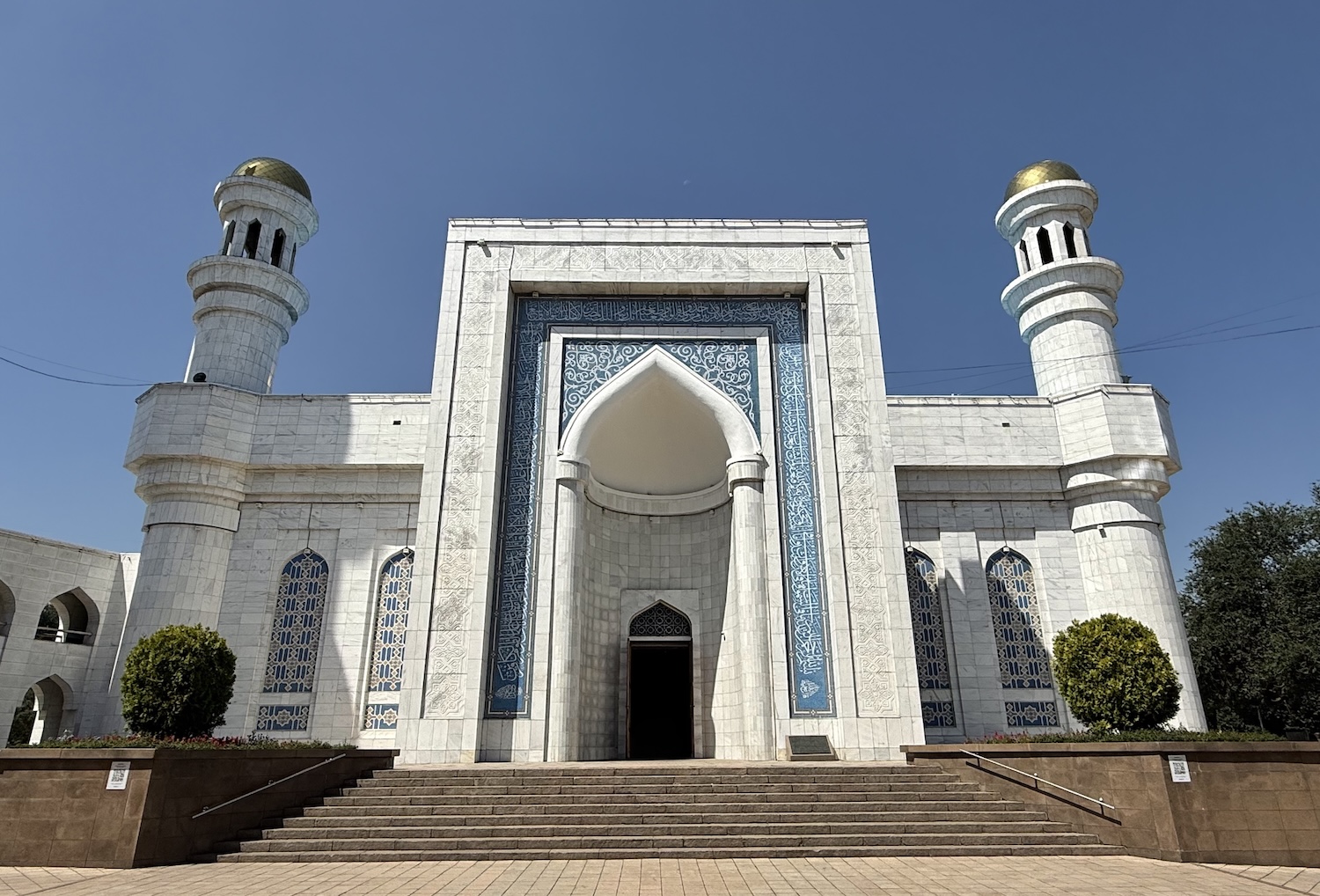
Most Kazakhs – about seven in ten – are of course Muslims, and in Almaty their principal place of worship is the Central Mosque. This was built in 1999 on the site of its predecessor that was founded in 1890 but caught fire in 1987.
Almaty has a decent metro system, opened in 2011. Though it cannot compare to Moscow, it does have a few elaborate stations worth a look. The most interesting is probably Baikonur, which has a video on a loop of the Cosmodrome space centre.
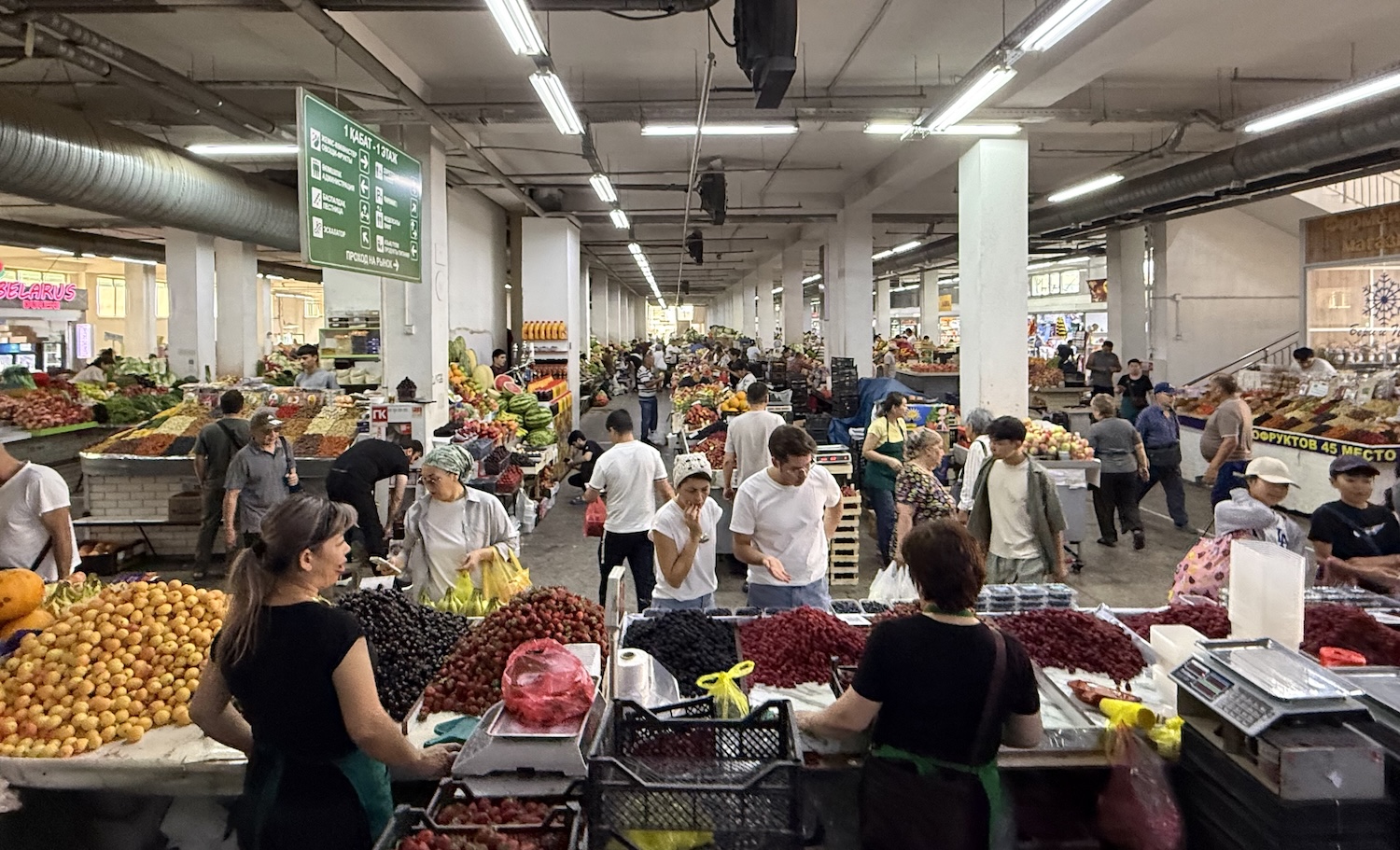
There is of course decent shopping in Almaty. The upscale mall is Villa, while value is found at Dostyk and tourist tat is on Arbat Walking Street. The Green Market is a classic Central Asian bazaar, and the ideal place to pick up horse meat if you are so inclined.
Good local cuisine is not hard to find, and I would especially recommend Alycha, Aul, and Yurta. Nuala is contemporary European but as it is in the setting of the historic post office building it is worth a night out. Panfilov Street also has many decent restaurants.
Wine bars (try Wine Time) and cocktail bars (see French 42, an award winning gin joint, and Yellow Door, a speakeasy that will give out their address only when you reserve on Instagram) are popular. There are also several European beer bars, including the Munchen Pub, Mad Murphy’s, and Pheasant Feather, a Fullers hostelry that serves proper pints of London Pride.
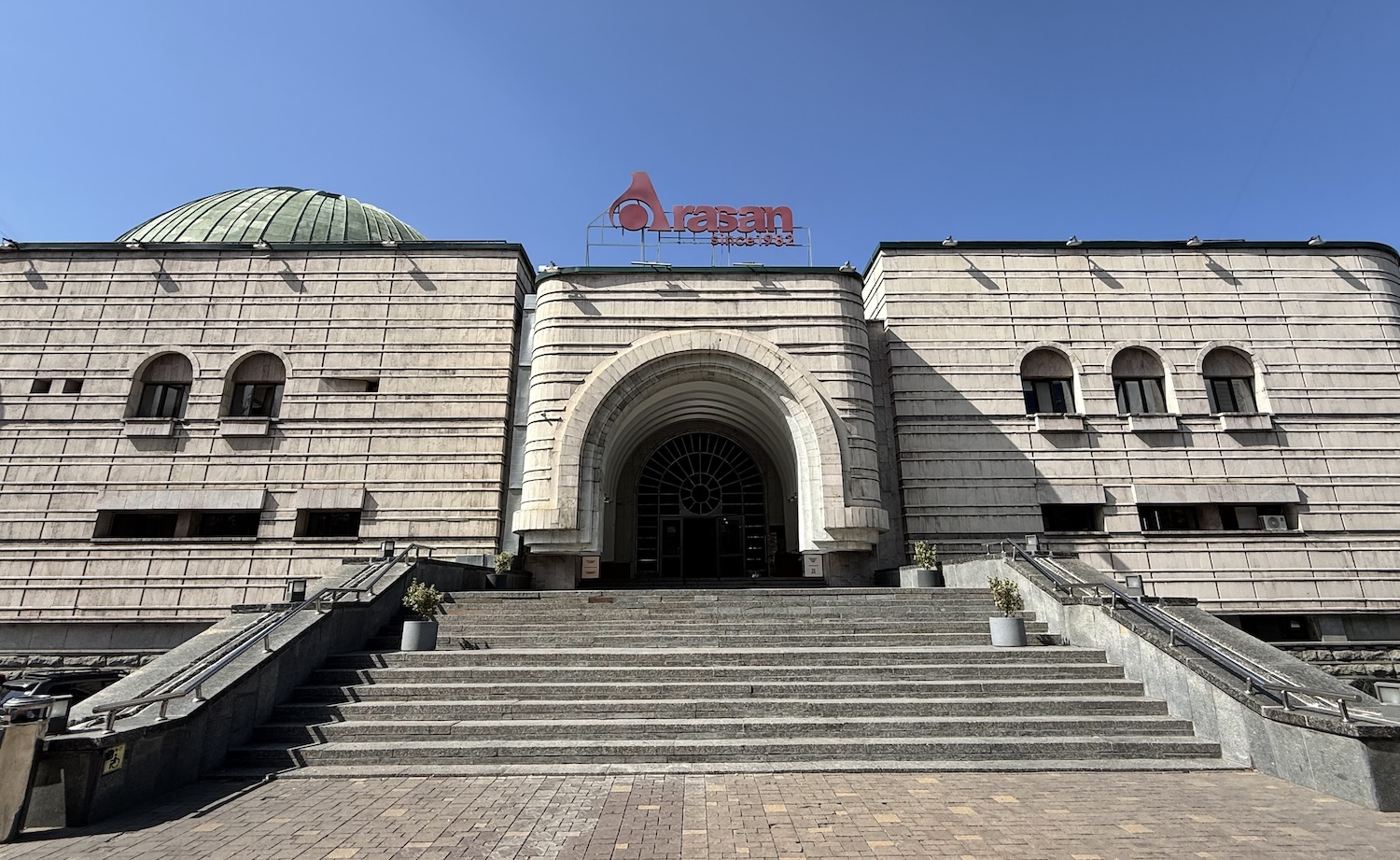
To return to health after all that eating and drinking, it is essential to go to Arasan sauna baths. Even though hammams are not quite the thing In Kazakhstan they are in say Uzbekistan, this is still an authentic experience. Built in 1982, this massive building has men’s and women’s sections, with felt hats and birch twigs for sale outside. In the men’s, there are several saunas and steam rooms on each of three or four floors, with the Russian red-hot sauna as the focal point. There are showers of chain-pull buckets of iced water, plus a massage room where you lie on a marble table stark bollock naked while a young man with a beard and budgie smugglers beats your muscles to a pulp and scrubs your skin raw red before adding moisturising lotion, all in a hall where twenty other blokes are receiving the same treatment. In the main pool, scores of locals sit nakedly manspreading, proudly displaying not just their big bellies and man boobs. Great fun.
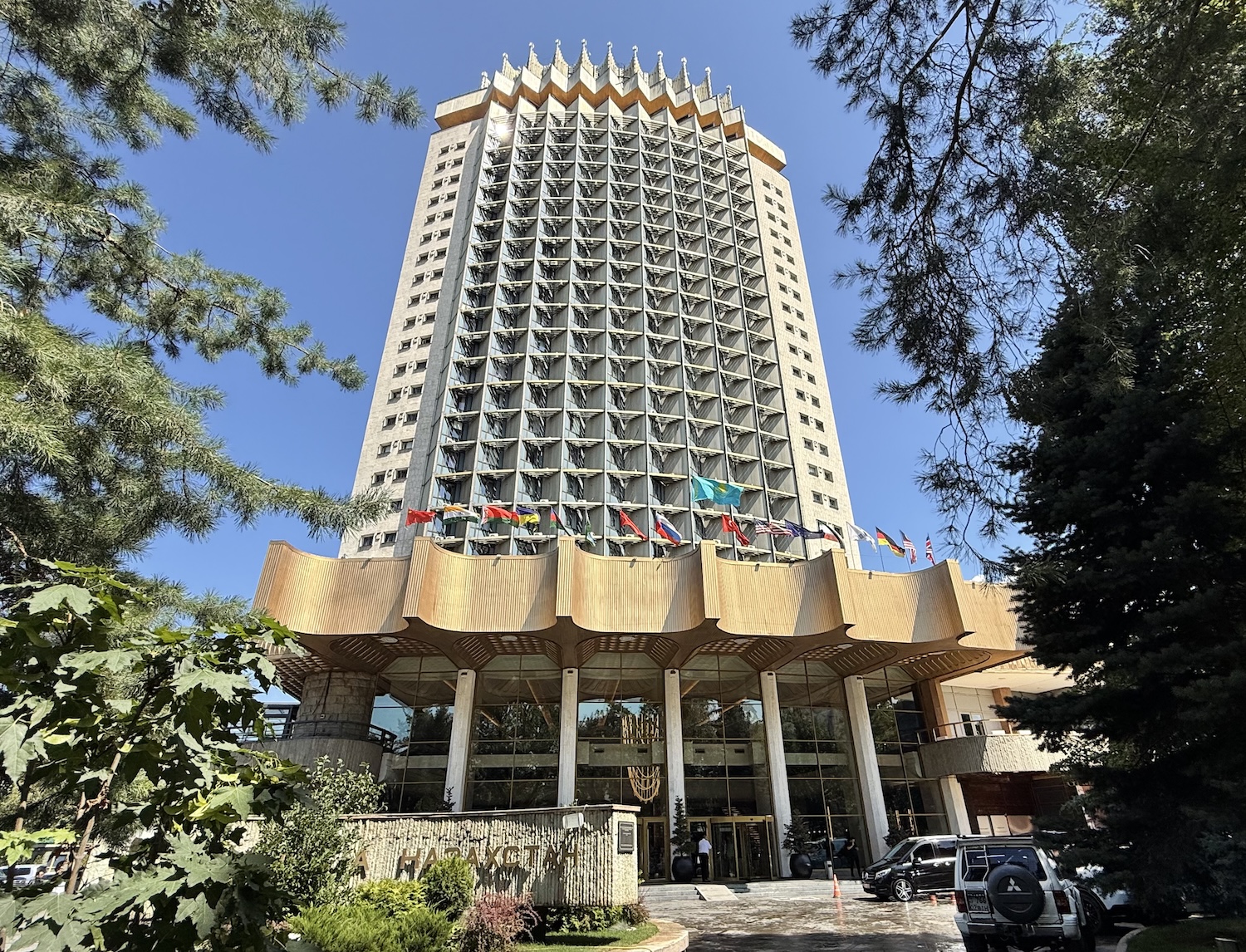
Almaty has many good hotels, including top drawer places such as the Ritz-Carlton, which has great views from its thirtieth floor Sky Bar, and the Rixos, as well as decent business standards including the InterContinental and the Rahat Palace. The historic place to stay is the Kazakhstan Hotel.
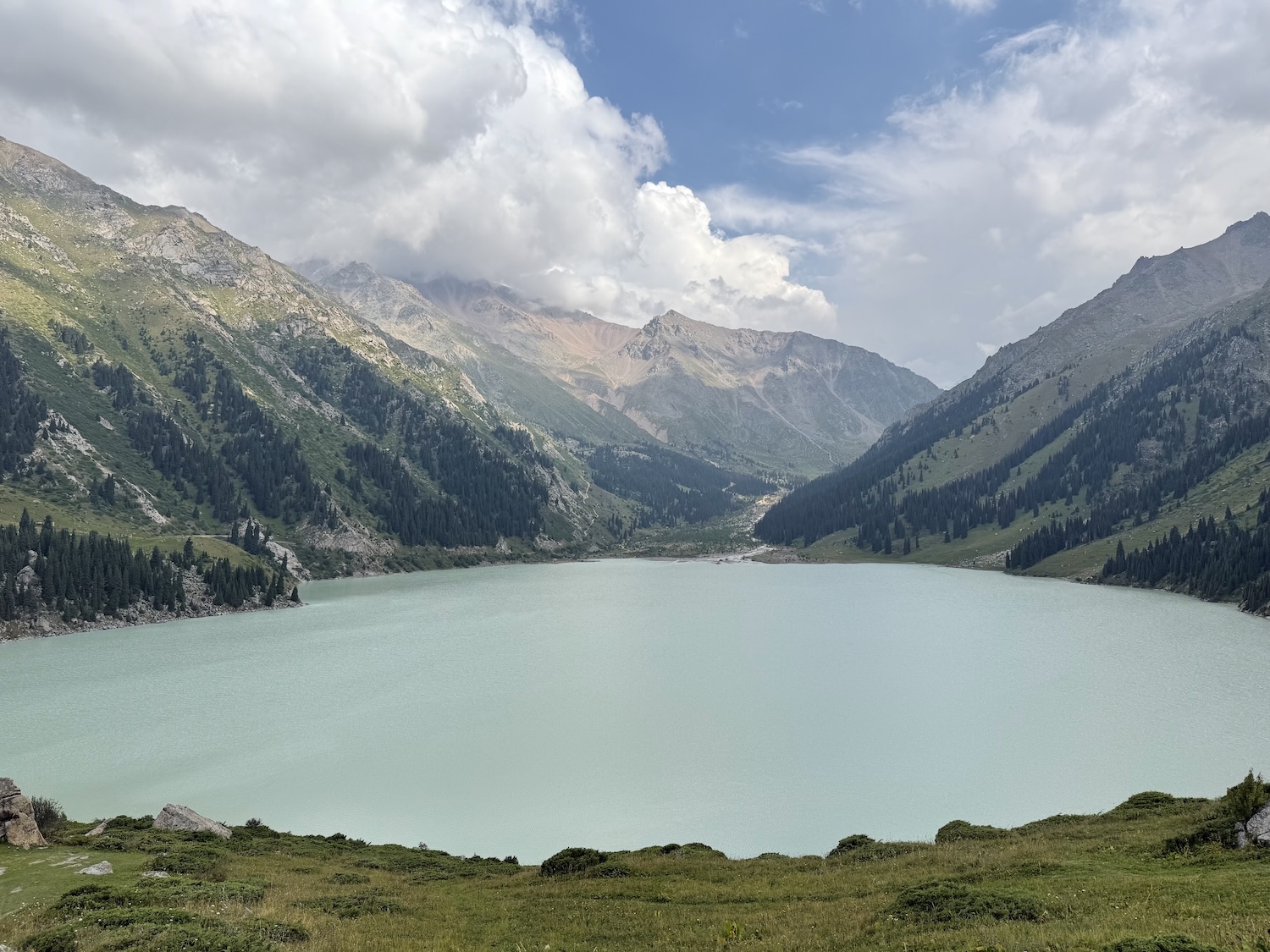
Only about 15 kilometres south of the city, but a ninety-minute drive twisting up into the Trans-Illi Alatau Mountains, is a popular day trip to Big Almaty Lake. On the way you will pass the Sunkar Falcon Centre, which breeds and exhibits various birds of prey, and hosts a show a couple of times a day. We will see more authentic versions around the country.
Immediately after the centre is the city limit and a toll booth to enter the Big Almaty Lake National Park. From here it is not much more than 5km before the road is blocked, about 10km from the lake. To get there, you can flag a ride with a 4×4 and a local driver or hire an electric motorbike (which takes about 20 minutes) Or hire a pedal-powered bicycle (an hour), or walk the road (4 hours) or walk along the 6.5km water pipeline (3 hours). In tourist areas like this, falcons are hawked for photos.
Finally, on another route south, beyond the Bellagio, a charming al fresco restaurant, and the Medeo Gorge, a mountain valley boasting the world’s highest ice-skating rink, is the Shymbulak ski resort. Only 25km out of Almaty, it bid to host the Winter Olympics of both 2014 and 2022. Skiing season is November to April.
Kaindy, Kolsai & Charyn
The local tourist authorities market Lake Kaindy, the Kolsai Lakes and Charyn Canyon as the Golden Triangle. They are the most popular destinations beyond Almaty among foreign visitors to Kazakhstan, not least because they are easily explored in a self-drive vehicle but mostly because they are spectacular.
From Almaty it is a hefty four-to-five-hour schlep 280km east to the little town of Saty, the gateway to these natural phenomena. The smooth A3 highway runs alongside the foothills of the Tian Shan, the Celestial Mountains, before turning south at Shelek onto the A351, then the P16 past the Black Canyon on the Shilik River. This is mostly through the grassy plain, where shepherds on motorbikes tend their sheep while birds of prey circle overhead.
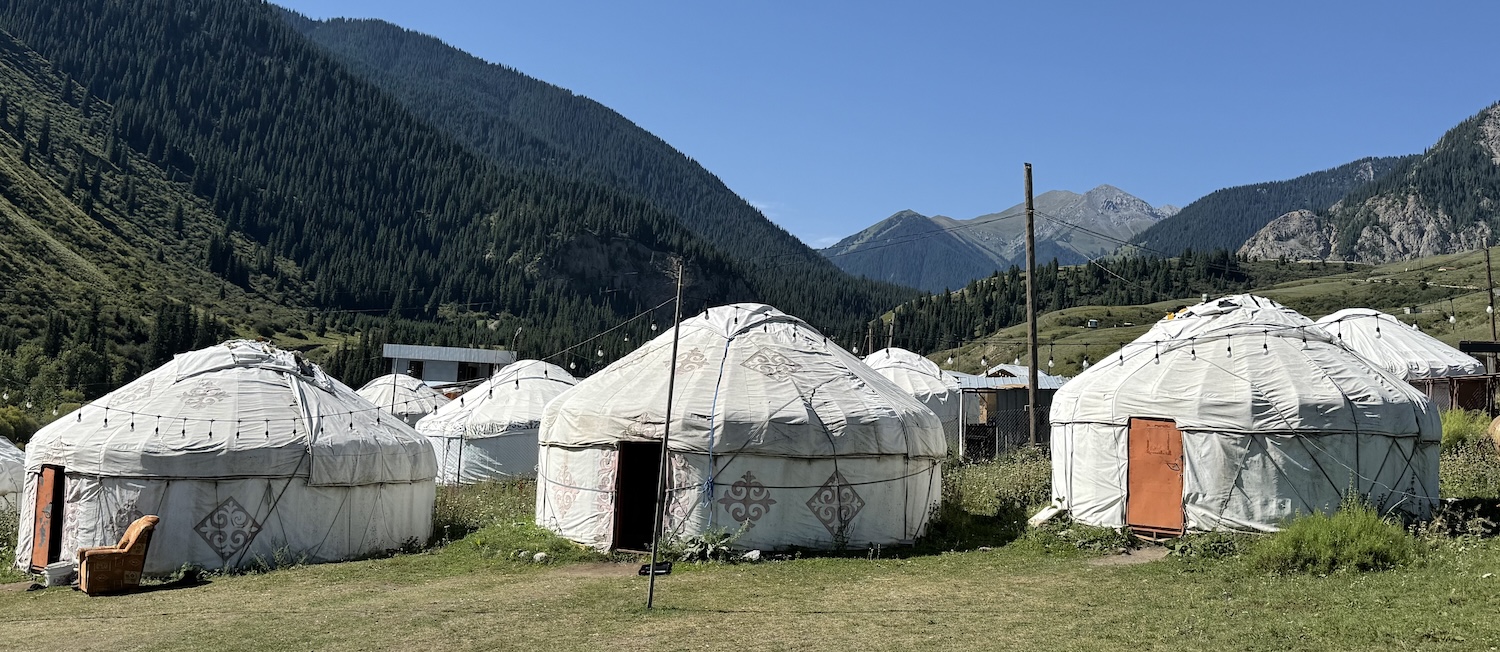
Saty is in a gorgeous location between the river and the mountains, but it is a bit of a dump. The only reason it seems to exist is to offer cheap accommodation, with a few supermarkets and a handful of restaurants, to visitors. These days, yurts – little white round tents originally used by nomads across the steppe – are less central to life in Kazakhstan than other Central Asian countries, and here is the best place in the country to experience one.
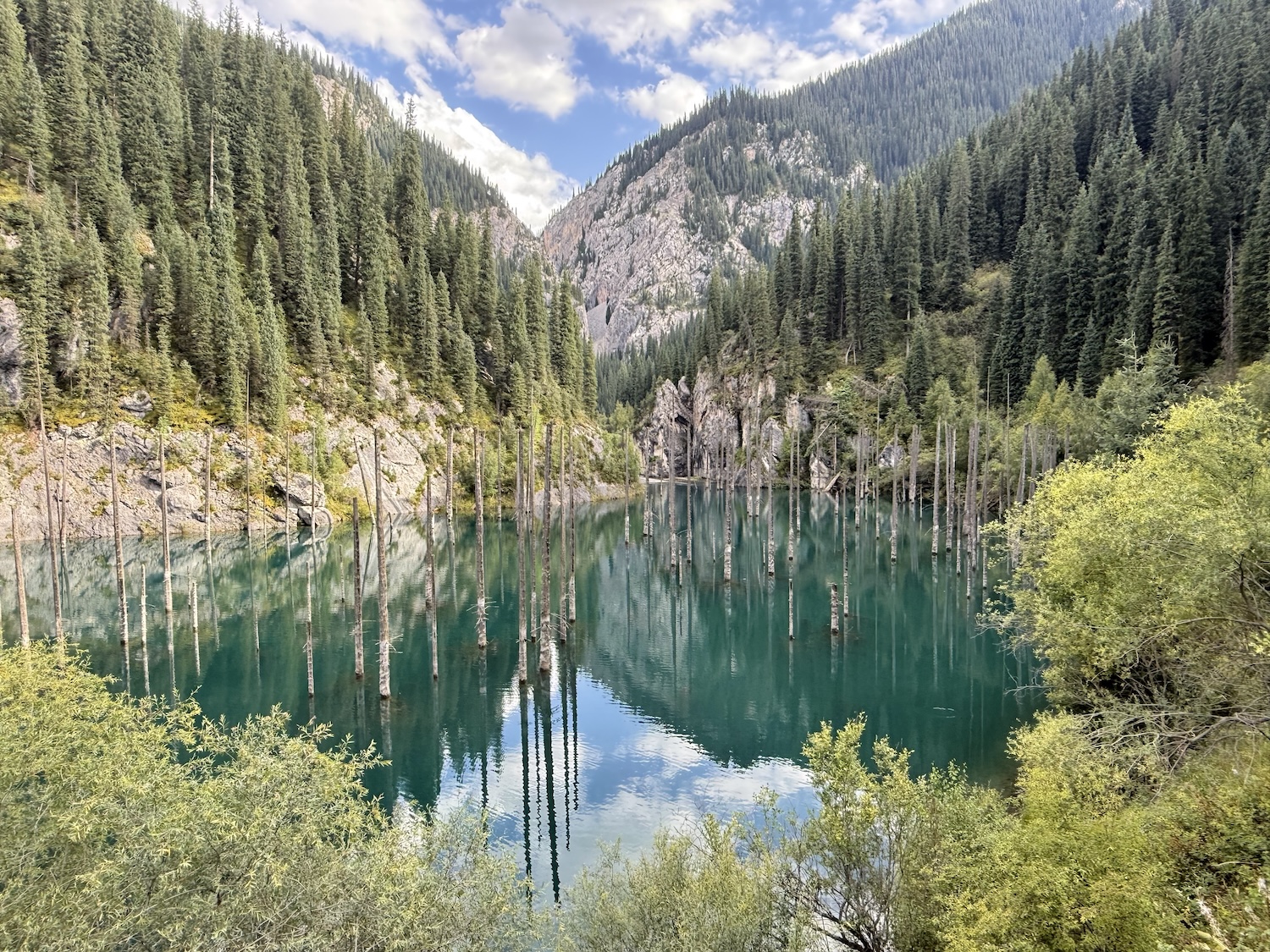
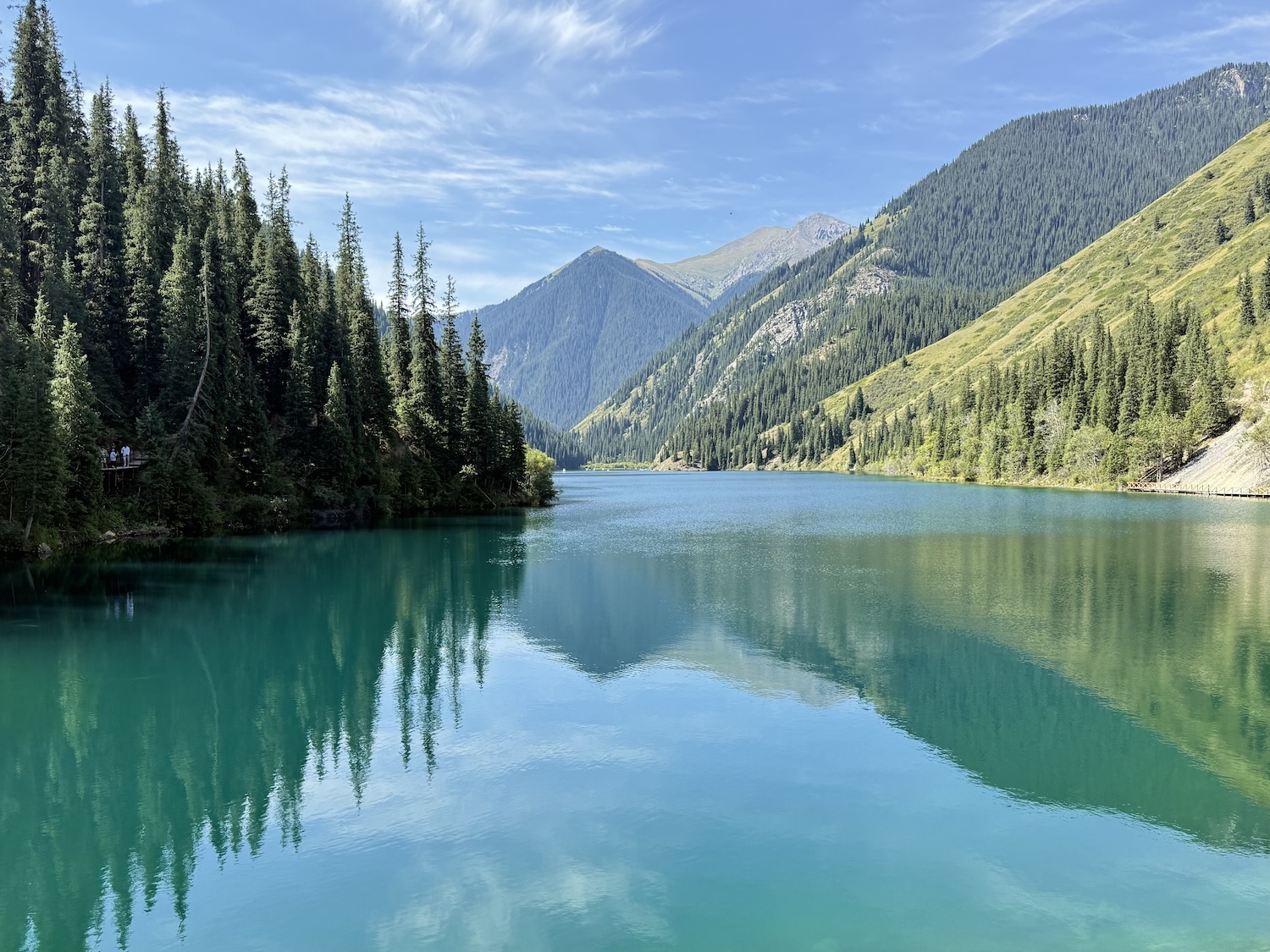
From Saty, it is just over 10km south on a paved road through hilly walls of pine trees to the ticket barrier for Lake Kaindy. There are then two ways to reach the water itself, about 2km further on. Either you take the trail along the forest floor by foot, or you jump on a horse to trot along the bridleway that loops up into the hills. Both routes meet at the end where you are greeted by the staggeringly beautiful lake. Kaindy, a sunken forest just 400m long, was formed when the 1911 earthquake triggered a landslide of limestone that has left the tops of hundreds of spruce trees visible above the surface of the azure water.
Again starting at Saty, it is 15km southwest to the first of the chain of three Kolsai lakes, also formed from tectonic activity a century ago. Another gorgeous pool of turquoise water, this Lower Lake is the biggest and is easily reached all the way by car. It is therefore popular with local visitors who swarm the cafes and hire the boats. The whole area is crossed by trekking trails, and visitors everywhere are carrying picnic hampers and swimming towels.
The Middle Lake is 8km further south, and the Upper Lake is another 5km on, both accessible only by foot or horse. The hills around the waters are home to 700 species of plants and 50 species of mammals, including bears, snow leopards, lynx, wolves, foxes, badgers and marmots.
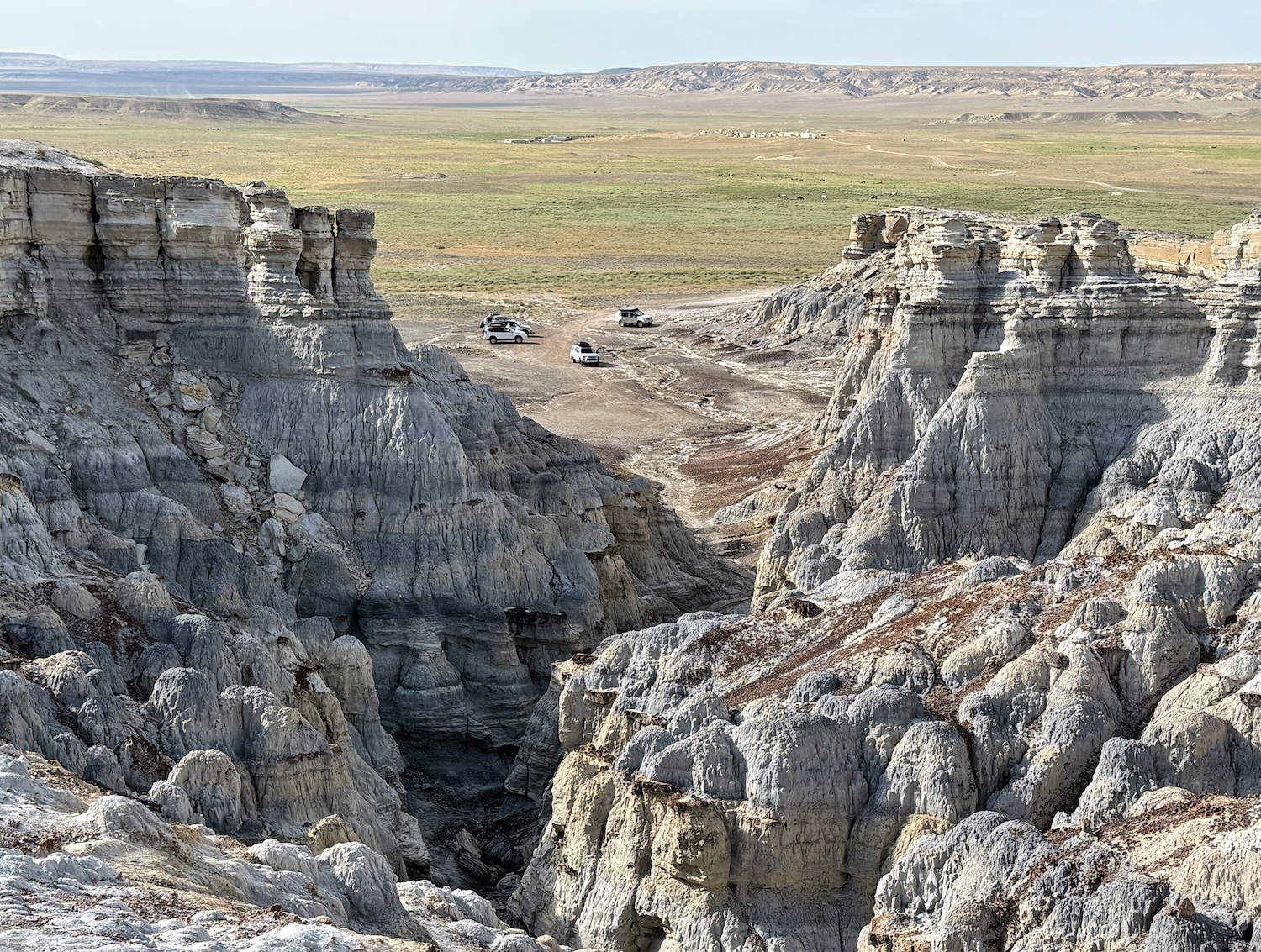
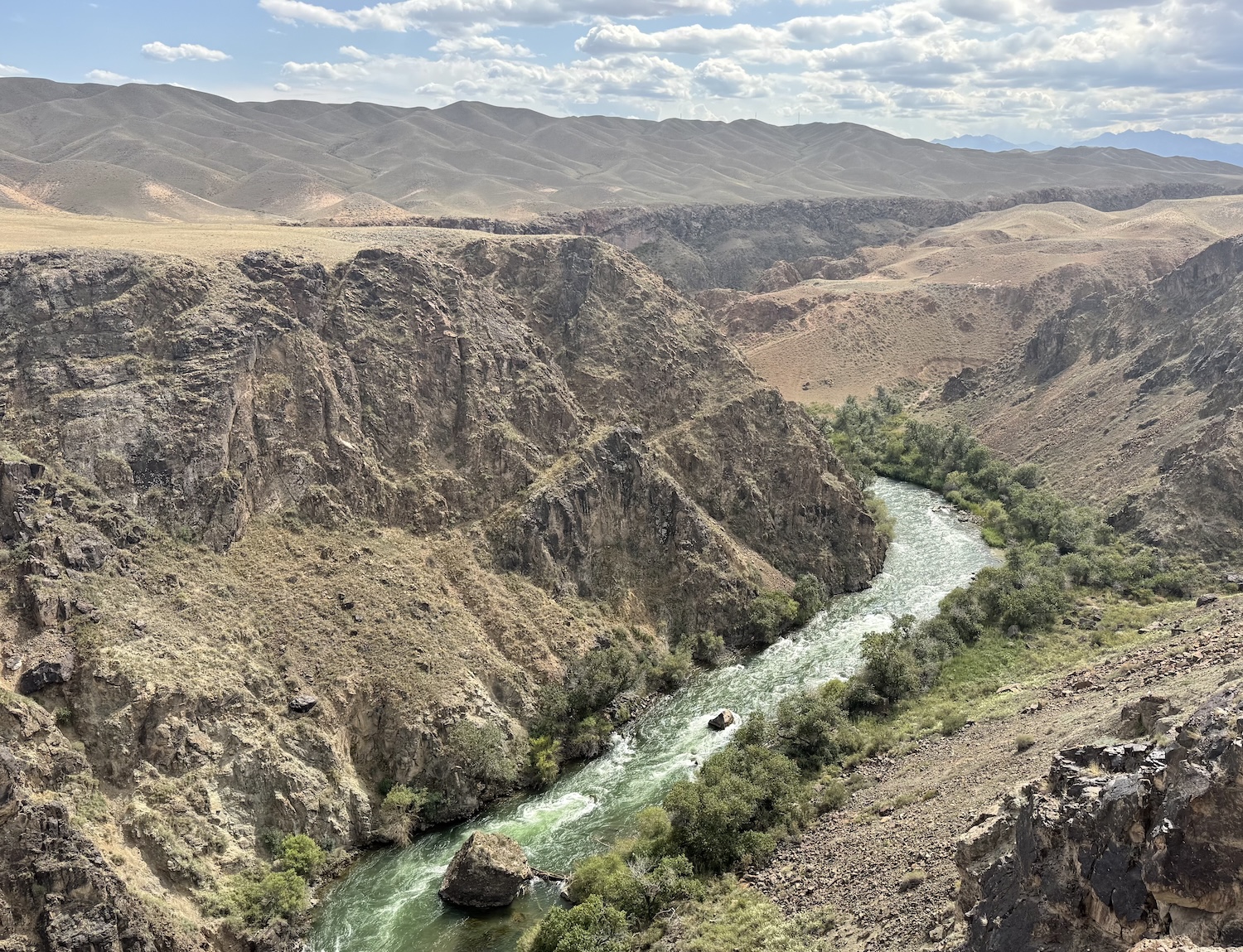
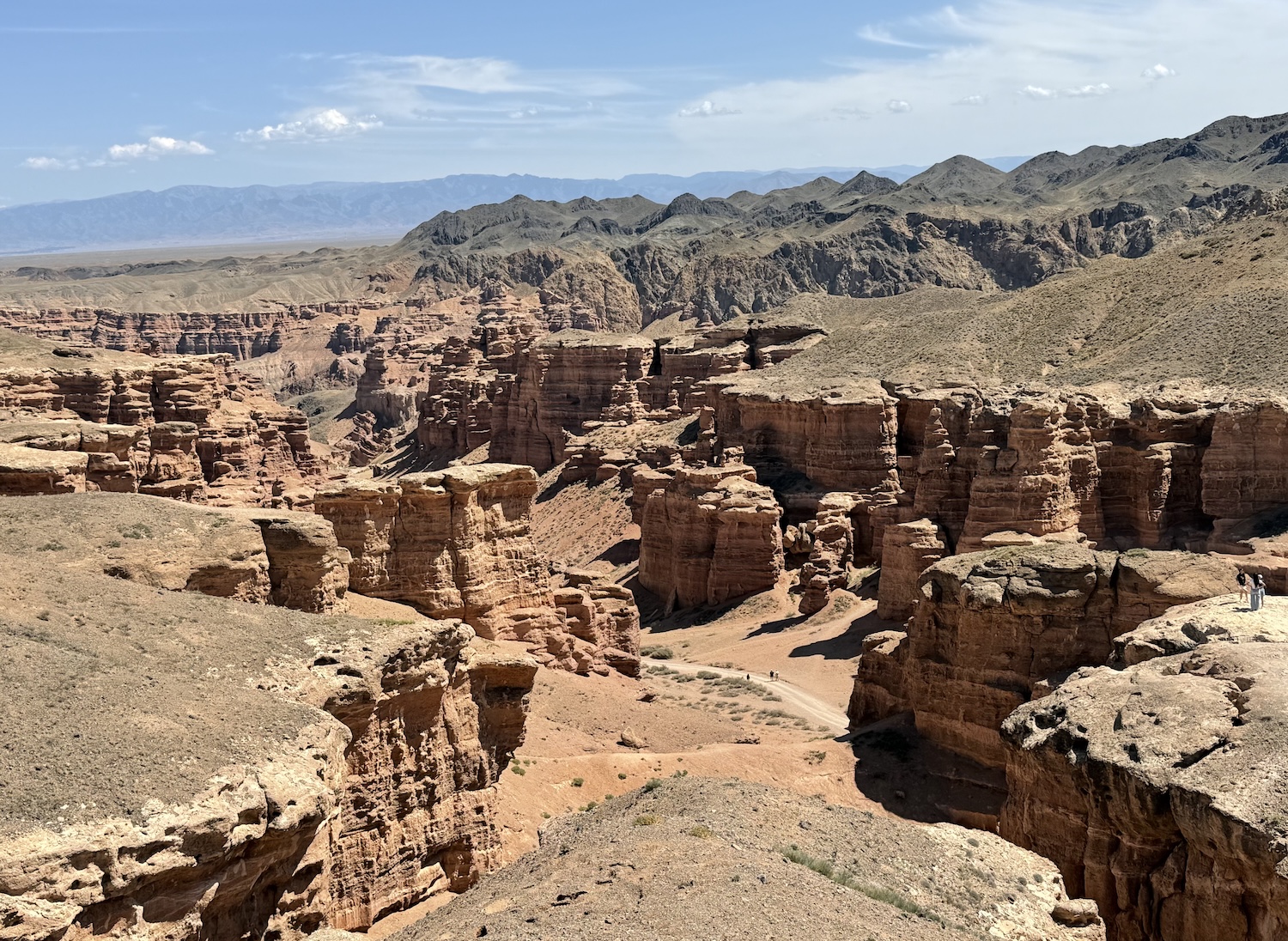
On the drive from Almaty to Saty, we passed the Charyn Canyon National Park, and it is a 90km loop back northeast from Saty to get here. These sandstone sculptures were originally created twelve million years ago, and continue to be shaped today, by the erosion of the waters that rise in the Tian Shan and the wind that whistles through the valleys. The main area to explore – with trails on the canyon floor and the 300m-high ridges – is a 2km section called the Valley of Castles, and its red rocks are reminiscent of Arizona and Utah.
Altyn-Emel National Park
Altyn-Emel National Park, a UNESCO Biosphere Reserve of almost 5,000km2, is a desolate place, full of endless forbidding plains of scrubby desert and rocky hills, with pretty minor attractions. Most people skip it and it is eminently skippable, though it is the journey, rather than the destinations, which made this worth the effort for us.
The main entrance is on the north side near the town of Basshi. This is more than 250km from the Valley of Castles, on a long loop that skirts around the eastern and northern borders, much of it along the shallow valley floor of the northern part of Charyn Canyon.
Basshi is akin to Saty, a tiny village created for visitors to rest before visiting Altyn-Emel. It is in a less pretty location and the only places to stay are rustic guesthouses and even more bucolic camping grounds. These all seem to serve their own food, so there is only one restaurant, the Altyn Aray. However, that is a cultural experience not to be missed. It is out near the petrol station on the main road; from the outside it looks abandoned, and inside it looks like a wedding reception waiting for guests (as you will undoubtedly be the only ones here). Yet the service, the dumpling soup, and the boiled meat and potatoes, are among the best we found in Kazakhstan.
To enter the National Park, you will need to purchase a permit in cash at the Central Office on Mametove Street (open 8am to 1pm, and 2.30pm to 5.30pm), where you will be given an old-skool hand-drawn map, which is the only tool for finding your way.
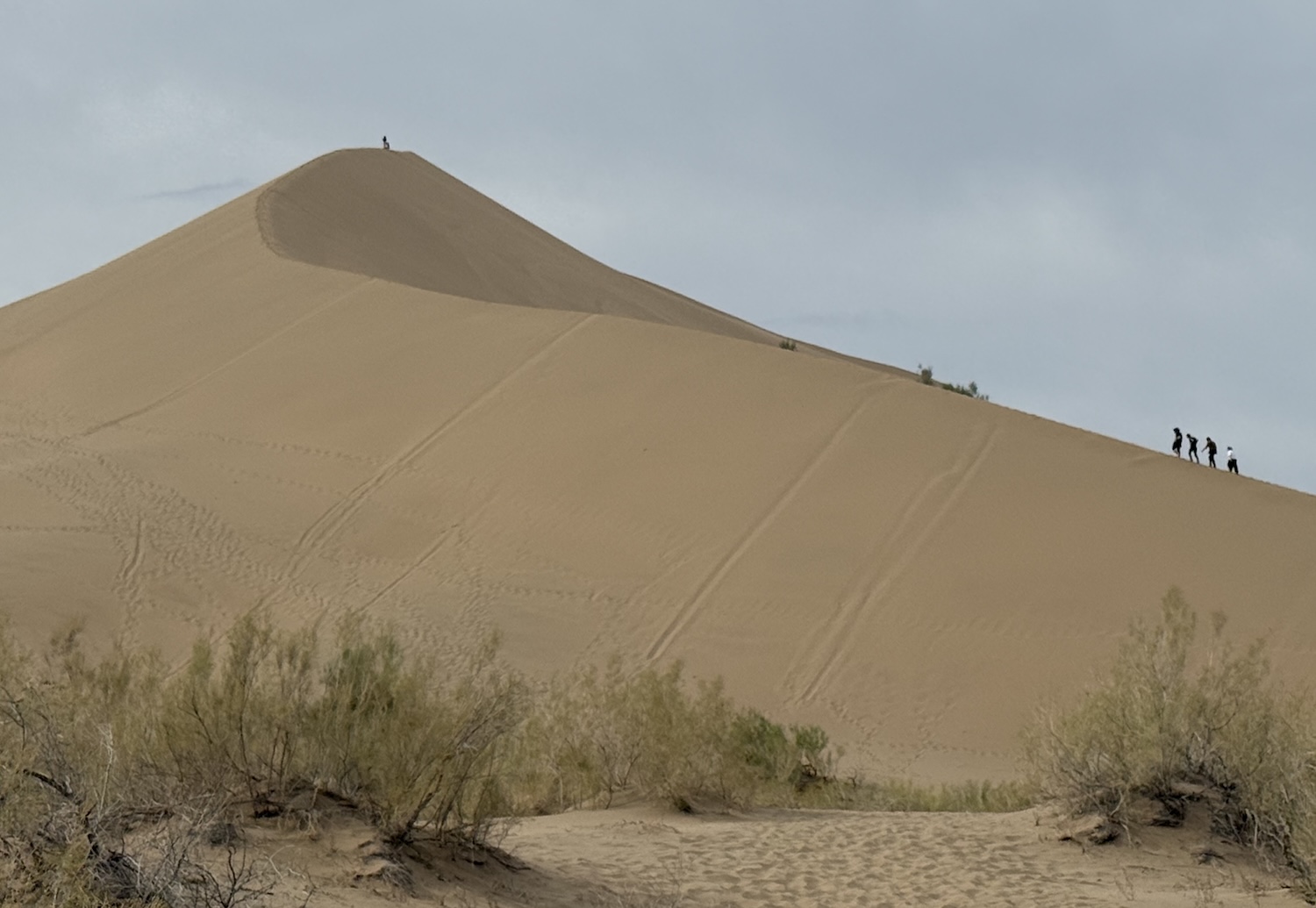
The permit checkpoint is less than 10km south of Basshi and leads to two geological features. The Aktau Mountains, 75km southeast of the checkpoint, amount to a small massif with colourful layers of sedimentary rock. The Singing Dunes, 50km southwest of the checkpoint, are sandy mounds 150m high and 3km long that will take anyone with average fitness about twenty minutes to scramble up before walking along the ridge.
The other entrance is in the west, and as there is no road through the park you have to take the 170km drive along the A353 then the A3 from Basshi through grassy plains before turning left at the town of Shengeldy. From here it is 40km on a road that starts paved but for the last 10km shrivels into dirt before it reaches the checkpoint. Note that you cannot buy permits here; you can only get them in Basshi.
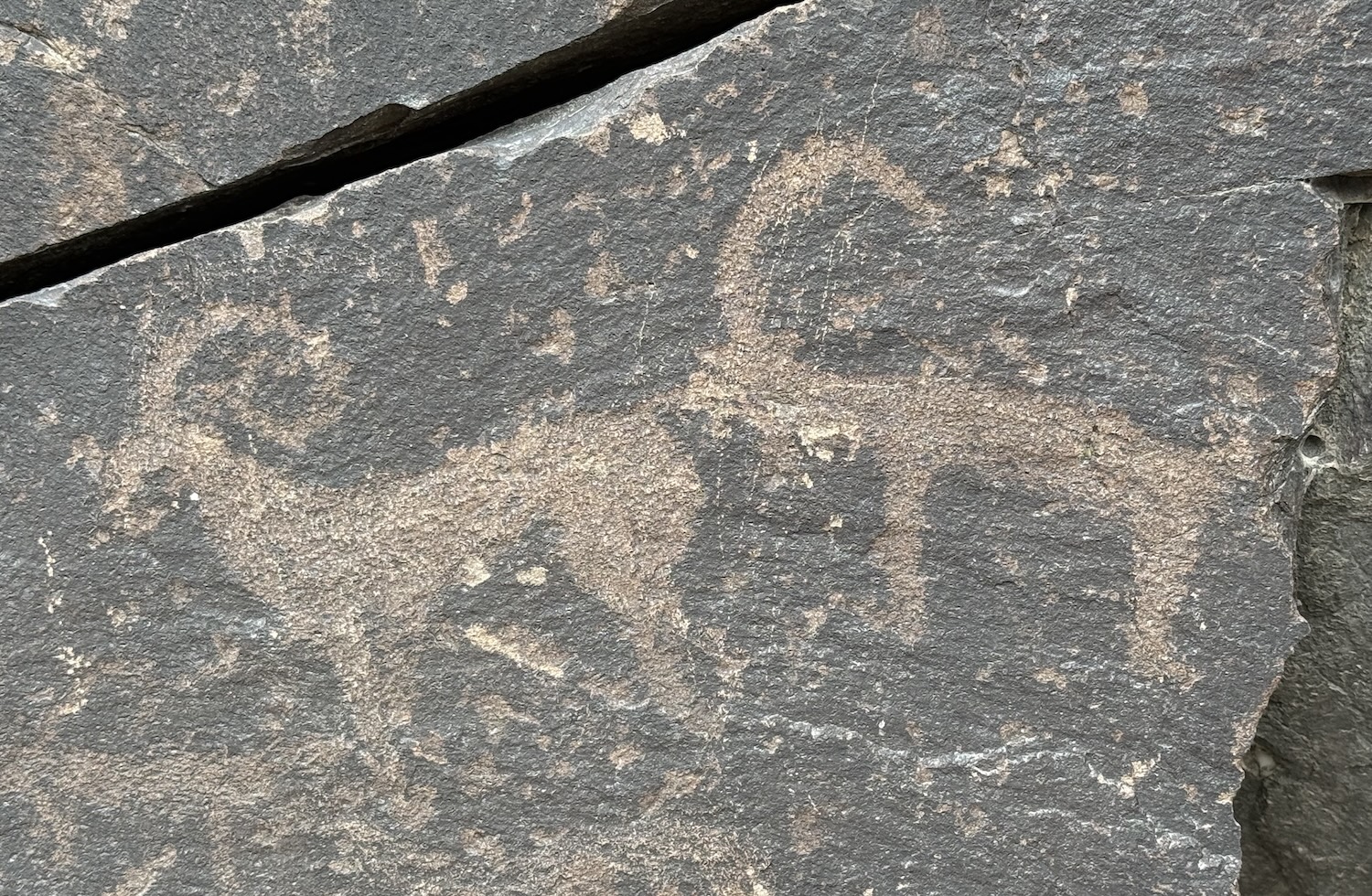
Here, there are two human creations. It is 12km east from the checkpoint to the Tanbaly Tas petroglyphs, which feature Bronze (roughly 3500 to 1200 BC) and Iron (about 1200 to 500 BC) Age simple carvings of wild animals. From here it is 25km on, driving parallel to the north coast of the beautiful 140km-long Kapchagay Reservoir, to the Besshatyr burial mounds, which are a humble necropolis of rock piles put here by nomadic Saka tribes between the sixth and fourth centuries BC. These shale tracks are a much rougher rollercoaster ride than around Basshi – our 4×4 even got a puncture here – and these are very much the roads less travelled.
From Shengeldy it is a bit more than 100km back to Almaty on the A3. For most foreigners this region around Almaty is as much of Kazakhstan as they will see. Yet this is a massive country with so much to explore that we spent another couple of weeks heading west all the way to the Caspian Sea via the sites around Shymkent, Turkestan and the Aral Sea before looping back to the new capital of Astana.
Shymkent
Shymkent, pronounced Chimkent, was an ancient settlement destroyed by Genghis Khan that recovered to become a major stop on the Silk Road, which in the twentieth century has developed as an industrial hub as Kazakhstan’s third city with a population of 1.3m. Yet it is little visited except by business executives, which is a shame as there is enough here to keep you busy for a day.
There is a railway service that runs from Almaty to Shymkent, on which the First Class overnight sleeper carriages are excellent. There is also a one-hour flight that lands at the airport just 11km northwest of the city centre.
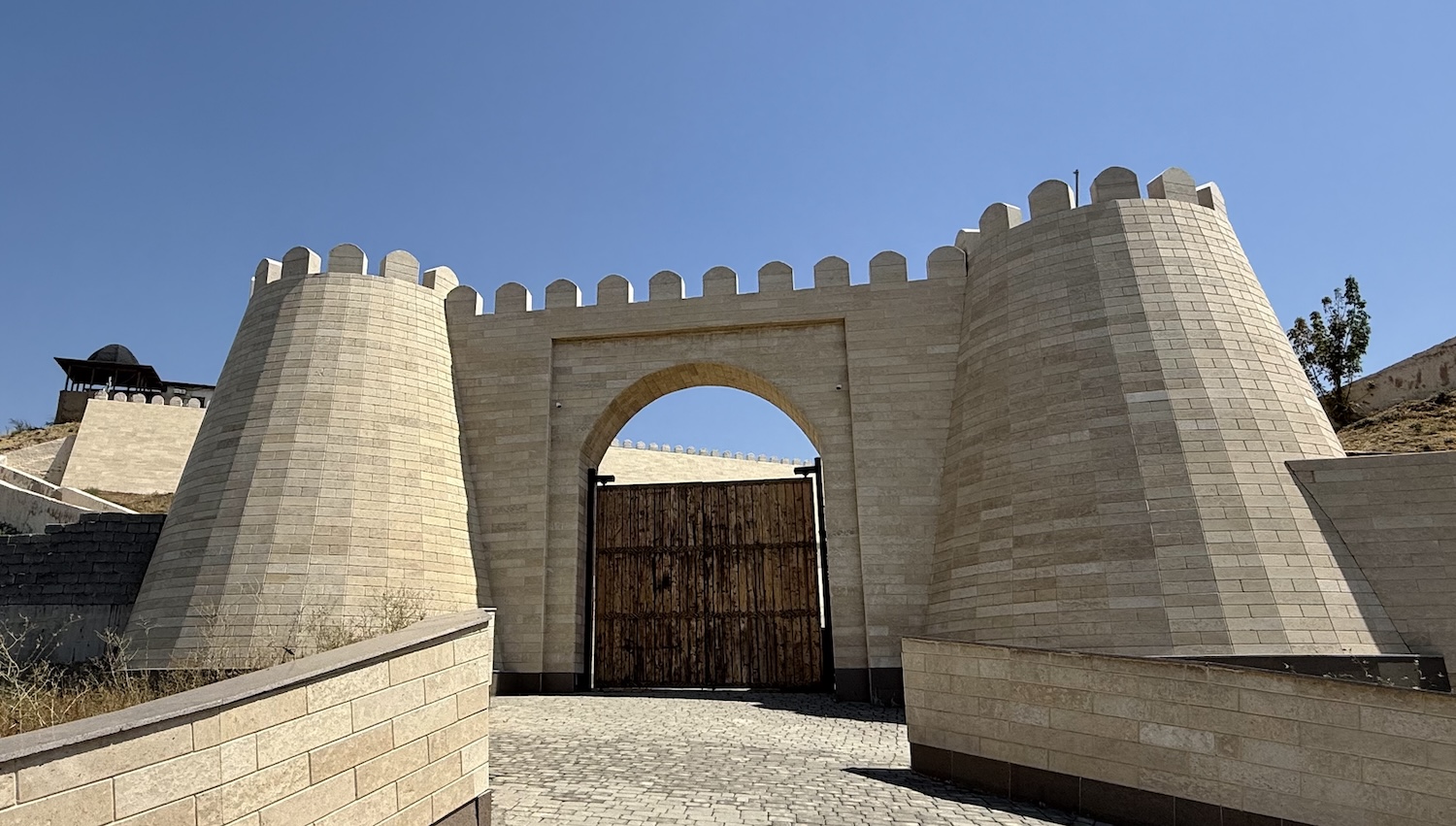
The old town is built around the Shymqala Citadel, where archaeologists have found evidence of a ruler’s palace and fortress walls from 2,200 years ago. Sadly, this has been reconstructed.
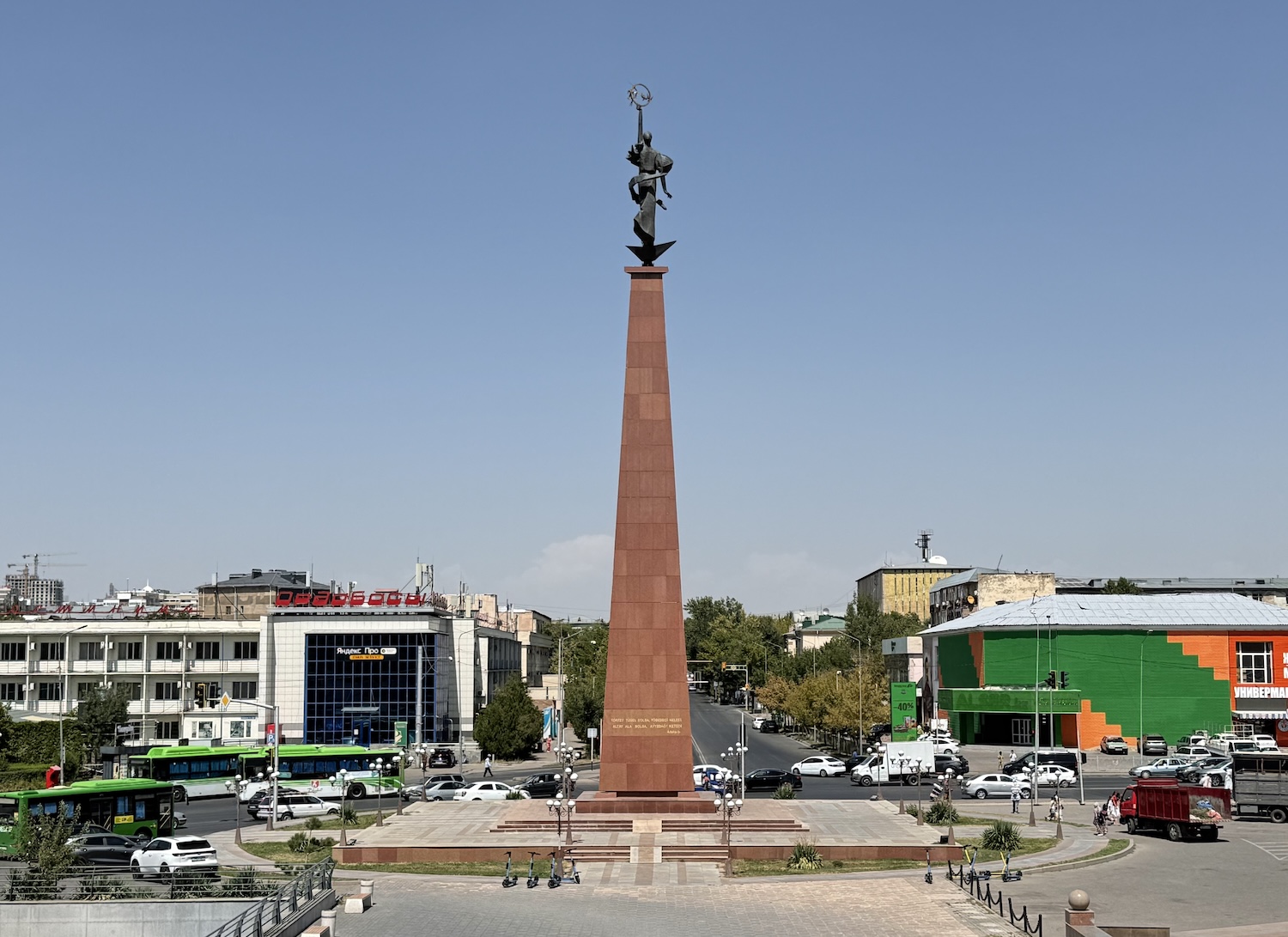
Near it, in Ordabassy Square, is an obelisk commemorating Kazakhstan independence in 1991.
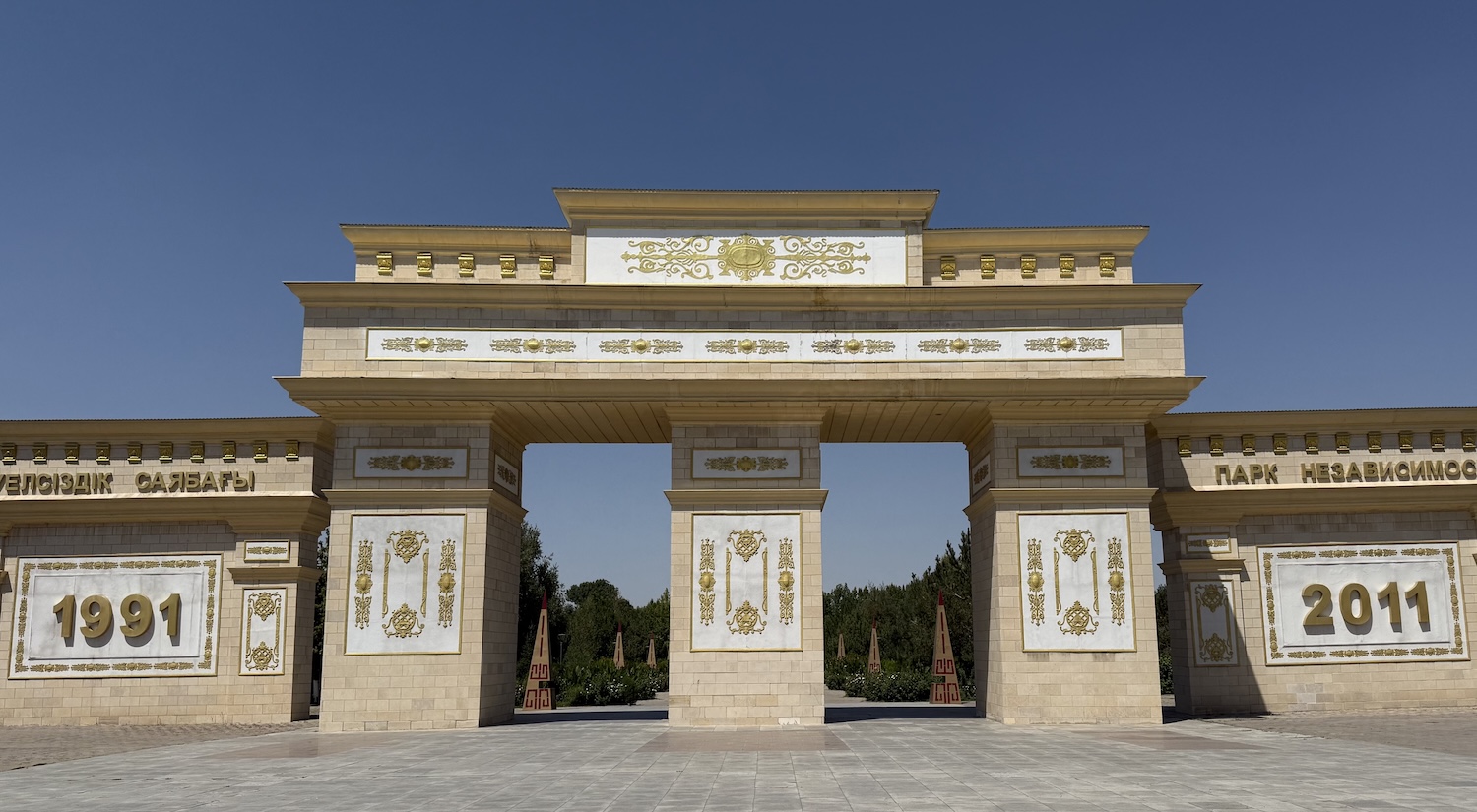
Across a short bridge from here is Independence Park, with its attention-seeking entrance archway, which were opened to mark the twentieth anniversary of independence.
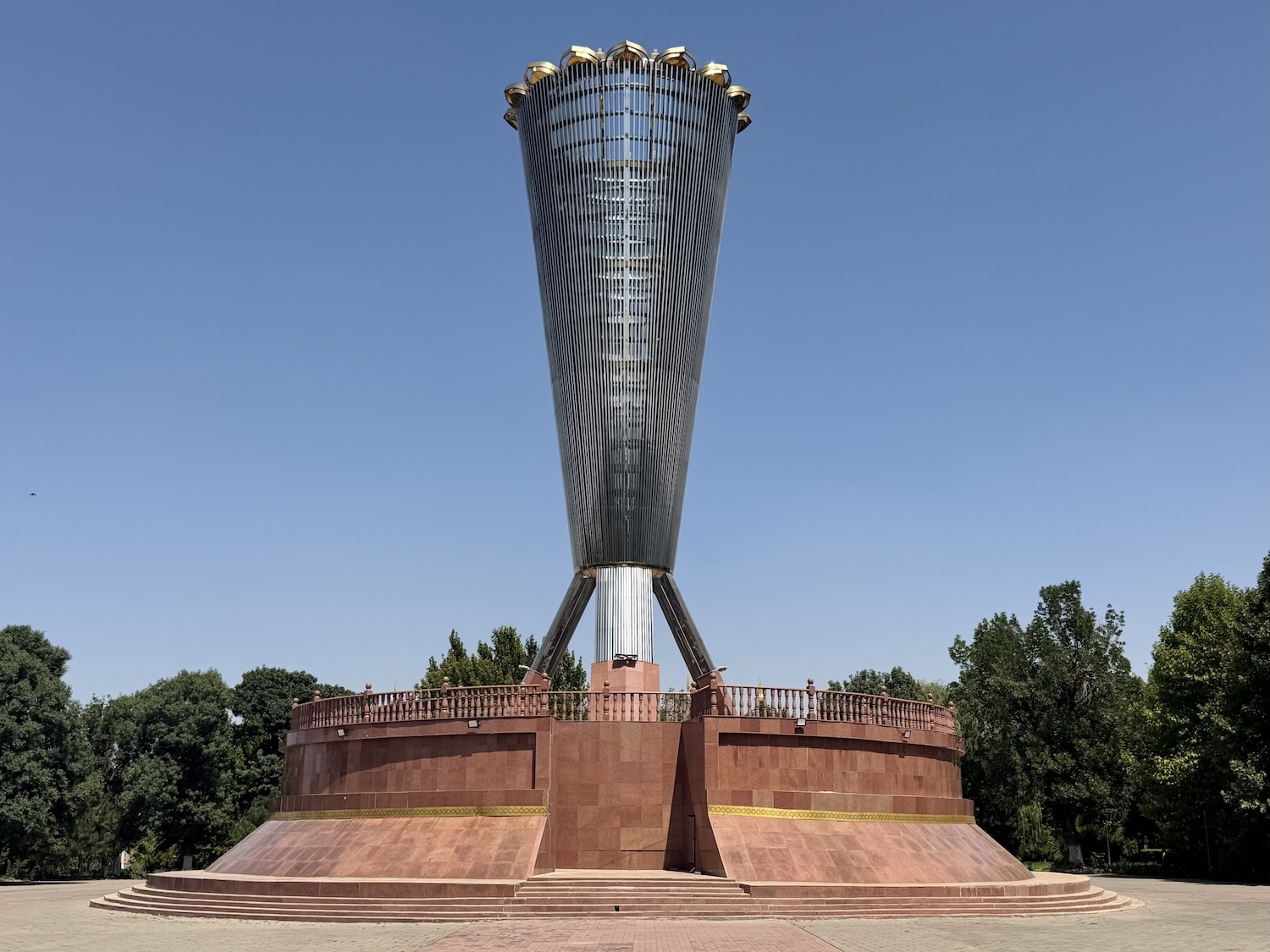
Also in the park are a giant national flag, with a desert eagle flying under a bright sun, and the Altyn Shanyrak Monument, representing the unity of the Kazakh people who at the time this was put up in 2011 apparently came from 137 different nationalities.
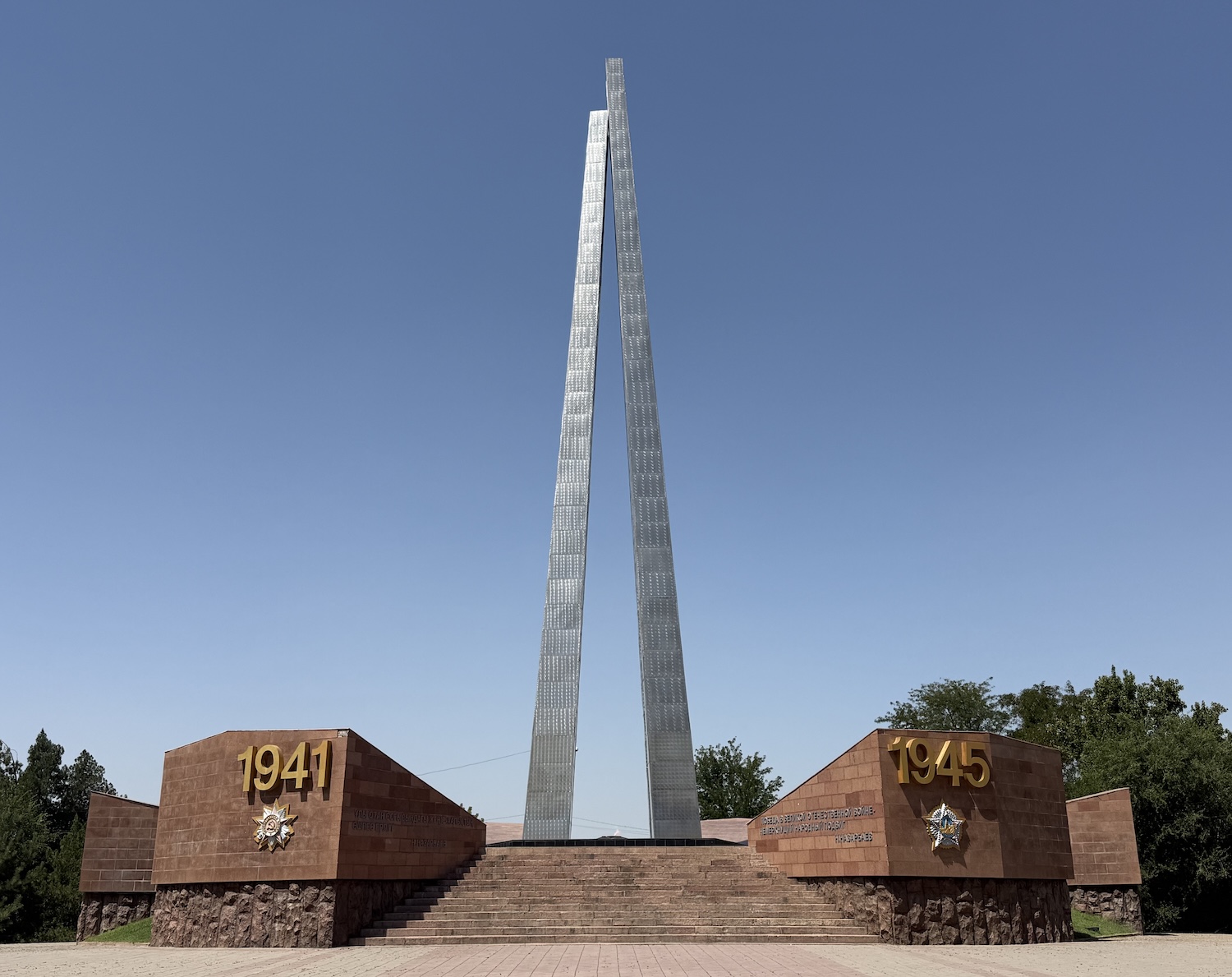
Across town in Abay Park is a moving Second World War Monument with an Eternal Flame.
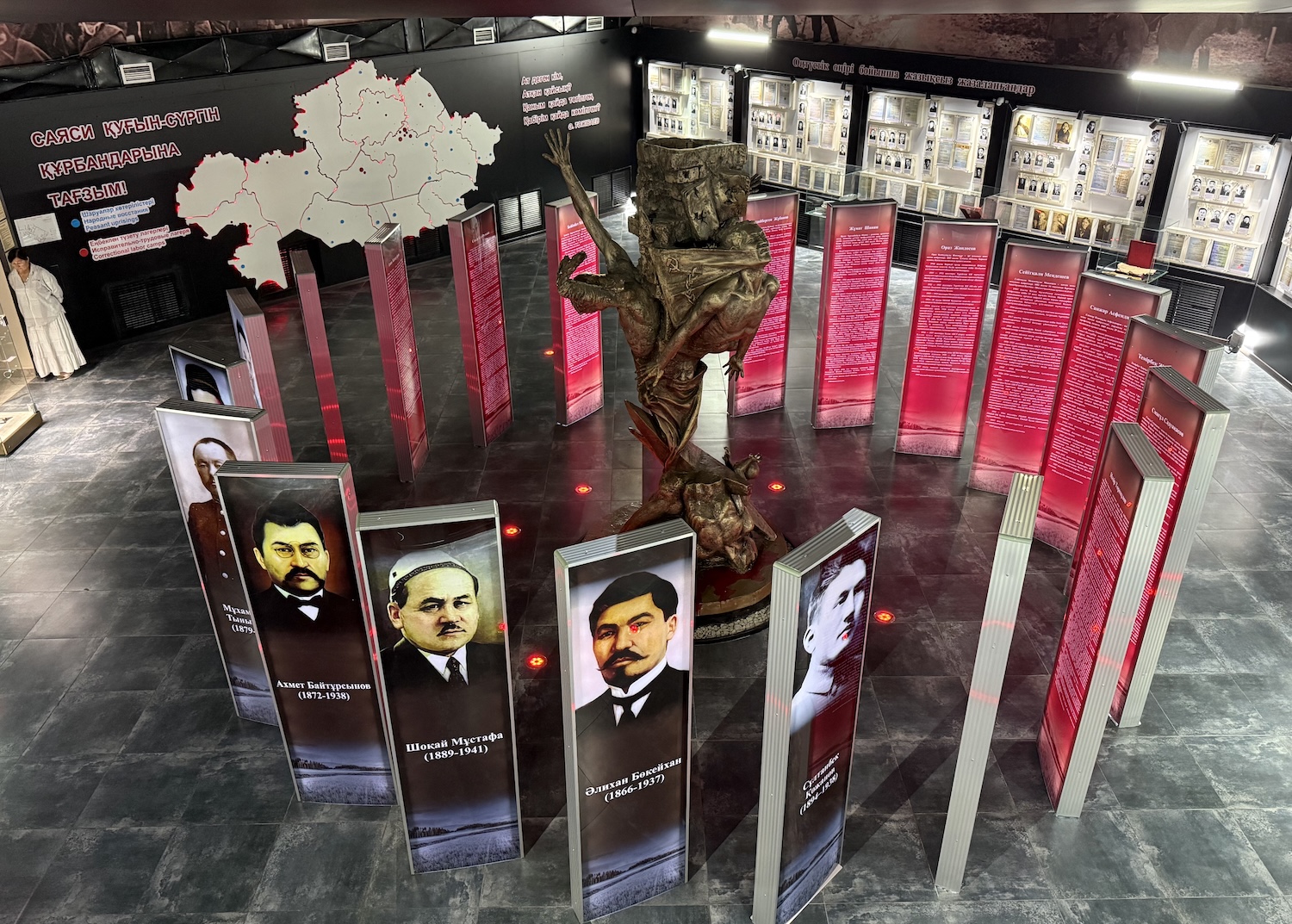
Over the road is the Museum of Victims of Political Repression, which opened on the tenth anniversary of independence. In its main hall are large portraits of local political leaders murdered by Stalin in the Great Terror of 1937-38. They are set around Repression, a sculpture of men, women and children whose faces are tortured by anguish.
The place to stay in Shymkent is the Rixos, and one of the reasons for coming here is this is the gateway to a series of ancient heritage sites a little further north.
Otyrar
It is a 150km, two-hour, drive from Shymkent to Otrar. We used the inDrive app, on which you announce where you want to go and how much you want to pay, then wait for any drivers willing to take the job to respond directly to your own phone. Ours ding-ding-dinged like we had hit the jackpot on a fruit machine for the next ninety seconds, in which time we received forty-one calls and eighteen Whatsapps.
Otyrar, where the grass is less green and we see camels and donkeys wandering about for the first time, is a dusty town located at the confluence of the Ayrs and Syrdaria rivers with two significant but underwhelming historic sites.
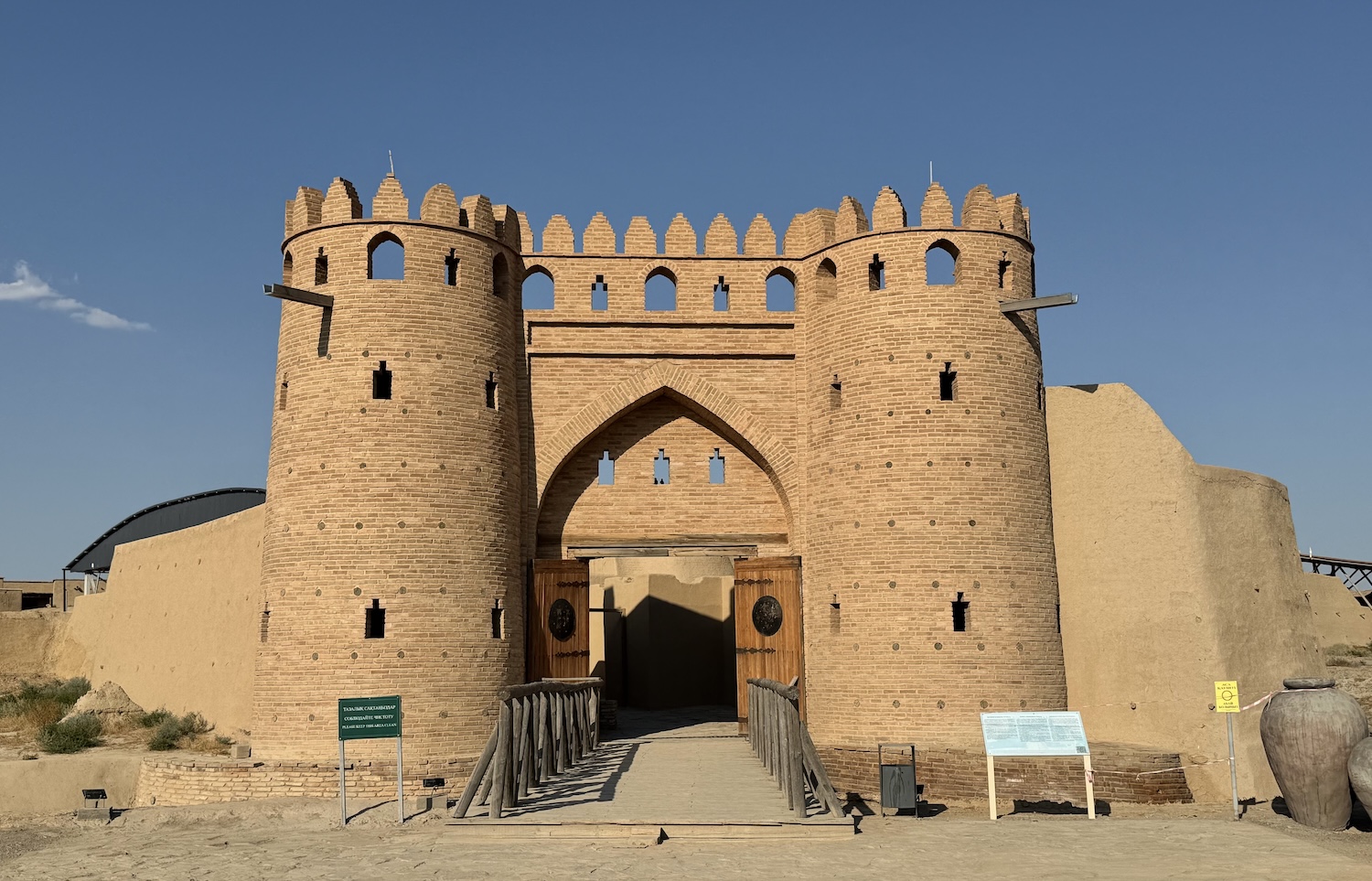
A major settlement on the Silk Road from about the seventh century, this was a centre of science and culture that grew to become the capital of this region by the fifteenth century before it was destroyed by the Dzhungars in the 1680s. Inside the old city walls is an archaeological dig that has revealed an eleventh century residential quarters, a thirteenth century bathhouse, and a fourteenth century mosque. Sadly, all have been rather unsympathetically reconstructed.
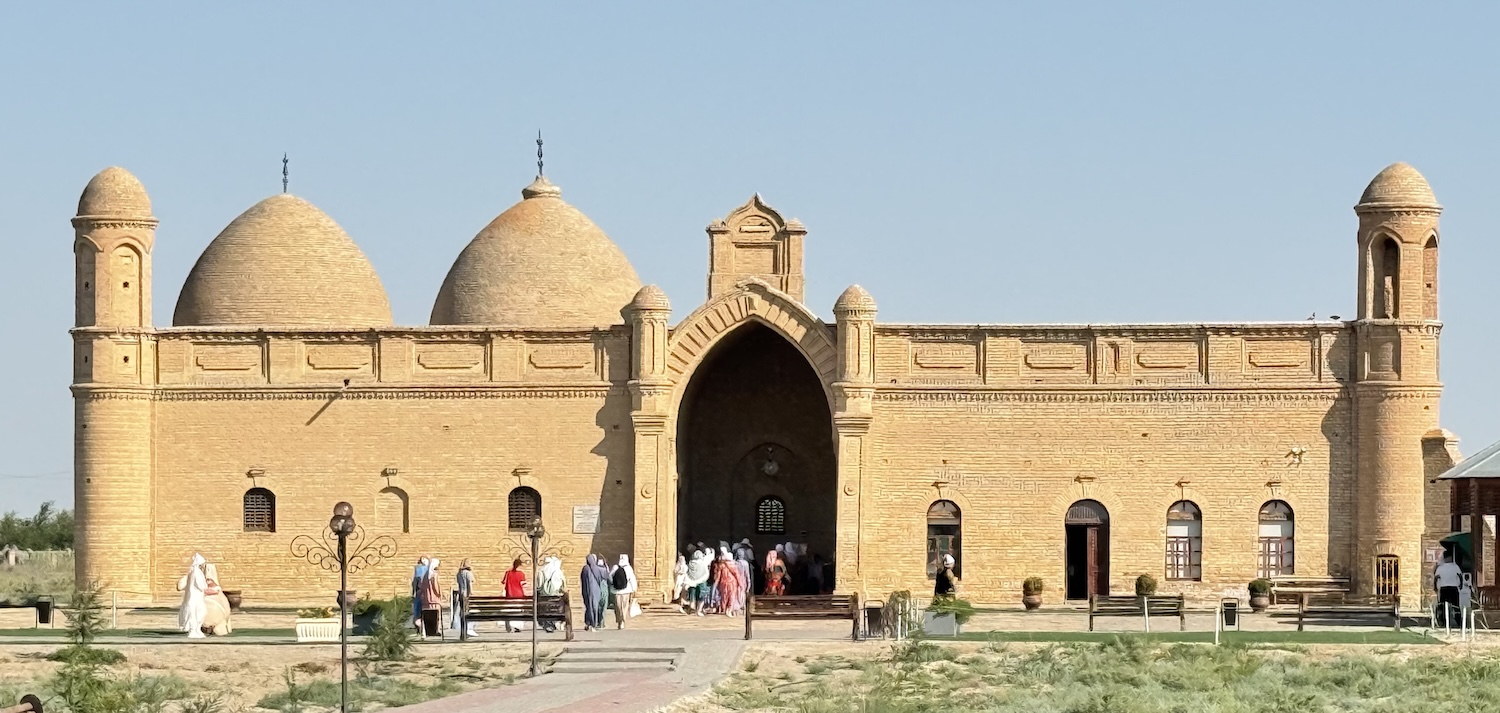
Just a couple of kilometres away is the Mausoleum of Arystan Bab, as far as I can tell a mythical figure believed to have been a Companion of the Prophet Mohammed (PBUH). It is said that Bab died at about 500 years old in the twelfth century, though a mausoleum was not erected over his grave until the fourteenth, and that was destroyed by an earthquake in the eighteenth, so the current structure is no more than a century old. It nonetheless attracts a constant parade of pilgrims.
The fields around Otyrar are known for their wild tulips, in full bloom in early May, when they can be seen in Aksu-Zhabagly Nature Reserve and Sairam-Ugam National Park.
Turkistan
Islam was initially brought to this region by Arab expeditions in the eighth century, and it was established as a state religion by the Karakhanid Dynasty in 960. However, it took several centuries to indoctrinate the nomadic tribes of the steppe, a task undertaken largely by Sufi missionaries. Sufism is an ascetic strain of Islam that focusses not just on religious instruction, but also on inner purification through a direct personal relationship with God, often aided by poetry, music and dance. The best-known examples are the whirling dervishes.
The most successful of these Sufi teachers was the mystic and poet Ahmed Yasawi, who exerted a powerful influence on the development of Sufi orders throughout the Turkic-speaking world, where he is still revered today. He died in 1166 in the backwater settlement of Turkistan, 70km north of Otyrar, since when this has been a major pilgrimage destination for Muslims across Central Asia.
One worshipper at the grave of Yasawi in 1389 was Amir Timur. Timur was the founder of an empire that ruled over most of the Eurasian Steppe and Persia, with his capital at Samarkand in modern Uzbekistan. He immediately ordered the construction of a magnificent mausoleum over the tomb. This was never finished, though since 1405 what was built has been held as an architectural masterpiece in the style exemplified in Registan Square 600km south, and it is now recognised as a UNESCO World Heritage Site.
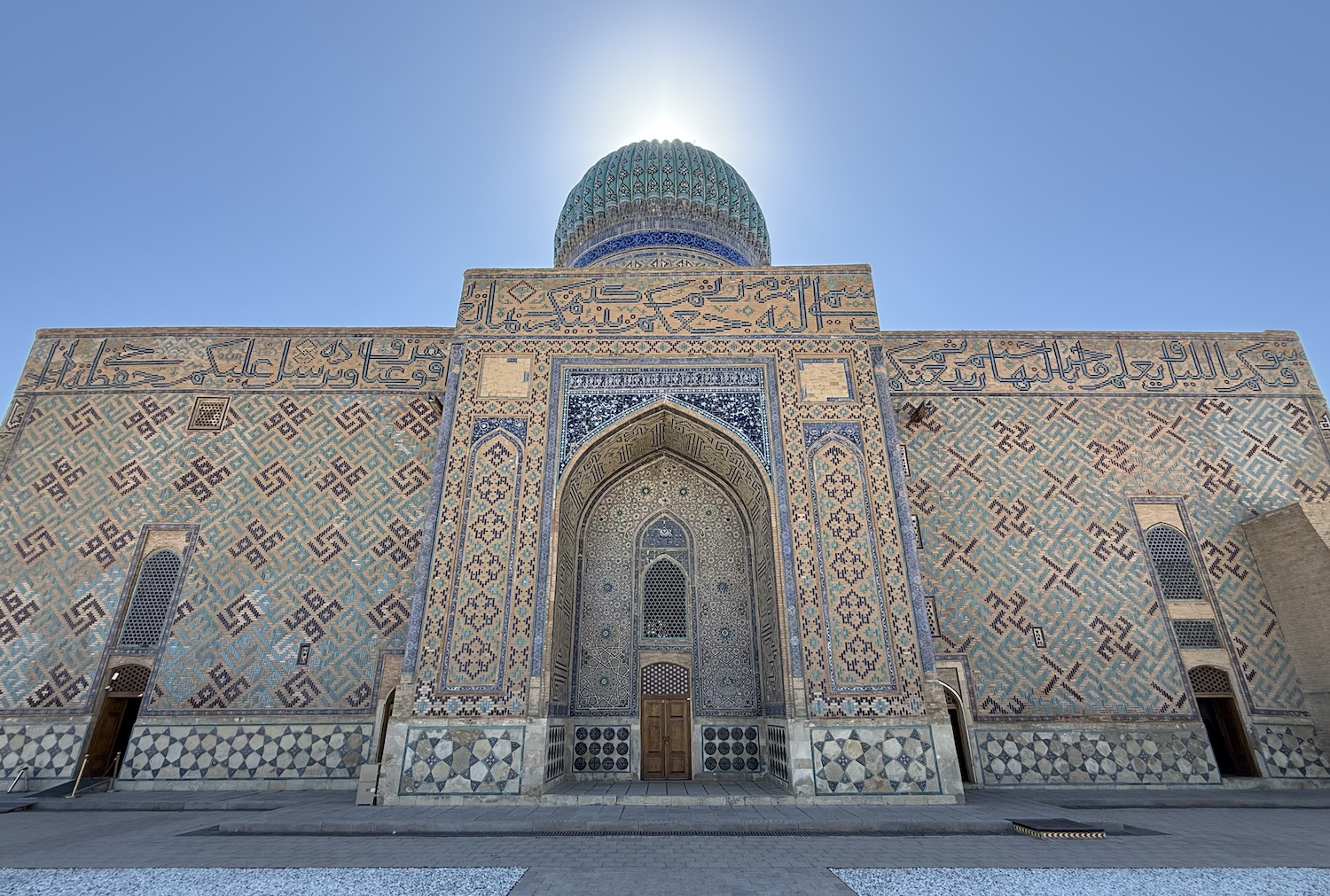
Incidentally, Yasawi was born in the ancient settlement of Sayram, now an eastern suburb of Shymkent, where there are mausoleums of his father, Ibrahim Ata, and mother, Karashash Ana. (Across Central Asia, the suffixes Ata and Ana are honorific that signify someone is widely considered a wise old fox.)
The Yasawi Mausoleum is protected by an ancient perimeter wall, in which there are several restored entry gates. Inside this area are the final resting places of numerous other Medieval religious and political figures who were laid down over the following centuries. The most impressive of these is that of Rabia Sultan Begim, a daughter of a grandson of Timur, who was buried in the fifteenth century.
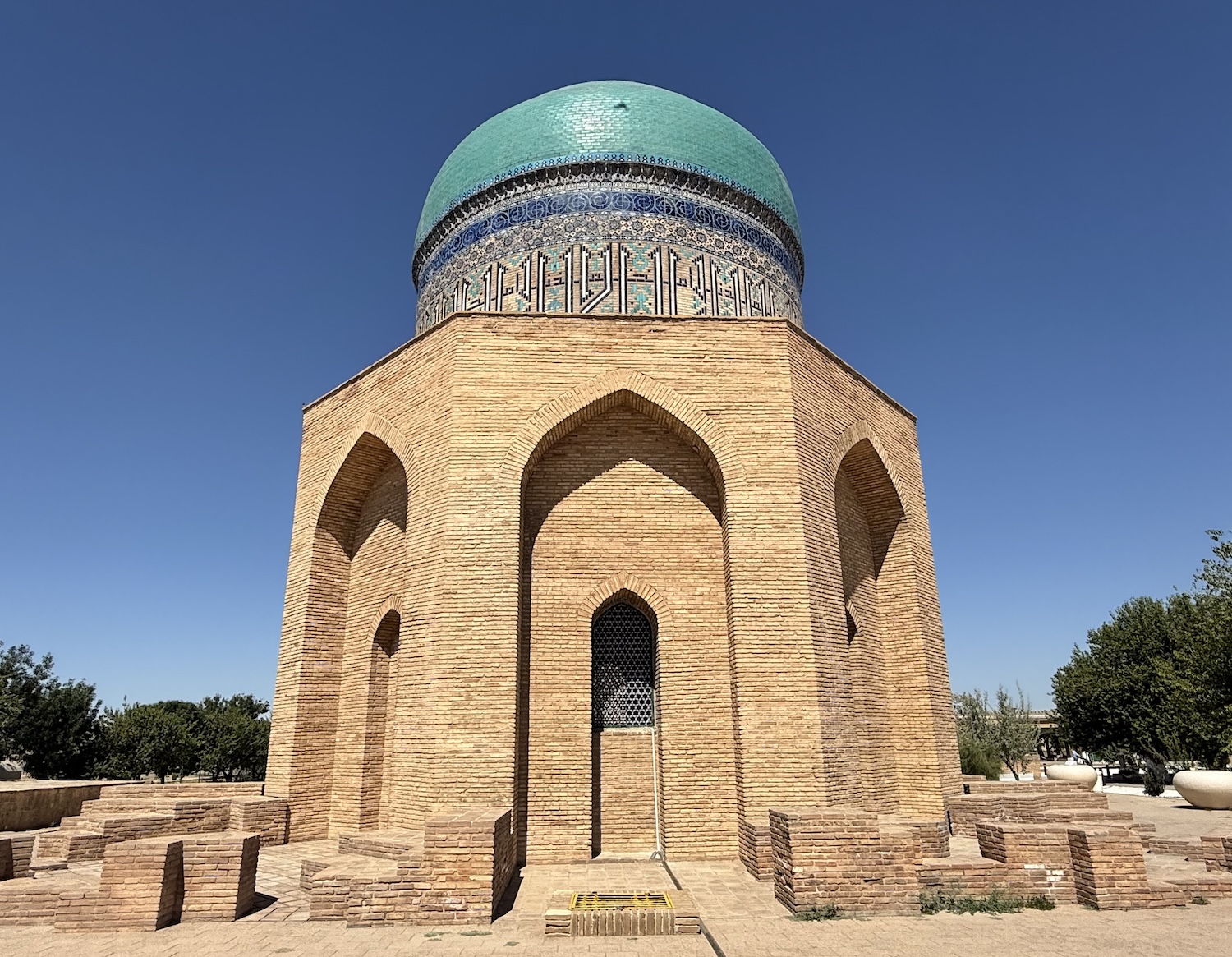
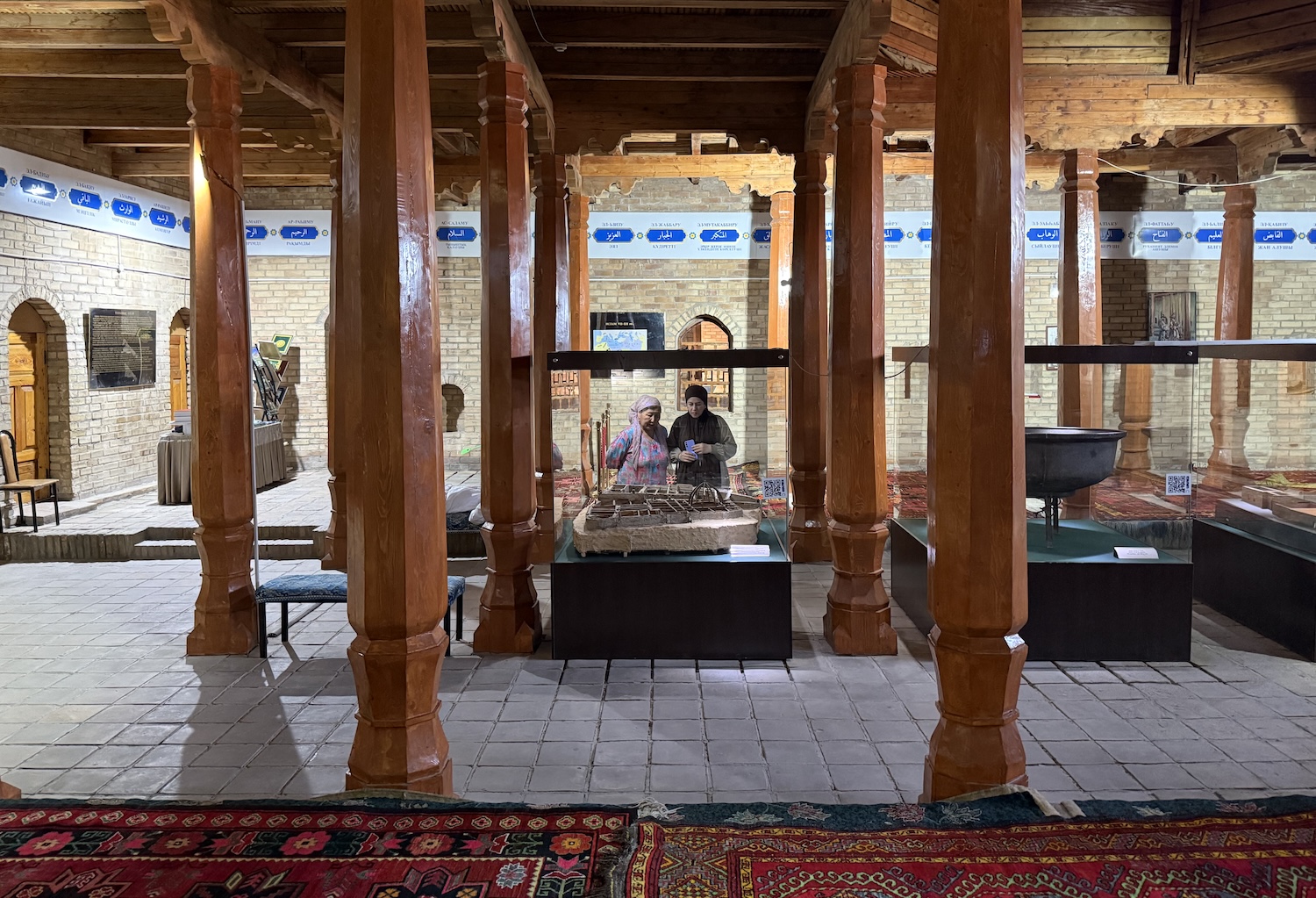
There are two other celebrated sites here. The Juma Mesit, or Friday Mosque, is a simple shrine. It is next to the Hyluet semi-underground mosque, which was constructed in the twelfth century around the tiny cave where Yasawi is said to have spent the final years of his life.
In attempt to attract tourists with a brash development considered Dubai-style, the local tourist authority has recently added the dreadful Karavansaray theme park and retail complex, aimed at day-trippers from Tashkent, Bishkek and Almaty. For those of us staying over, the place to sleep is another Rixos.
Sauran
About 50km northwest of Turkistan is Sauran, another former Silk Road metropolis. Although this too lies in ruins, it is in much better condition than Otyrar and is in fact considered the best kept Medieval caravanserai in the whole of Kazakhstan. Yet it is so rarely visited there is not even a ticket office.
It is up the M32 highway, with a turnoff at Chernak, then another 10km after the sign to the new town of Sauran. You can see the walls about 2km from the road. If you use inDrive or take a taxi, tell them you want to go to Krepost Sauran so they understand you want the ancient settlement.
This was constructed as early as the tenth century and was one of the few caravanserais to survive the Mongol invasion of the 1200s before it was adopted as the capital of the Mongol White Horde Khanate in the fourteenth century. It later became a military garrison under Timur. It was finally abandoned in the eighteenth century when the Syr Darya River changed course and Turkistan rose in prominence, shifting regional trade routes.
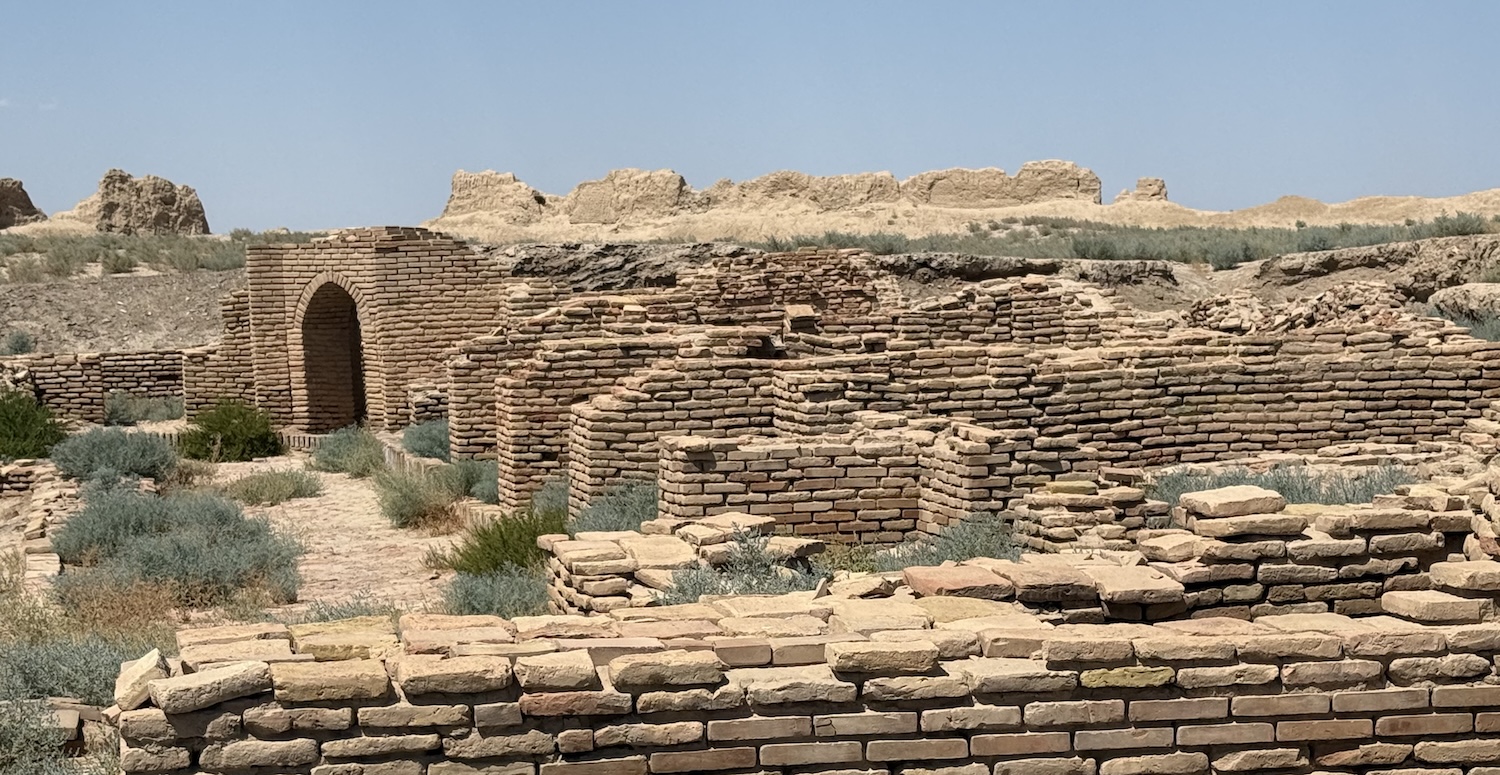
The perimeter fortress walls are largely still identifiable, if crumbling, and only occasional towers and the main gate have been restored. In the centre there is mostly scrubby desert with mounds covering whatever ruins are underneath, and it is easy to see fragments of ancient pottery glinting in the sand. There is a section – partly but more sympathetically rebuilt – of the madrassa, mosque and khanqah, a spiritual retreat for travelling Sufi mystics.
Aral Sea
Kazakhstan has almost 50,000 bodies of water and one of them, the Aral Sea, was historically the third largest lake in the world. However, in the early 1960s, the Soviet Union built dams to irrigate its expanding cotton fields that diverted so much water from two feeder rivers – the Amu Darya and the Syr Darya – that the Aral Sea shrank to 10% of its size, splitting into four smaller pools of water. A visit here, therefore, bears witness to one of the greatest ecological disasters of our times.
The entry point to explore the north part of the Aral Sea – much of the southern portions are in Uzbekistan – is the town of Aral, 750km west of Turkistan. There are no scheduled airline flights so realistically the only way to get here is by train. Luckily, the railway service is extremely reliable. Our train had already set off from Almaty fourteen hours earlier, and after another fourteen-hour slog from Turkistan we arrived into Aralskoye station bang on time.
Kazakhstan Railway is the country’s largest employer with 150,000 workers servicing 16,000km of largely remote track. There is no two-bed First Class on this route, so we booked all four bunks in a Second Class cabin to create privacy. Sharing this small space with a Kazakh family with screaming children and no English in the hope of learning from them about their country is for the birds. It is much better to nest comfortably while hypnotically watching the endlessly unchanging flat plain gradually become a few shades browner as we head west. Incidentally, there is a decent restaurant car, and although that does sell alcohol, drinking in the cabins is banned so you will need to smuggle in your own vodka for that. We appeared to be the only Westerners on our train, which seemed to be about 2km long, and found the excellent AC and the rhythmic sounds of the track bumps more than offset the juddering halts whenever we came into a station.
After ten hours or so, the train stops at Baikonur, an enclave leased to Russia in 1991 until 2050, where they spend Rubles and require special security clearance to enter. That is because this is the Cosmodrome from where Yuri Gagarin became the first human in outer space, Sputnik was launched, and Russia continues to send all its crewed commercial and military spaceflights. It is possible to take tours with the Public Service Centre, though they were closed to foreigners when we were here because of Putin’s damned invasion of Ukraine.
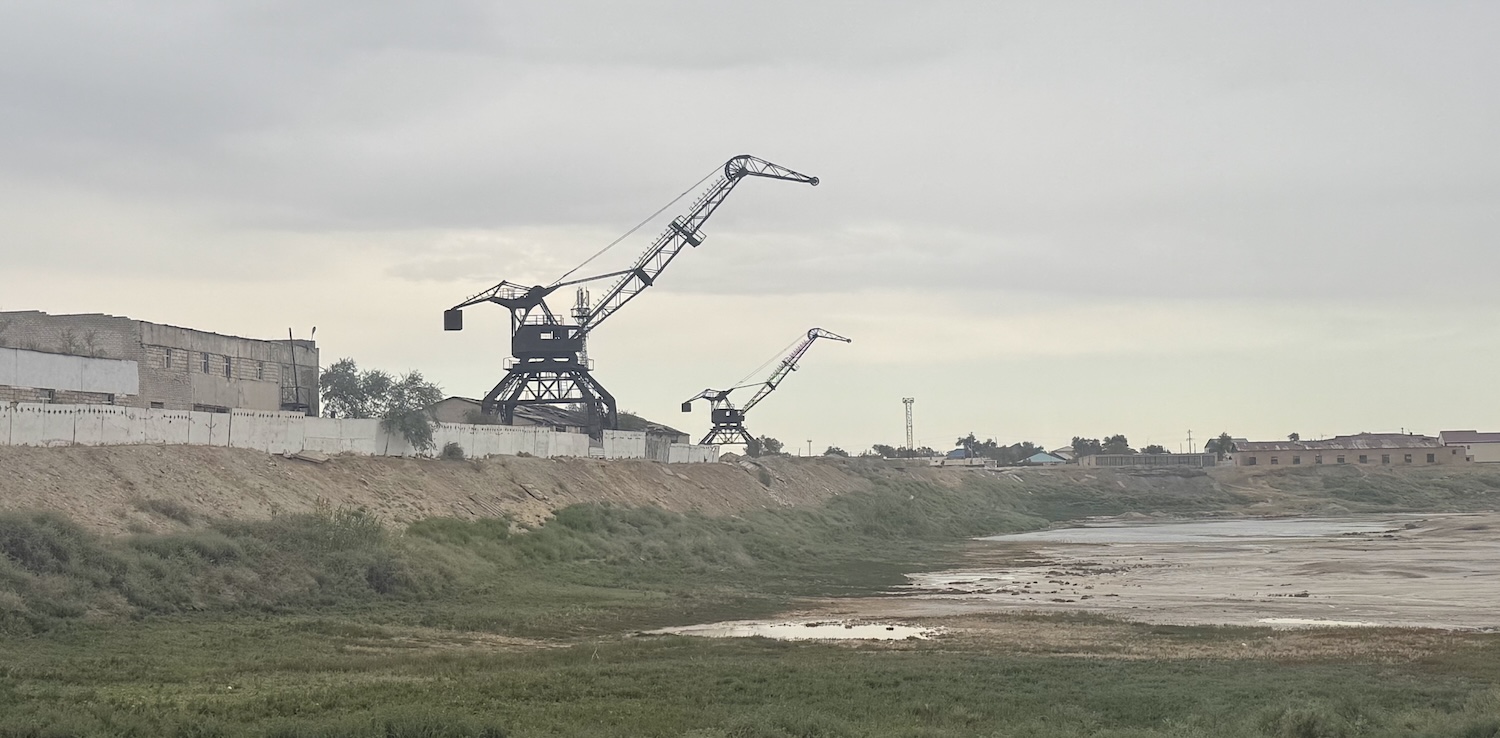
The town of Aral, about 200km on, at the east end of the old Aral Sea, was once a flourishing dockyard and the heart of the regional fishing economy. As the water level fell, however, the shoreline retreated more than 15km from here, so all that remains of the former seafront are two cranes and a sad little Geopark with a museum of its olden glory days, a Monument to Fishermen of yore, and a plaque inscribed with this heartbreaking appeal:
Hey, child of the Aral
Hey, child of the sea
If only you could see the sea lying parched and dying
Go back to the land where your umbilical cord was buried
And, with a prayer in your heart, pour a drop of water there
It is impossible to explore independently the former seabed, basically scrubby salt pans still littered with seashells, as there are few roads and few signs. You need a guide with a 4×4, and there are several operators offering one-day tours. We found the superb Serik Duisenbaev (+7 701 662 7163), who speaks perfect English, is great company and knows everything there is to know about the Aral Sea, through Indy Guide.
We set off on a 300km round trip to see the beautiful sandstone cliffs and dusty plains, populated by one- and two-hump camels, saiga antelopes and steppe eagles, which stretch down to the current shoreline. The complete panorama is from the Qarasandyq Plateau.
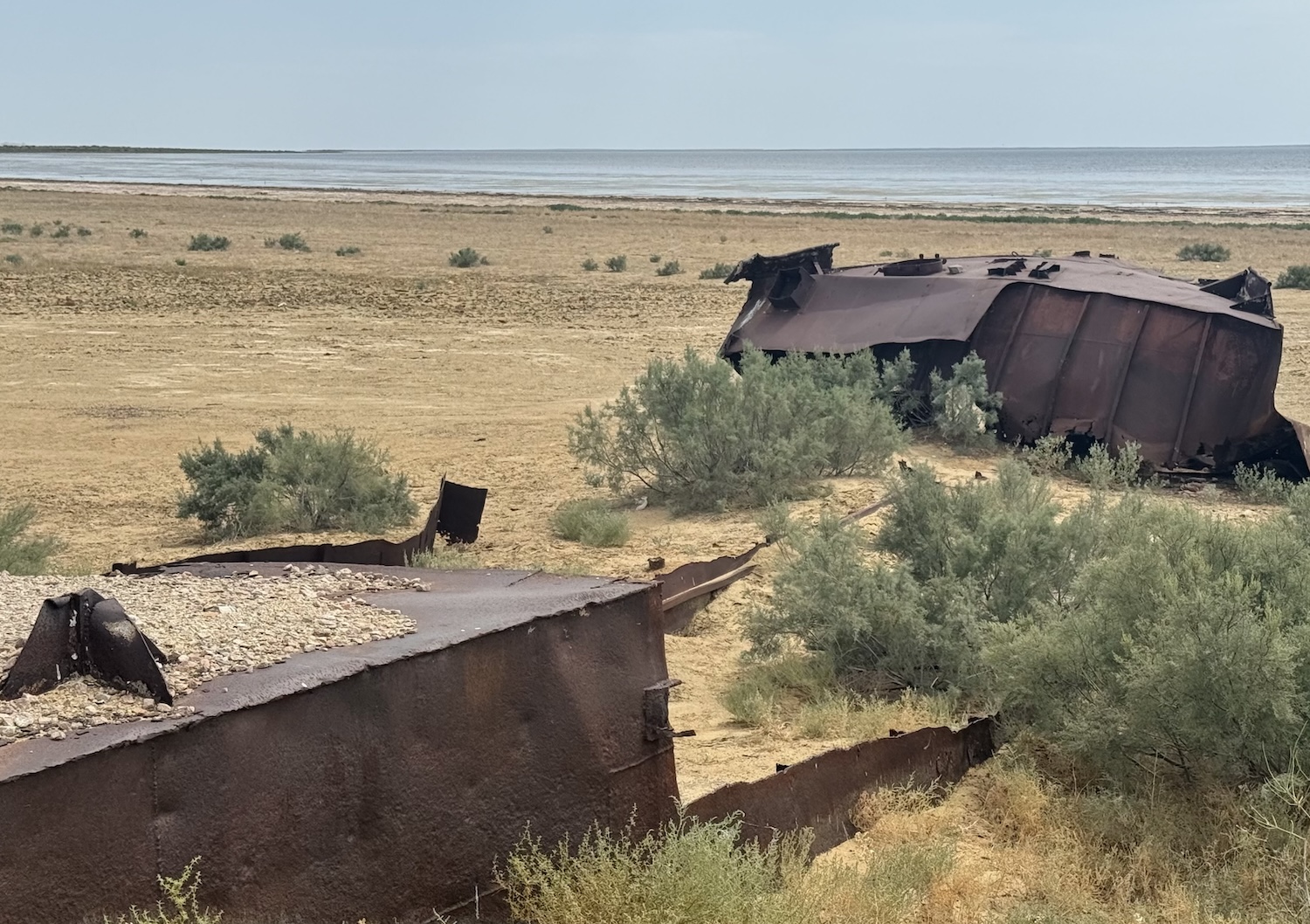
The ship graveyards, where vast vessels were left sinking into the sand as the water drained away, have almost all been cleared by scavenging locals desperate for money from the scrap metal. Only one remains now, at Butakov Bay, though it has also mostly been dismantled.
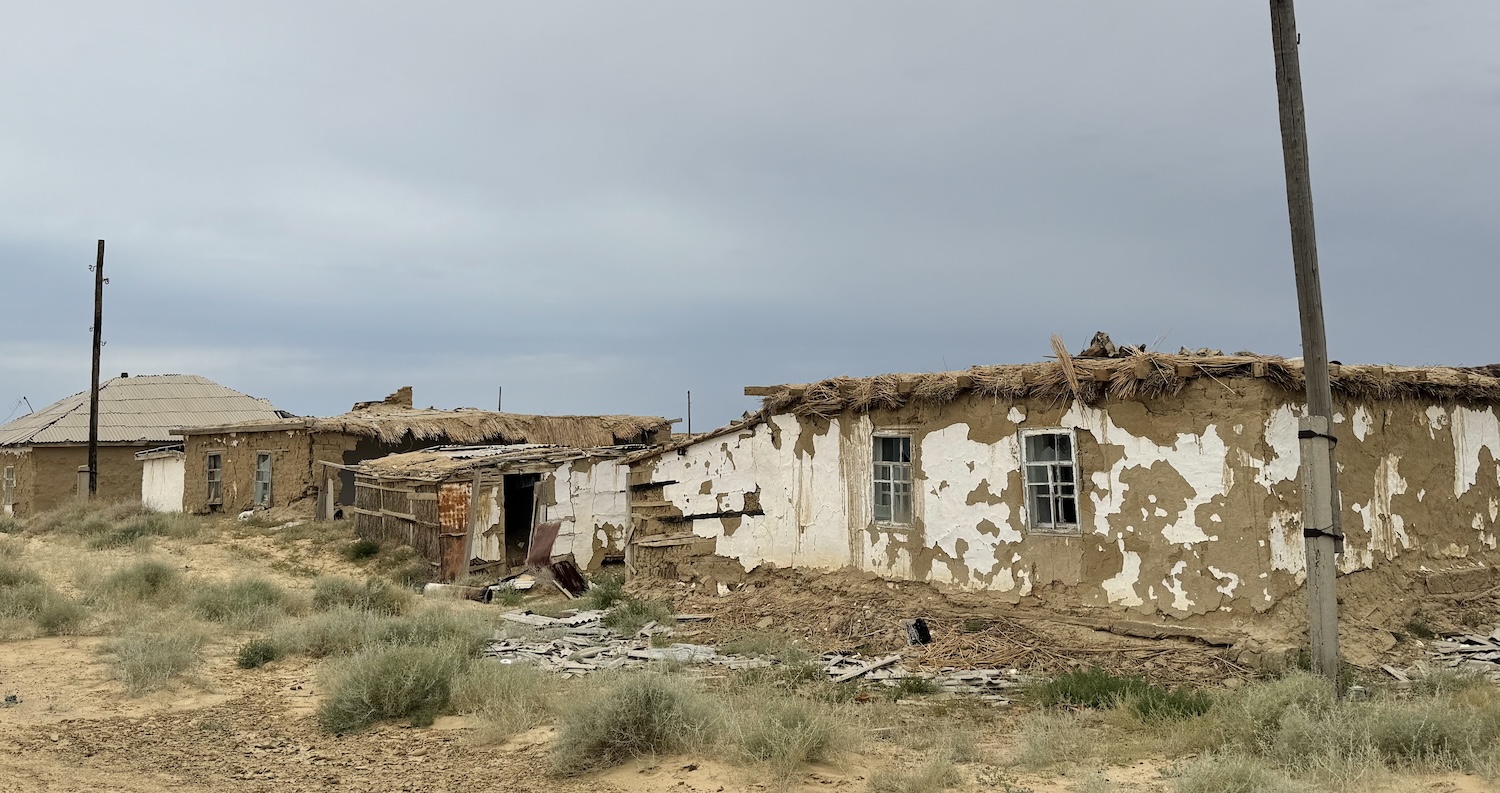
Akespe is a devastating example of a once thriving fishing village of a hundred families that was abandoned in the 1980s. As the sea retreated, the settlement drowned in sands blown from the exposed seabed.
In 2005, the Kazakhs built the 12km-long Kokaral Dam across the Berg Strait, 100km southwest of Aral. Their aim is to reduce the amount of water leaking away, and while it is too soon to be certain, there does appear to be some hope at last, at least for the north part of the Aral Sea. Time will tell.
The poverty of Aral is evident, not least with a sudden increase in visible ancient Lada cars, and also because there are not many hotel options (though the Araltuz is quite alright). I also strongly recommend the shashlik in the Loft, a funky place near the Geopark.
Aktau
Although there is an airport in Aktau, the main town of 400,000 people on the Caspian Sea in the far west of Kazakhstan, if you are coming from the Aral Sea as we were, then you have to take the one and only train that runs every day. It is a ride of twenty-two hours across 1,800km of the same unchanging barren steppe. Once again, it arrived smack on time, having come all the way from Almaty, 3,400km away, starting fifty-four hours earlier.
Aktau is rather tatty and bleak, a dreary seaside resort popular among Kazakhs for summer breaks. There is a 5km-long promenade that starts by the Holiday Inn, then goes past a series of abandoned building skeletons as well as a row of cool bars between L’amore and New Asian that have tables on decks facing the sea. For the final 1.5km it becomes the Rock Trail, a wooden boardwalk that goes around the white cliffs that give the city its name. The Melovoy Lighthouse, a curiosity perched atop an eleven-storey residential building, is just above. On the other side of the promontory is the Rixos.
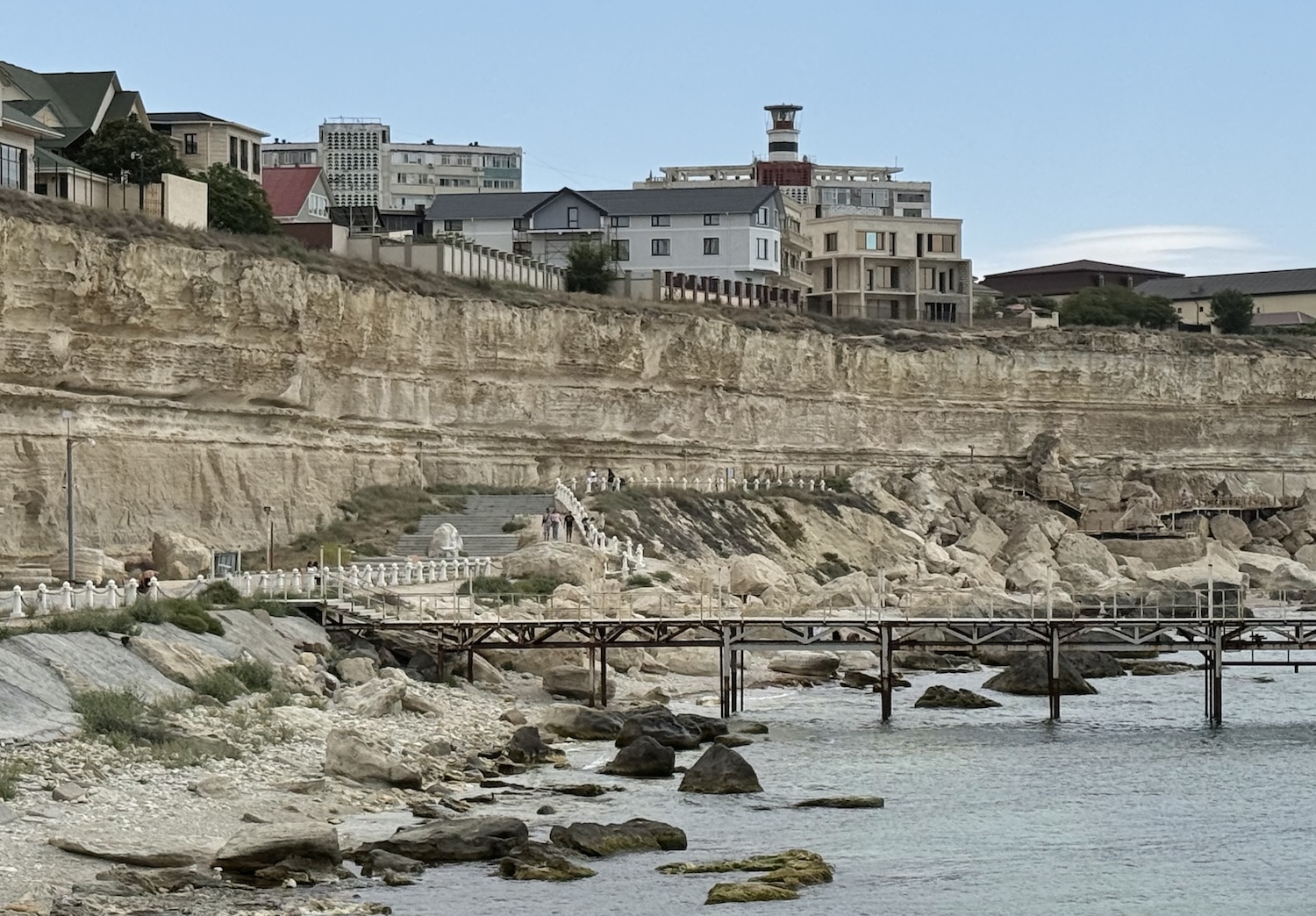
Although nomads passed through here for thousands of years, they did not settle because there is no natural source of drinking water. The modern city, which has a desalination plant, was a creation of the USSR in 1956, initially as a centre for uranium extraction, before becoming the capital of the local oil and gas industries.
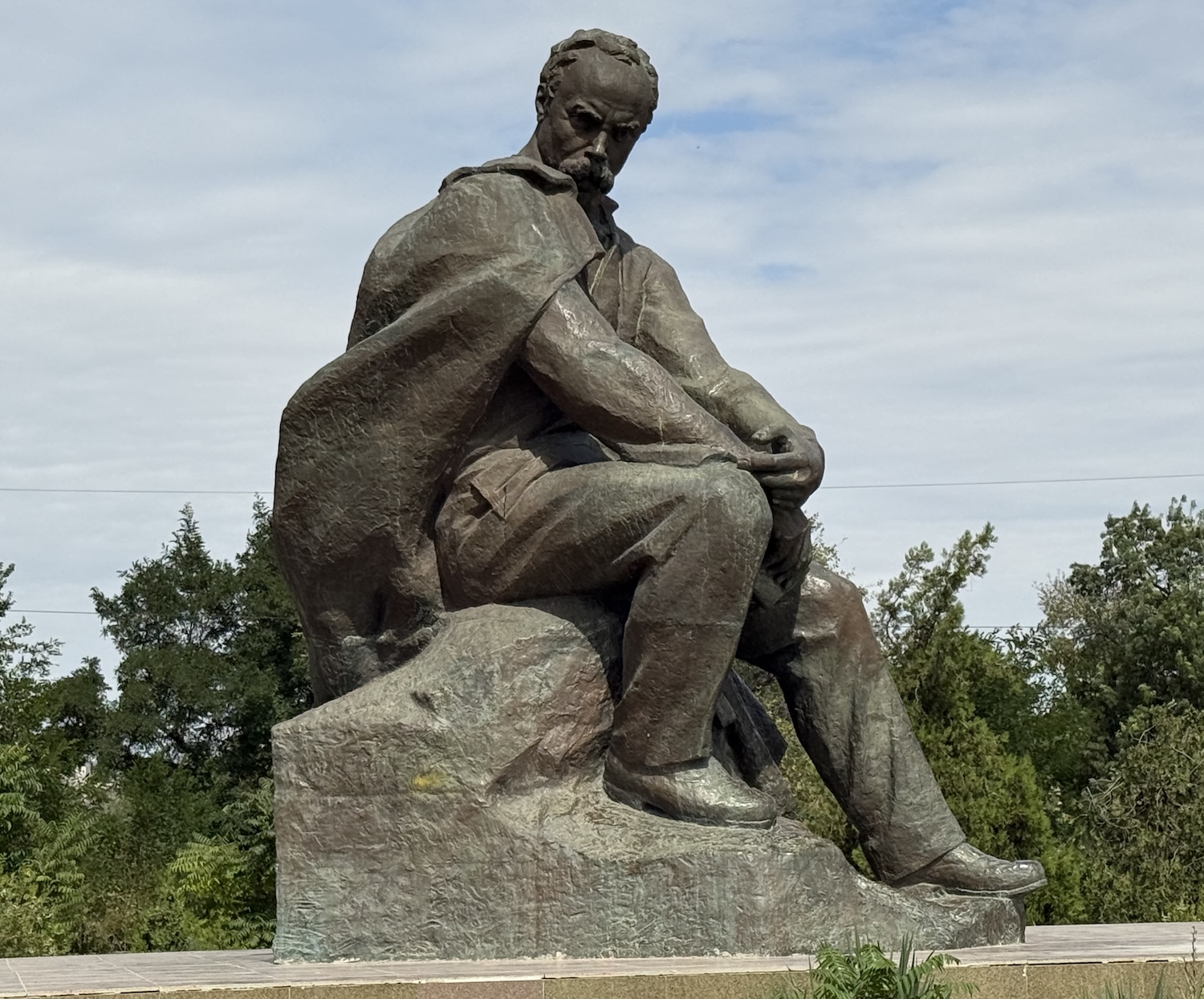
From 1964 to 1991, the city was called Shevchenko, after Taras, the Ukrainian national hero, poet and painter, who lived near here in exile in the 1850s.
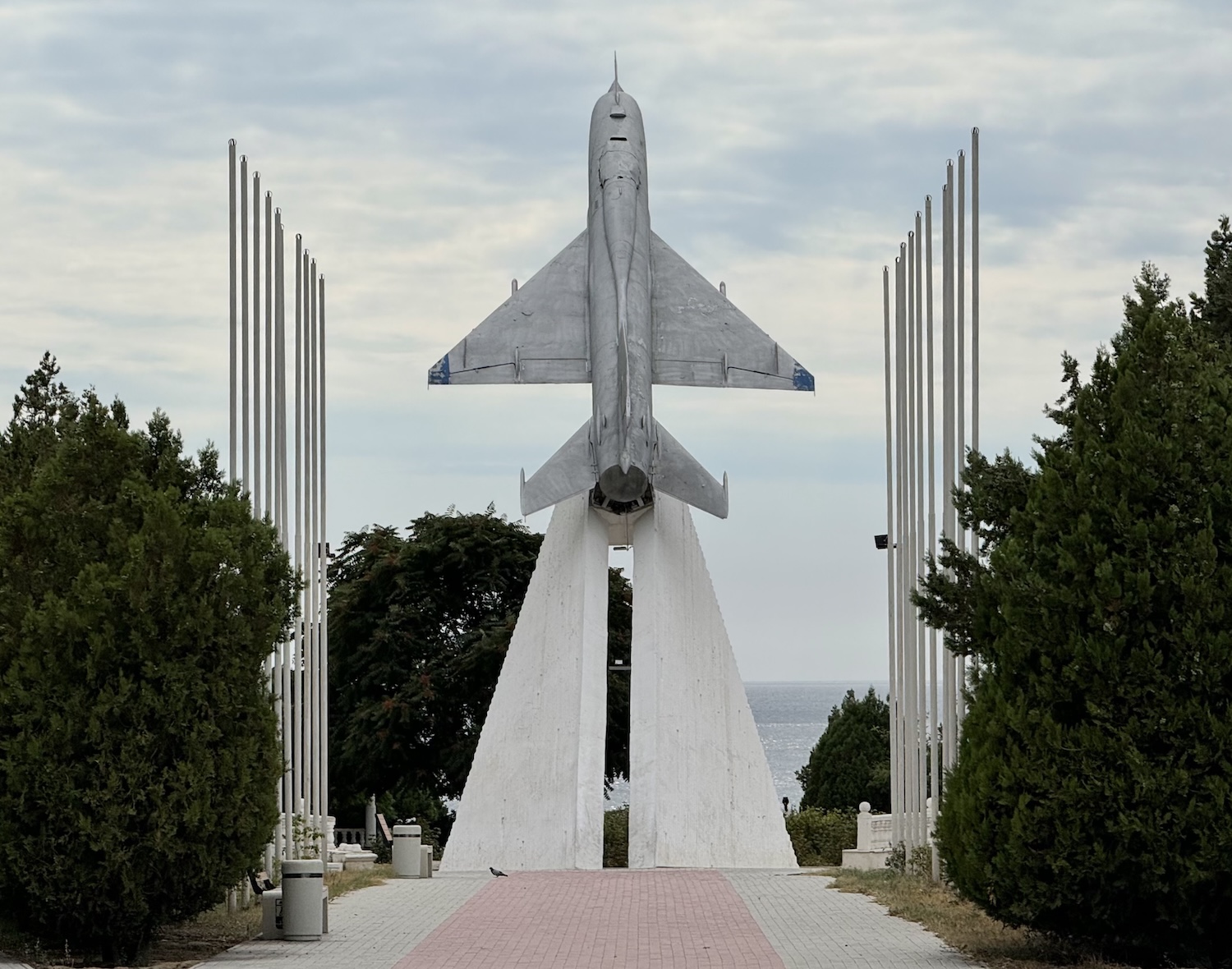
In Victory Square, a pathway through a park, there are several notable monuments. At one end is a MiG-21 airplane.
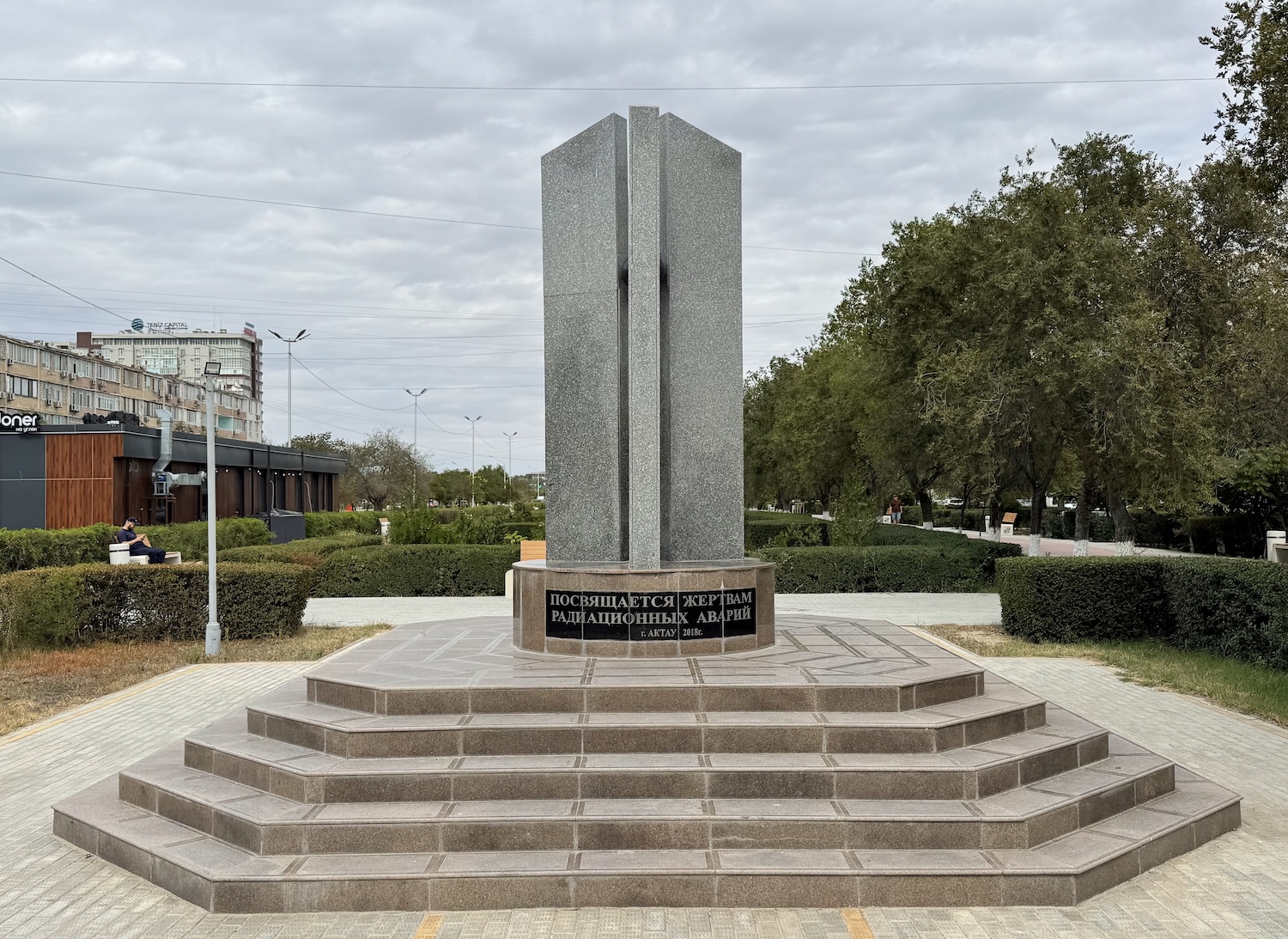
Then there is a Monument to Victims of Radiation Accidents and Catastrophes. This 3m-tall memorial honours local victims of Soviet-era atomic and radiation disasters, including Chernobyl.
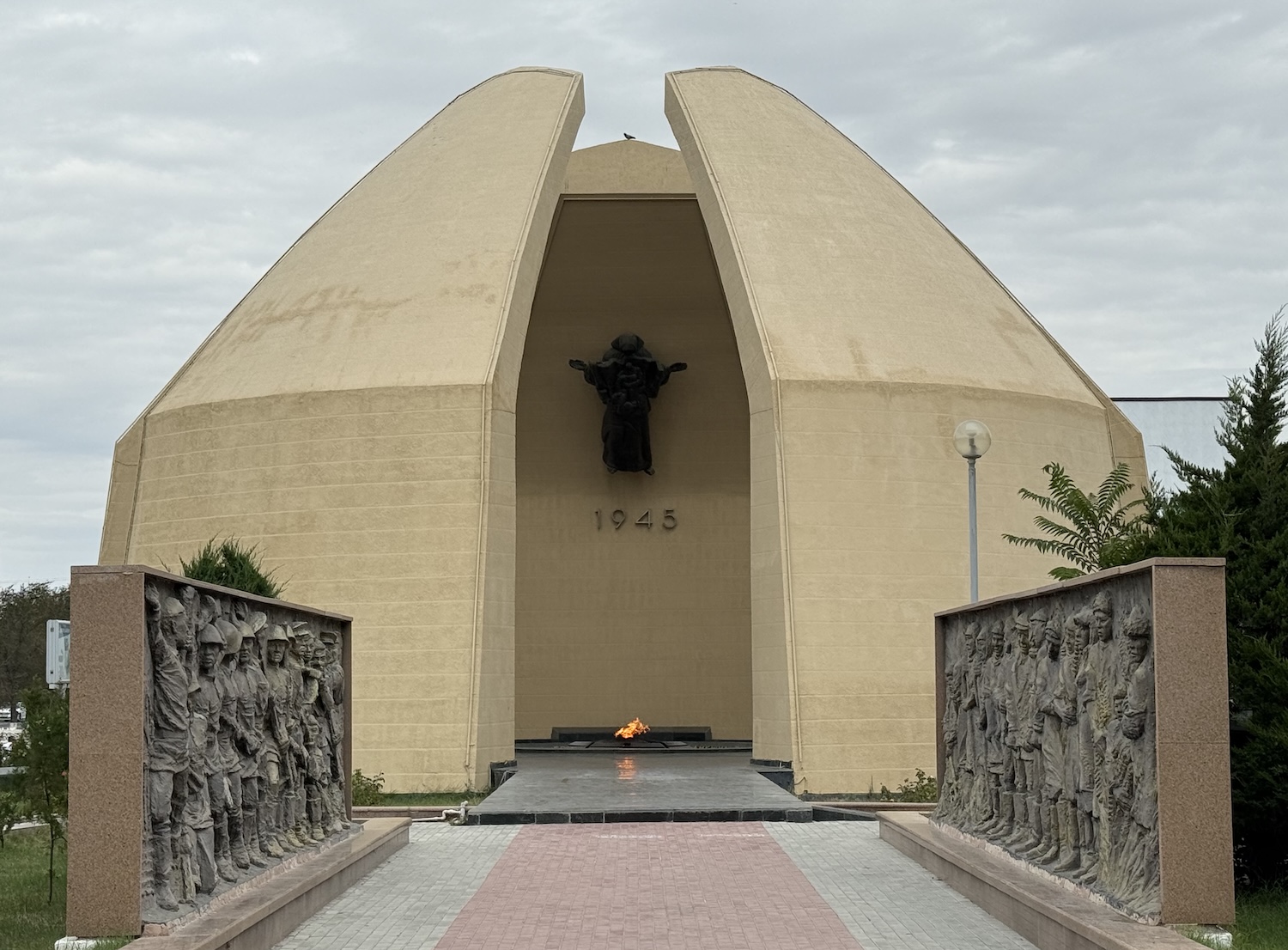
Then there is an Eternal Flame, done nicely.
Aktau is also known for its gigantic murals on the ends of housing estates. There are some to Islamic leaders and others to female soldiers.
Mangystau Desert
The reason we came to Aktau has nothing to do with the Caspian Sea or its minor history; we came because it is the gateway to the astonishing Mangystau desert region, just inland, which is the highlight of Kazakhstan.
It is possible to stay in Aktau and take a series of day trips, but there are so many things to see across such a vast area that I recommend spending a few nights in the steppe. Sadly, there are not even basic never mind luxury hotels here, but sleeping in your own tent under the stars really is the way to appreciate this wilderness.
There are a few asphalt highways, but all the sites are all off-road and unmarked so the only way to explore them is with a guide and a 4×4. We booked with Samaria Travel, which organises expeditions lasting between three and eight days. They helped us sculpt a bespoke itinerary, and Jack (our driver/chef) and Nurs (our English-speaking guide/photographer) could not have been more informative or better company.
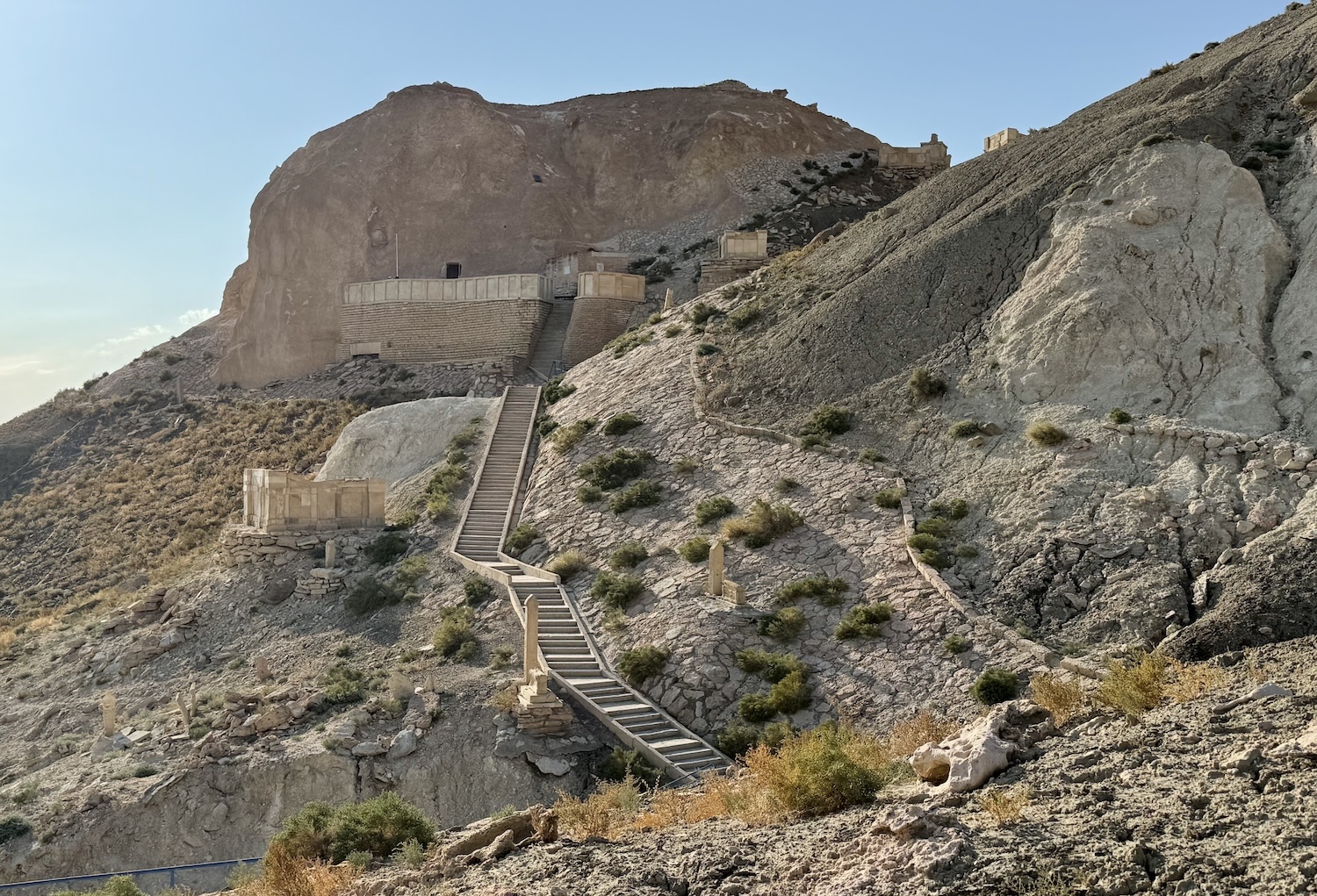
Mangystau is known as the “Land of 362 Saints”, which is the number of its sacred burial grounds. There are as many as thirty semi-underground mosques cut into the calcareous rocks to keep them cool, as well as fifty or so more above ground, devoted to religious scholars who led the Sufi indoctrination of Islam in the Middle Ages.
Five of these have been inscribed on the list as UNESCO World Heritage Sites, those of Sultan-Epe, Shakpak-Ata, Karaman-Ata, Shopan-Ata and, most significant of all, the Mausoleum of Beket-Ata. Some date to the twelfth century but Beket-Ata was an eighteenth-century Sufi master who is known as the Last Preacher. To reach this major pilgrimage site, where you will be invited to sit on the floor and join in a prayer, it is a 1.5km walk down the cliffside steps to reach a little oasis at the start of the valley.
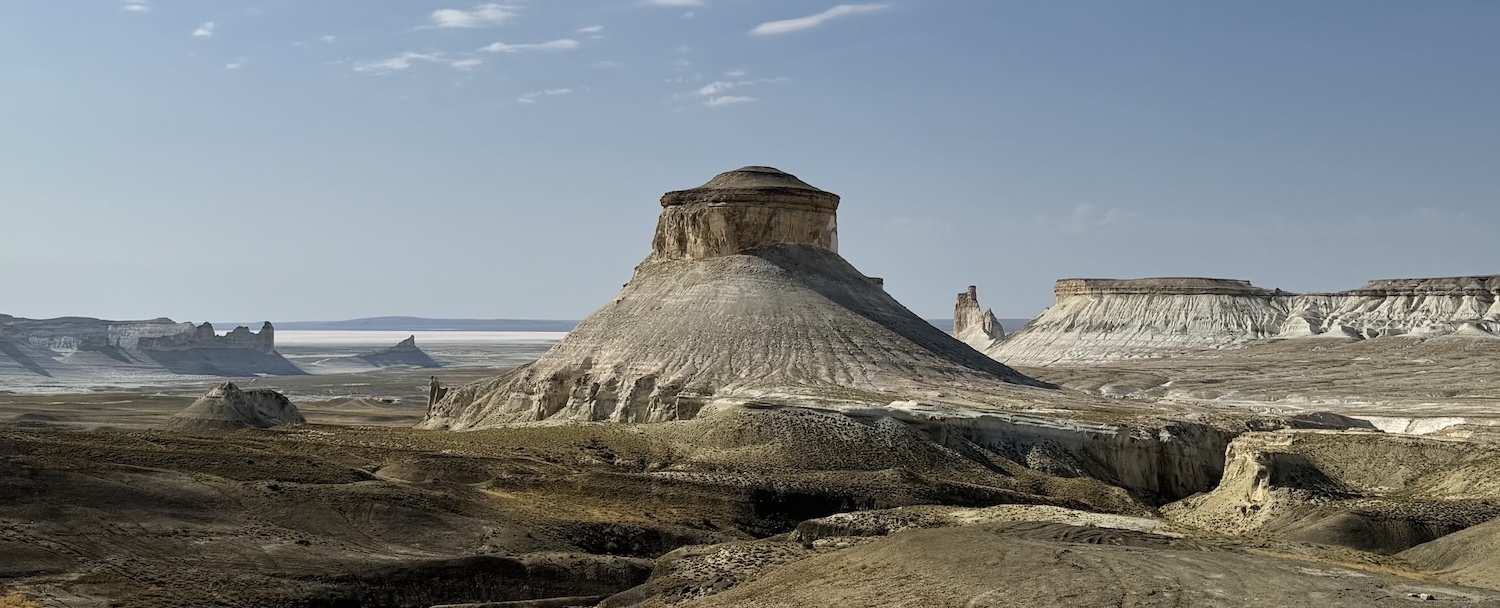
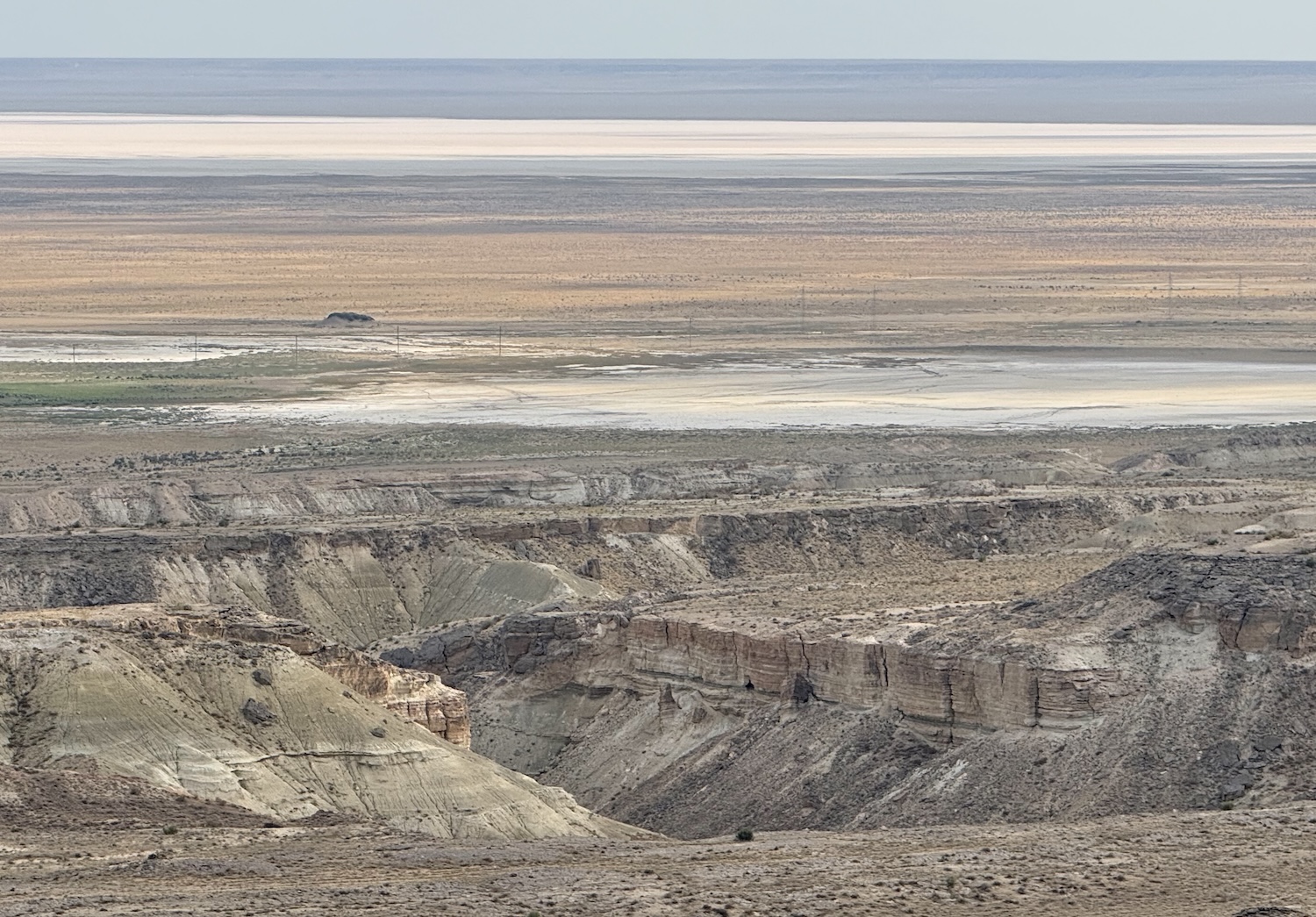
In addition to these isolated religious sites, the principal delight of Mangystau is its seemingly endless weird and wonderful geography. About 50m years ago, this area was submerged under the prehistoric Tethys Ocean, when layers of soft clay and chalk built up on the seabed. When the water receded, the exposed limestone hardened into arid desert that was then sculpted by harsh heat and strong winds into dramatic canyons and valleys. Now, it feels like every ten or twenty kilometres there is another unusual rock formation in a topographical playground for us to explore.
For instance, about 50km east of Aktau is the lowest point in Asia, 132m below sea level, known as the Karakia Depression.
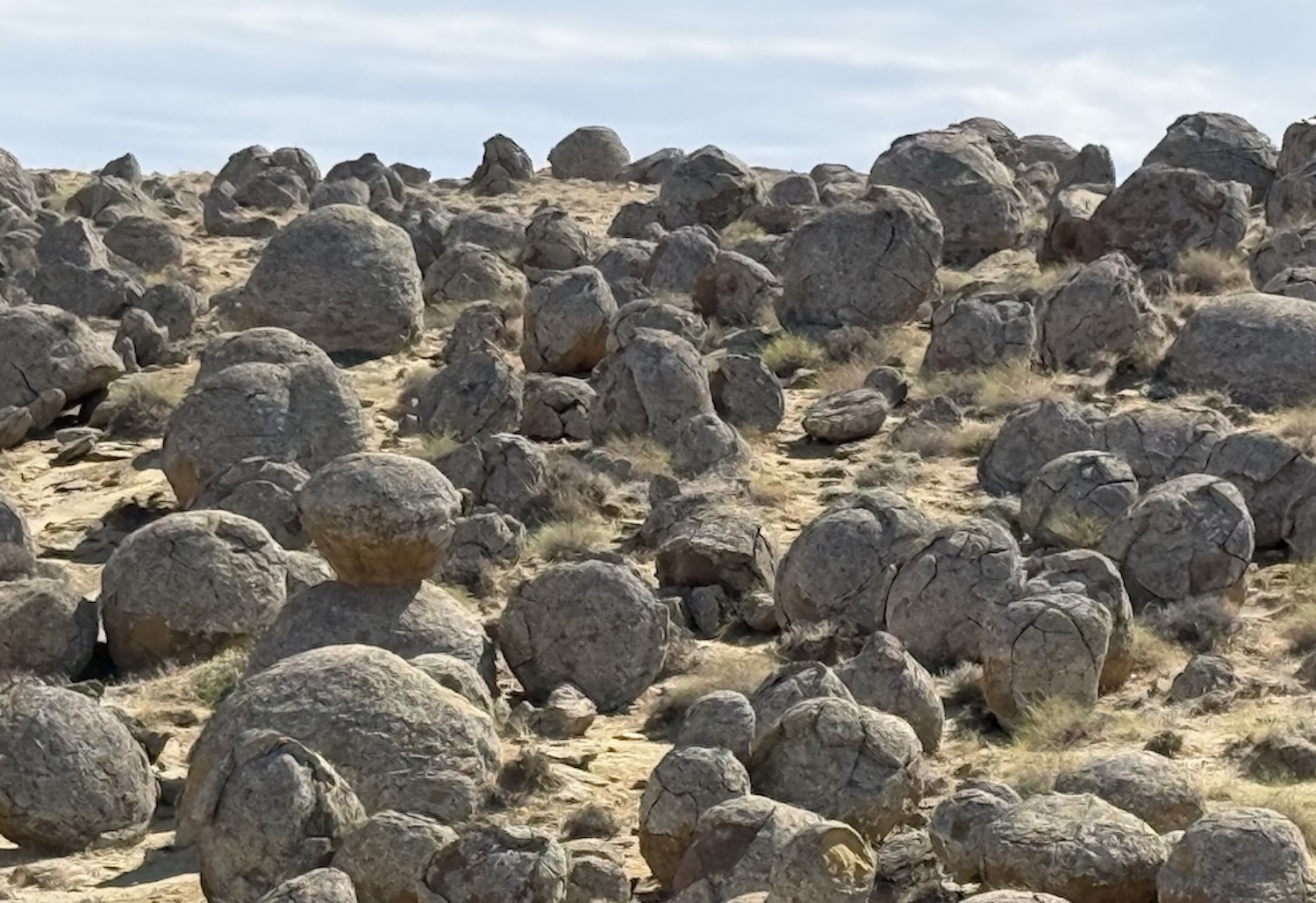
There are several oddities, such as the Torysh Balls, thousands of naturally occurring, giant spherical stones on the hillside, like massive versions of the camel dung scattered all around. They were formed through concretion, when minerals in the ancient ocean slowly attached to a microscopic core, such as a shell or fossil.
There are many examples of extraordinary geological processes in the northern sector of the desert, including the Kokala Canyon, Sherkala Mountain, and Airakty Valley of Castles, which is the ideal spot for our first night’s camp.
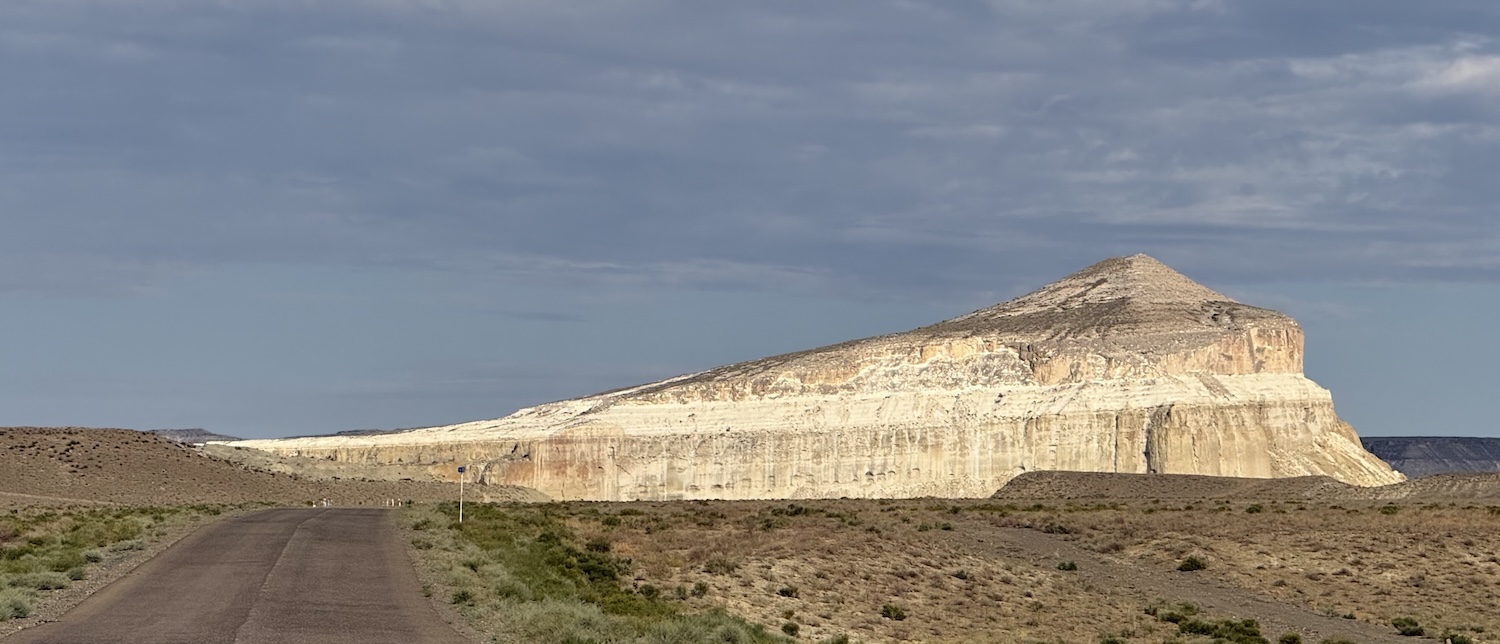
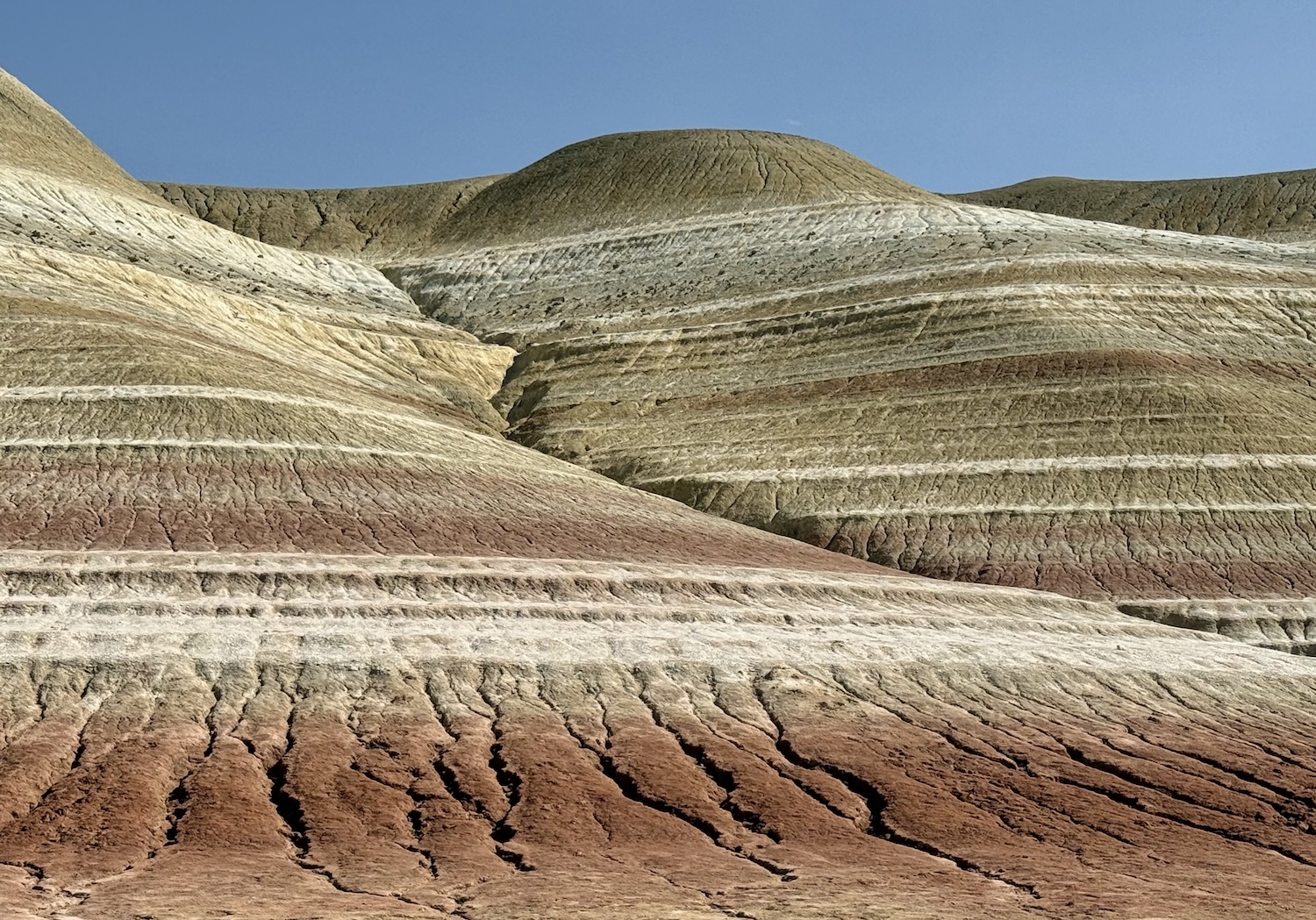
The most mind-blowing landscapes are in the southern section. Take, for instance, Kyzylkup Canyon, nicknamed Tiramisu because its stripes of white, pink, crimson and brown rock, coloured by mineral impurities, make it look like the cake.
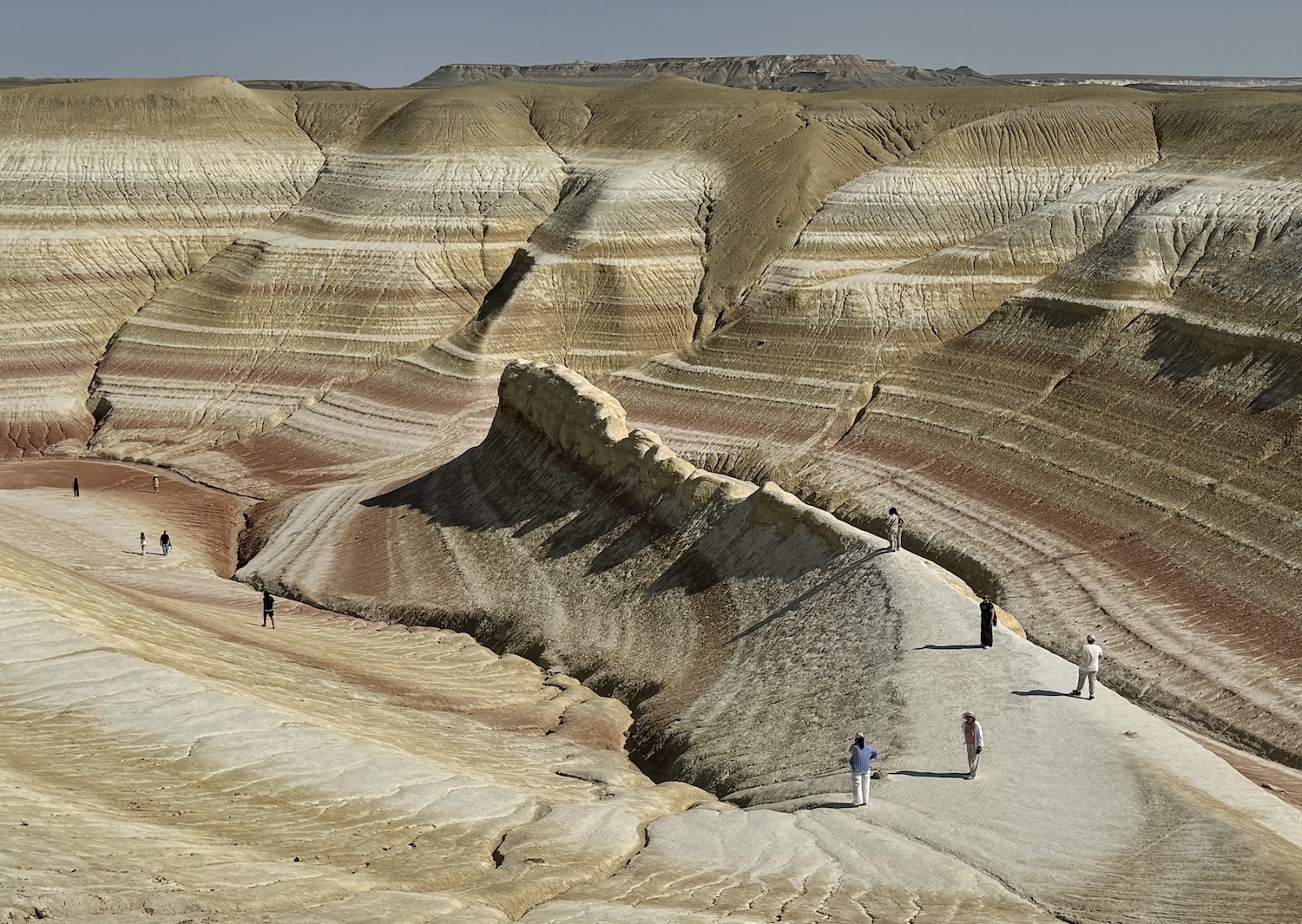
Nearby, in the same patterns, is Bokty Mountain, just 165m tall. This is so iconic its picture is on 1,000 Tenge notes.
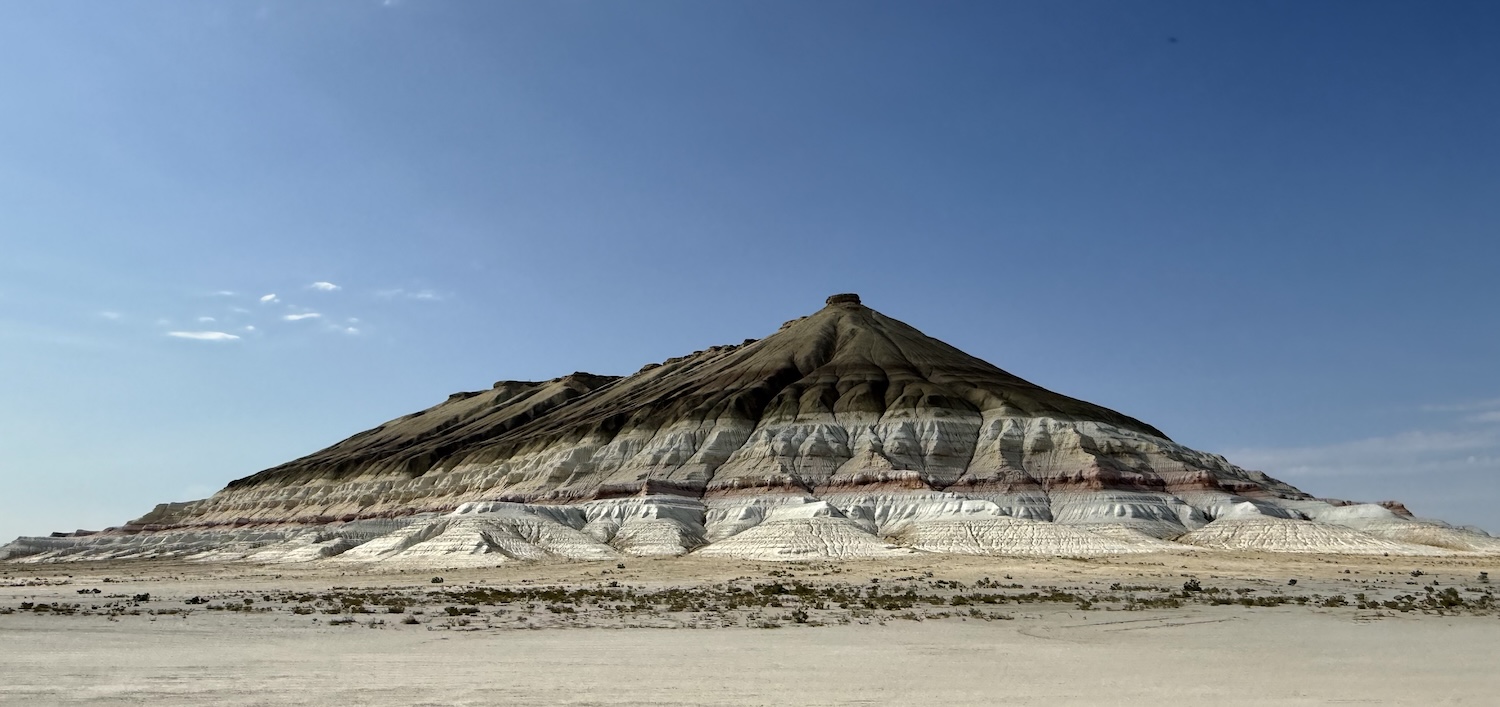
The absolute standout is Bozzhyra Canyon, an expansive moonscape of stark white chalk cliff walls surrounding towering spires and jagged ridges. It is so big it takes a full day to explore. Its emblem is a huge pair of fangs at the entrance to one vast tract, which are also on 1,000 Tenge notes. They make a stunning backdrop to our second night’s sleep in the open air.
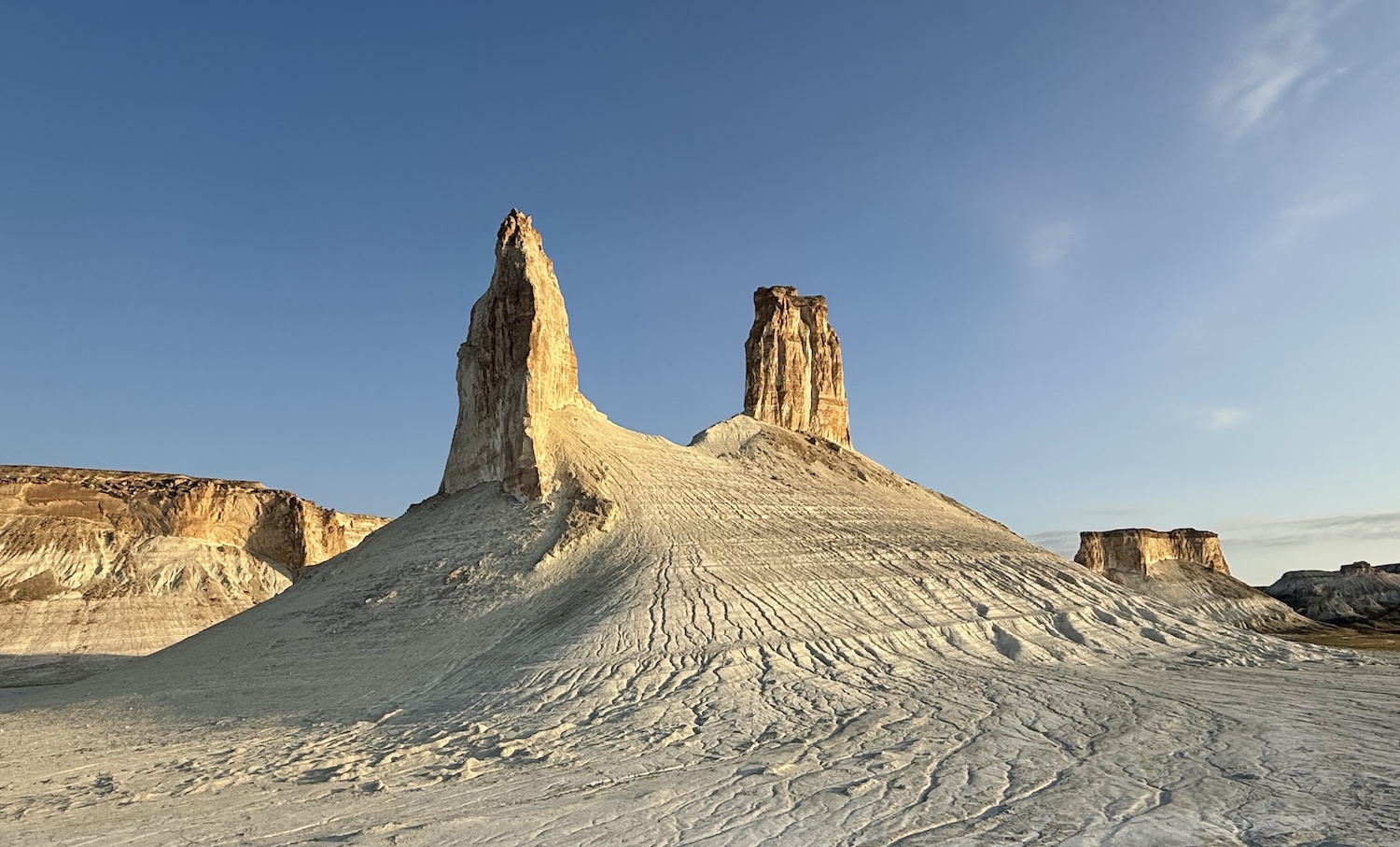
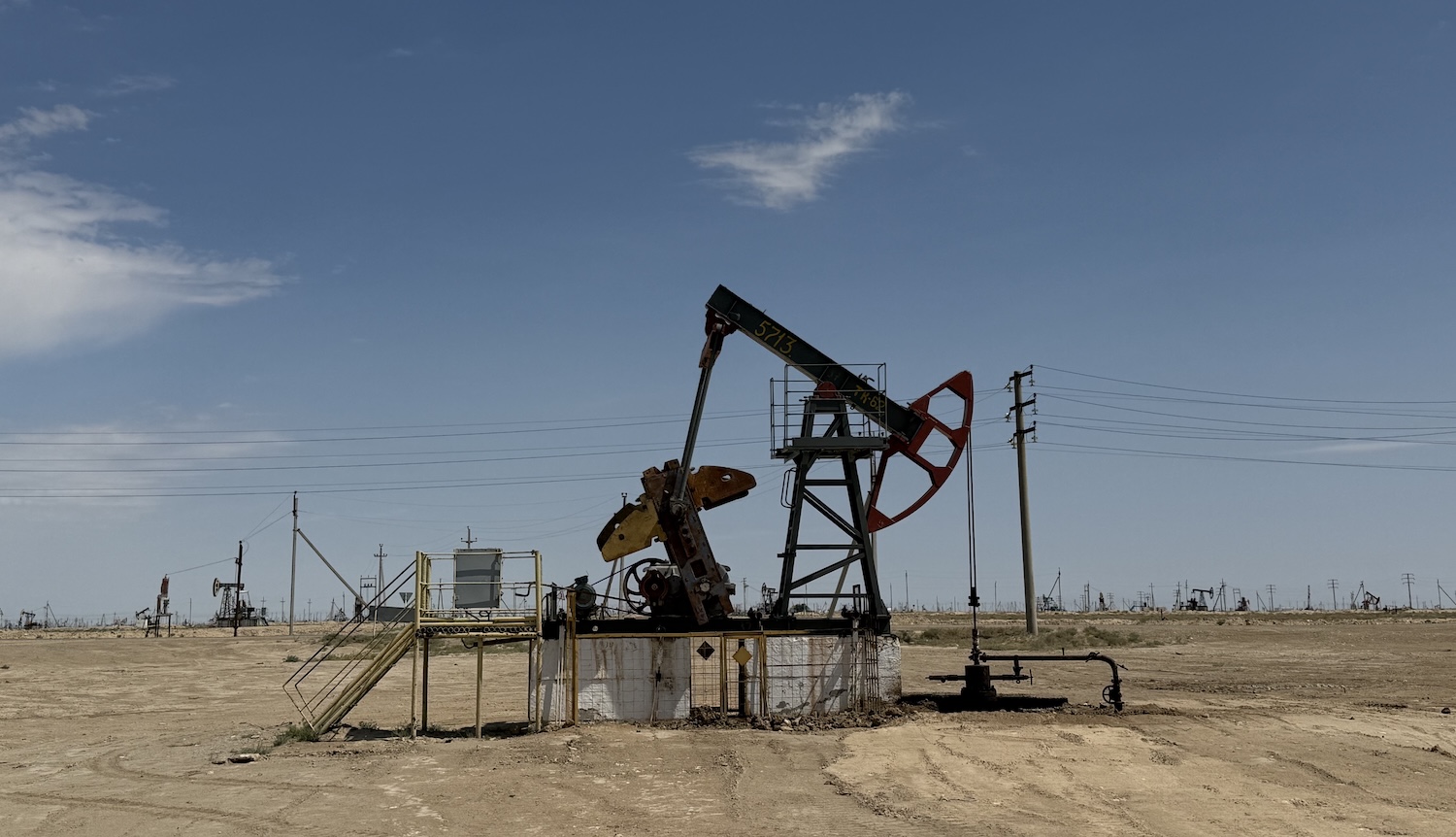
Amid all of this breath-taking scenery, 150km southeast of Aktau, is Zhanaozen. This town houses the 150,000 workers and their families who toil at the hundreds of little oil pumps working away 24/7. Perhaps because they are so emblematic of the disparities in income and wealth in Kazakhstan, Zhanaozen is also where the protests erupted in 2022 that finally got rid of President Nursultan Nazarbayev.
Astana
Though much smaller than Almaty, with a population of just 1.6m, Astana – which translates literally as “capital city” – has been the home of the government of Kazakhstan since 1997. That is when Nazarbayev’s vanity project opened its doors, a showpiece of urban planning designed to display the wealth and power of his country, and, frankly, also of himself.
So much so that in 2019, when he took the title Leader of the Nation, his puppet successor as president, Kassym-Jomart Tokayev, renamed the city Nur-Sultan. Though it was changed back again to Astana in 2022 once Nazarbayev was forced out, his name and image are omnipotent here.
Astana has been built in the middle of nowhere, and today cranes are everywhere expanding the city limits further into the endless steppe, beyond the airport 15km south of downtown. Temperatures can oscillate from 40°C in the summer to -40°C in the winter. Over our three days here in August, the weather was extremely changeable, dark and rainy for twenty minutes, clearing into blue sky for twenty minutes, and then closing over with thick black clouds for the next twenty, all with accompanying falls and rises in temperature.
Before we came, I saw the internet yapping about alleged wacky buildings and apparent lifelessness on the streets, so we arrived expecting a sort of freak show. Notwithstanding the constant homages to Nazarbayev, we found little of the sort. There are plenty of people visibly living normal lives, and while there are some creative buildings for sure, perhaps the internet has not been to Ashgabat never mind Pyongyang, or even Putrajaya just round the corner, to see truly zany stuff. At a glance, Astana seems akin to many other newly minted capitals, from Brazillia to Canberra, with wide boulevards in the centre and pre-fab housing in the suburbs.
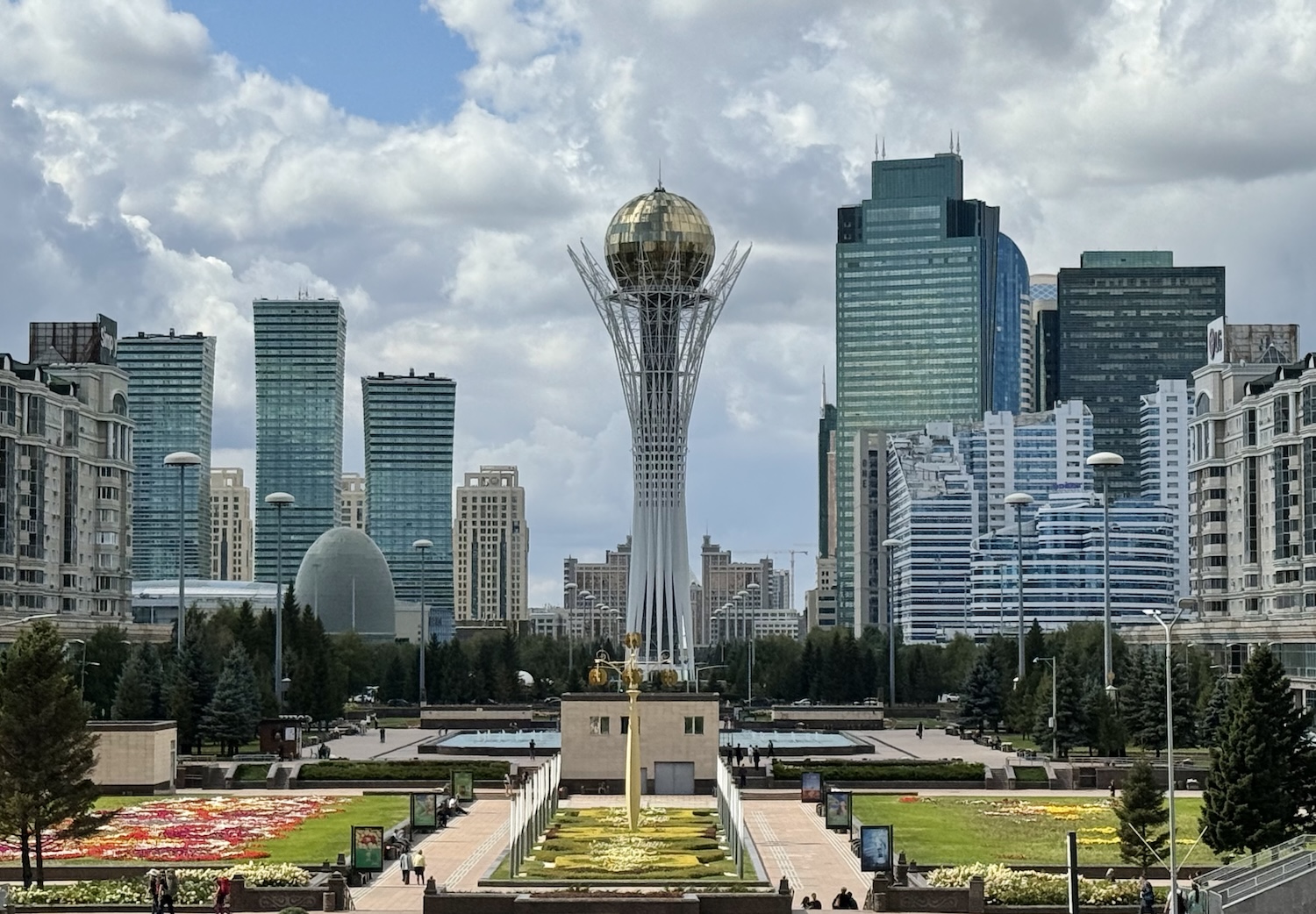
The heart of this city is Nurzhol Bulvar, a 2km-long line of gardens, fountains and plazas. In turn, its centrepiece is Baiterek Tower, the glitzy symbol of the city (which in my opinion would not look out of place in a Berlin or a Seoul). There are long queues for the lift up to the 100m-high observation deck, which is worth it for the tremendous panoramas through its tinted windows, and longer queues for the stairs up to where local people place their hand inside a golden palm print of Nazarbayev and make a wish, which you may or may not think a good idea.
At the west end of Nurzhol Bulvar is the grandiose arched joint headquarters of KazMunayGaz and KazTransOil, firms that have after all helped to pay for all this.
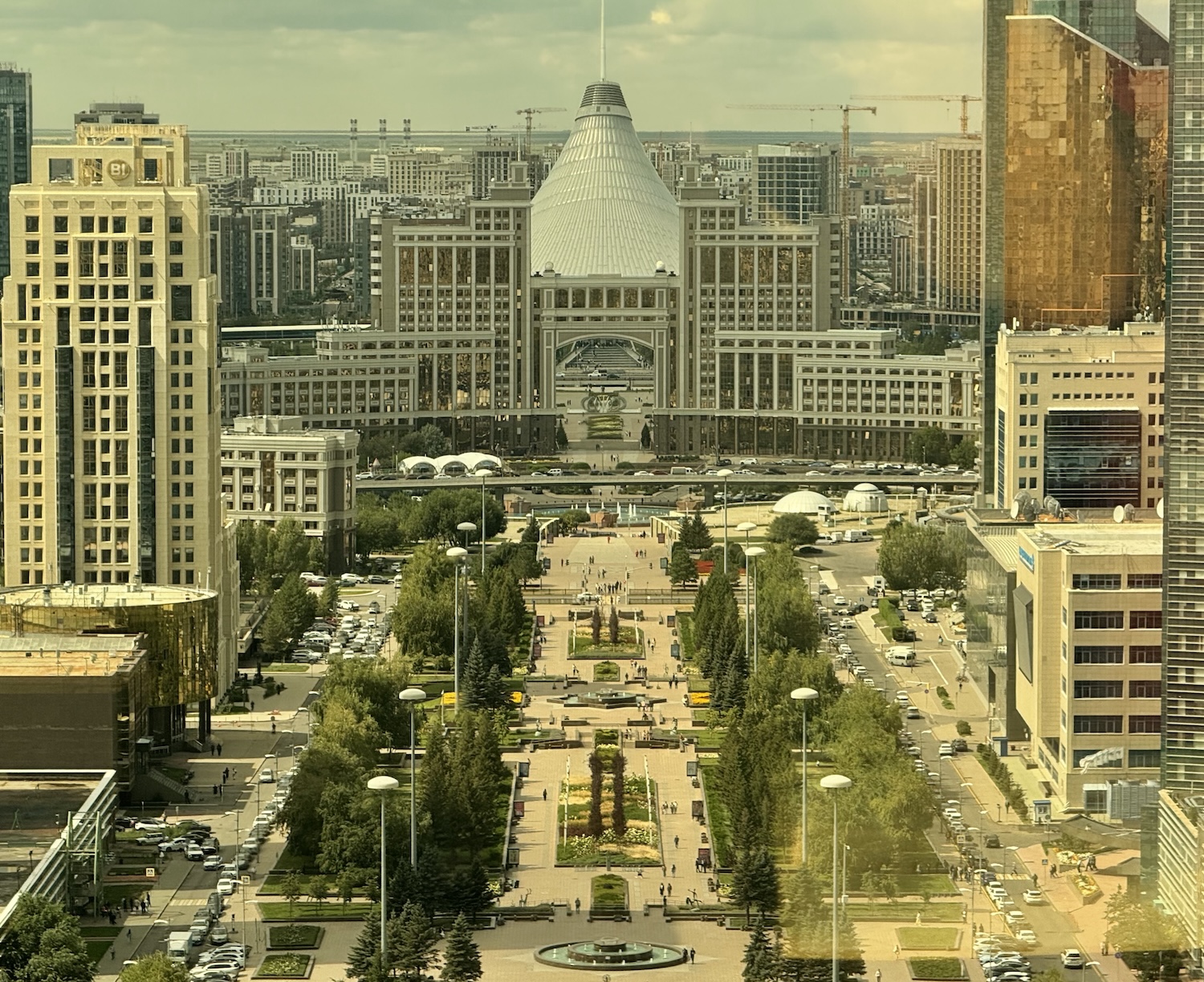
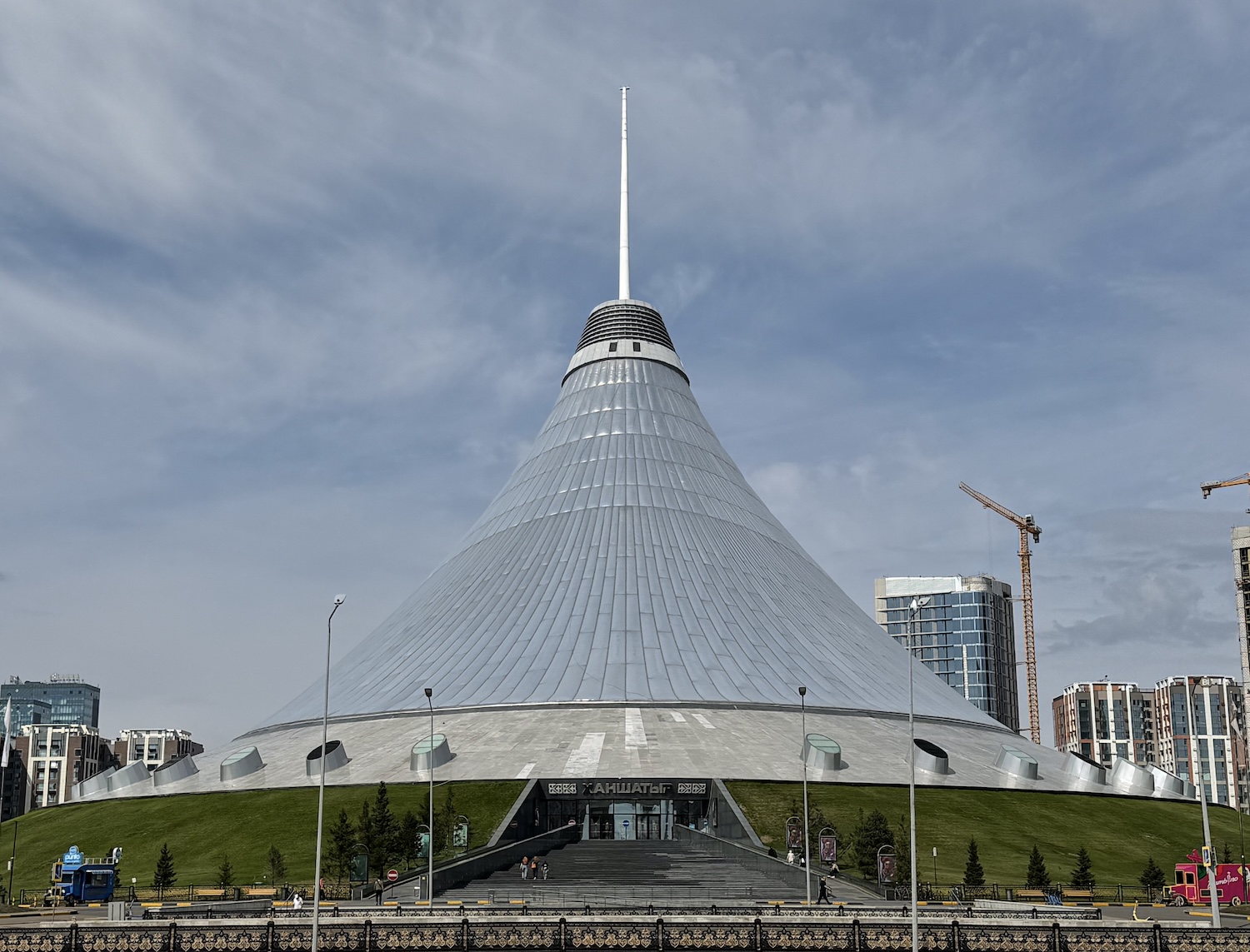
Beyond that is the Park of Lovers, the Soviet-style Opera House, and then the Khan Shatyr, built in the shape of a huge yurt. On its ground floor is a shopping mall of high street stores, very far from the Dubal-style I had been led to expect, and on the top floor a little pool and bar with a widely advertised fake beach.
Around Baiterek Tower are the National Archive, the National Library, the National TV Tower, the National Bank, the Ministry of Foreign Affairs and all the other governing institutions you would expect. Some are in innovatively designed buildings, but nothing over the top.
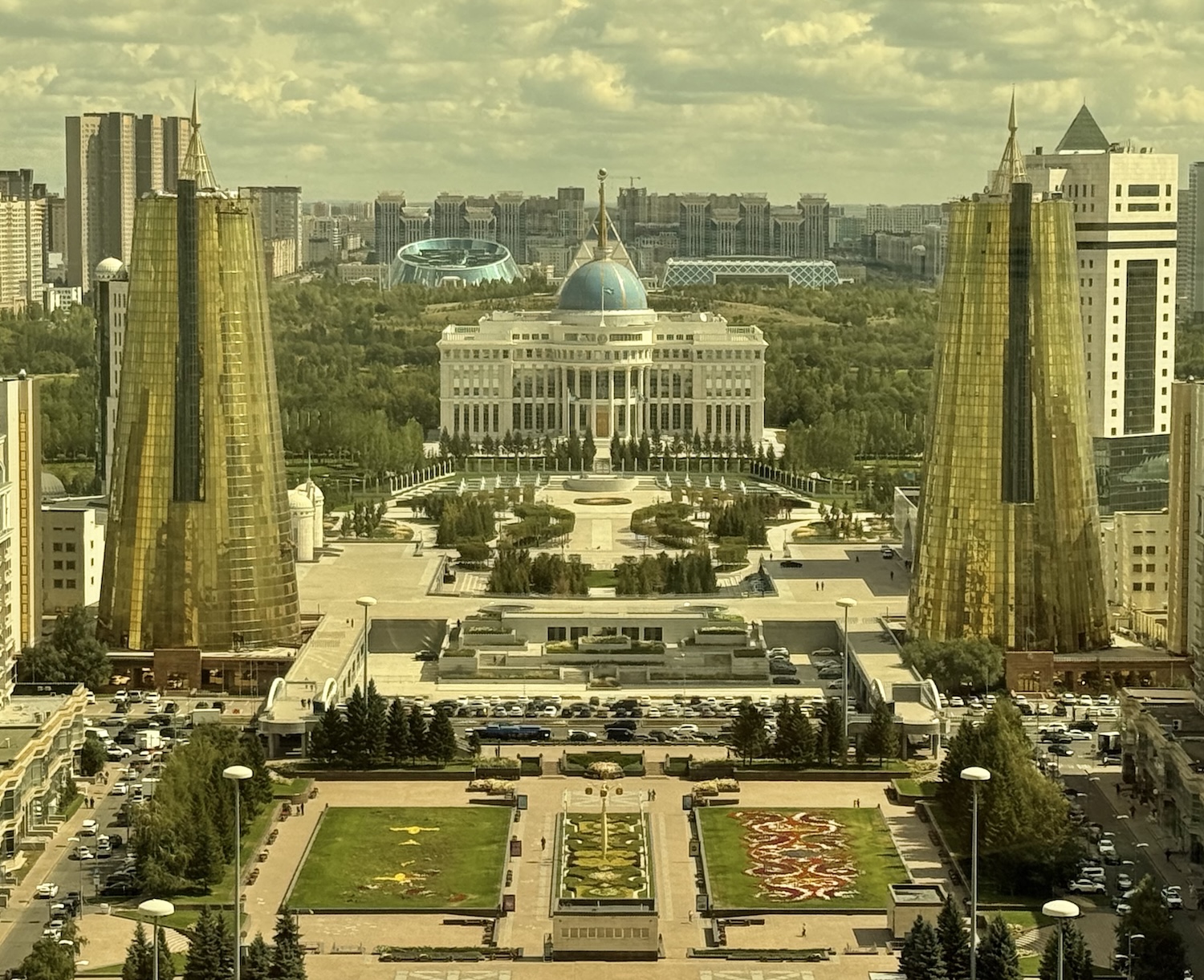
On the east side of Nurzhol Bulvar, lined with elite residences for officials, between the pair of 120m-tall golden towers that are part of the complex of ministries, is the font of power itself, the Ak Orda Presidential Palace. All around are the other offices of state, including the Ministry of Finance, the Supreme Court, and the elected parliament neutered by Nazarbeyev.
Not far away, in a conventional building, is a fairly boring Museum of Presidents. Tellingly, next door, in a much showier structure, is the Museum of the First President, which unsurprisingly lauds Nazarbayev even more than do all the other places in the city.
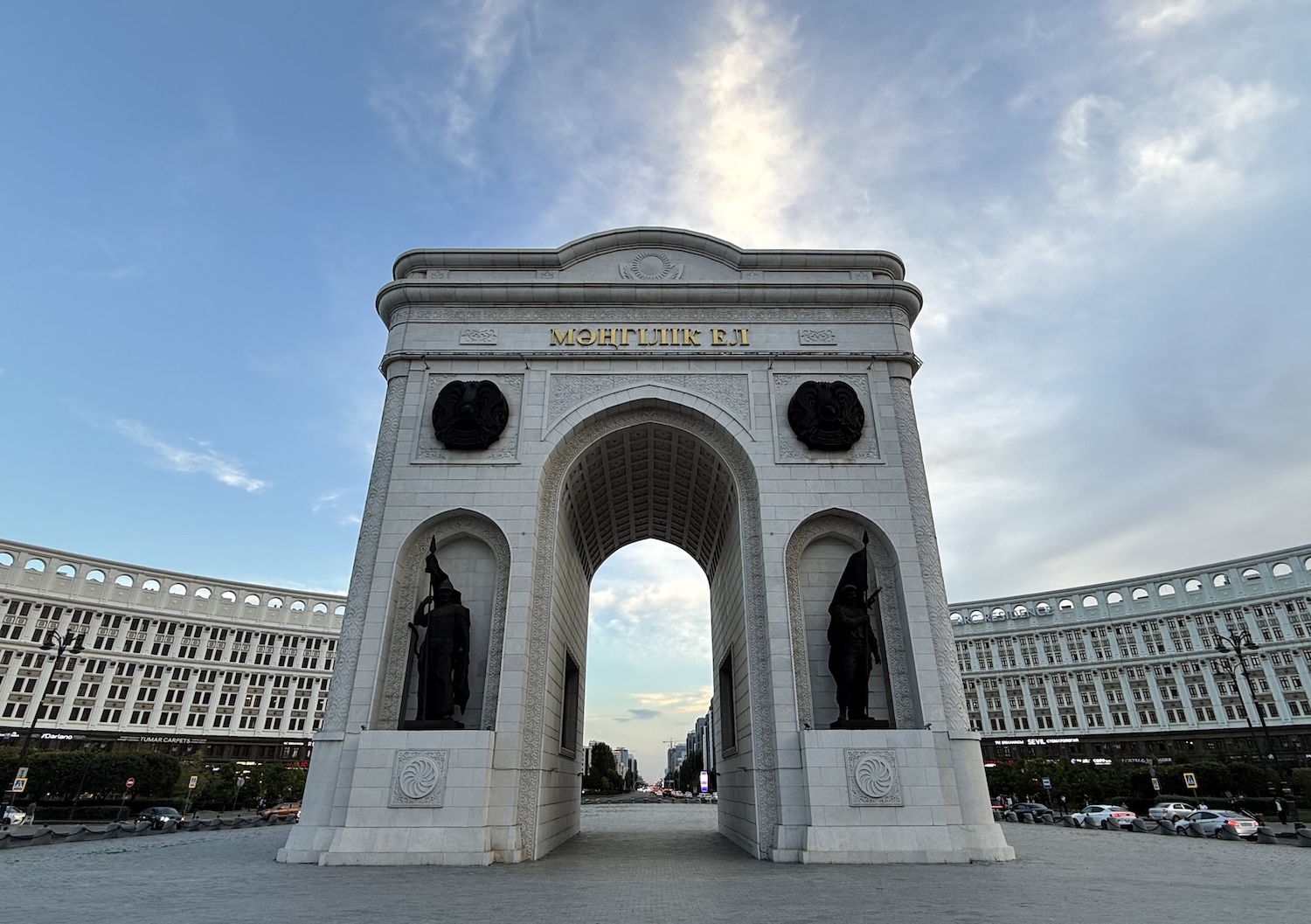
Beyond those is the Mangilik El Triumphal Arch, erected in the centre of a major transport interchange and surrounded on four corners by imposing residential buildings, which was opened to mark the tenth anniversary of independence in 2011.
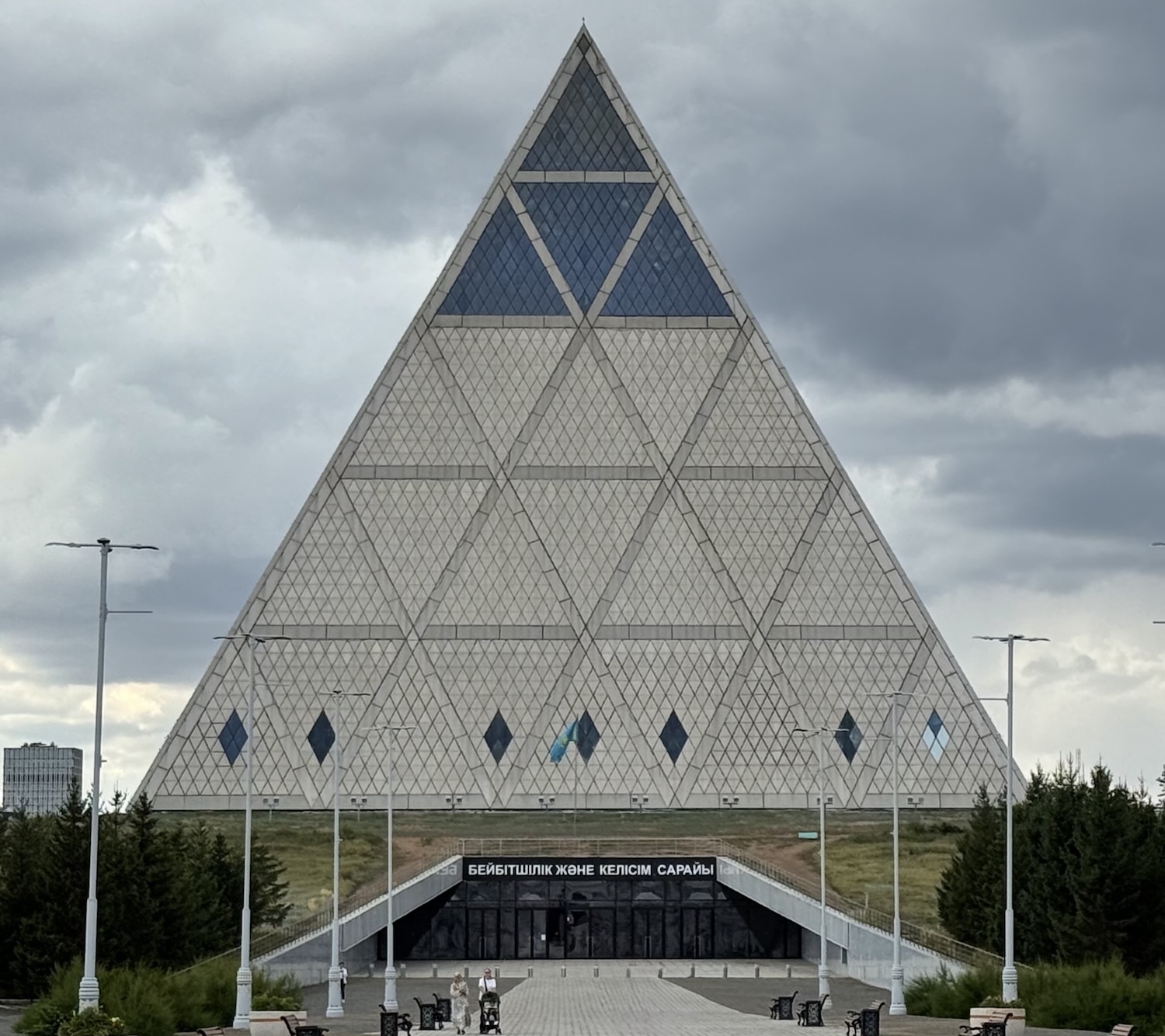
Over the Yesil River is the pyramid-shaped Palace of Peace and Reconciliation. This striking landmark was designed by Norman Foster, though its exact purpose is unclear since it merely claims to serve as a non-denominational spiritual centre. Olé.
Then there is Independence Square, where nationalist parades and other state-sponsored events of pomp and circumstance take place. At its centre is the Kazak Eli Monument, meaning “country of the Kazakhs”, which is flanked by the National University of the Arts and the Palace of Independence, the City Hall. Also around here are the National Museum and the National Musical Drama Theatre. It is true that some of these enjoy avant garde glory, though in my view they tend to look great from afar but then appear cheap and ragged closer up.
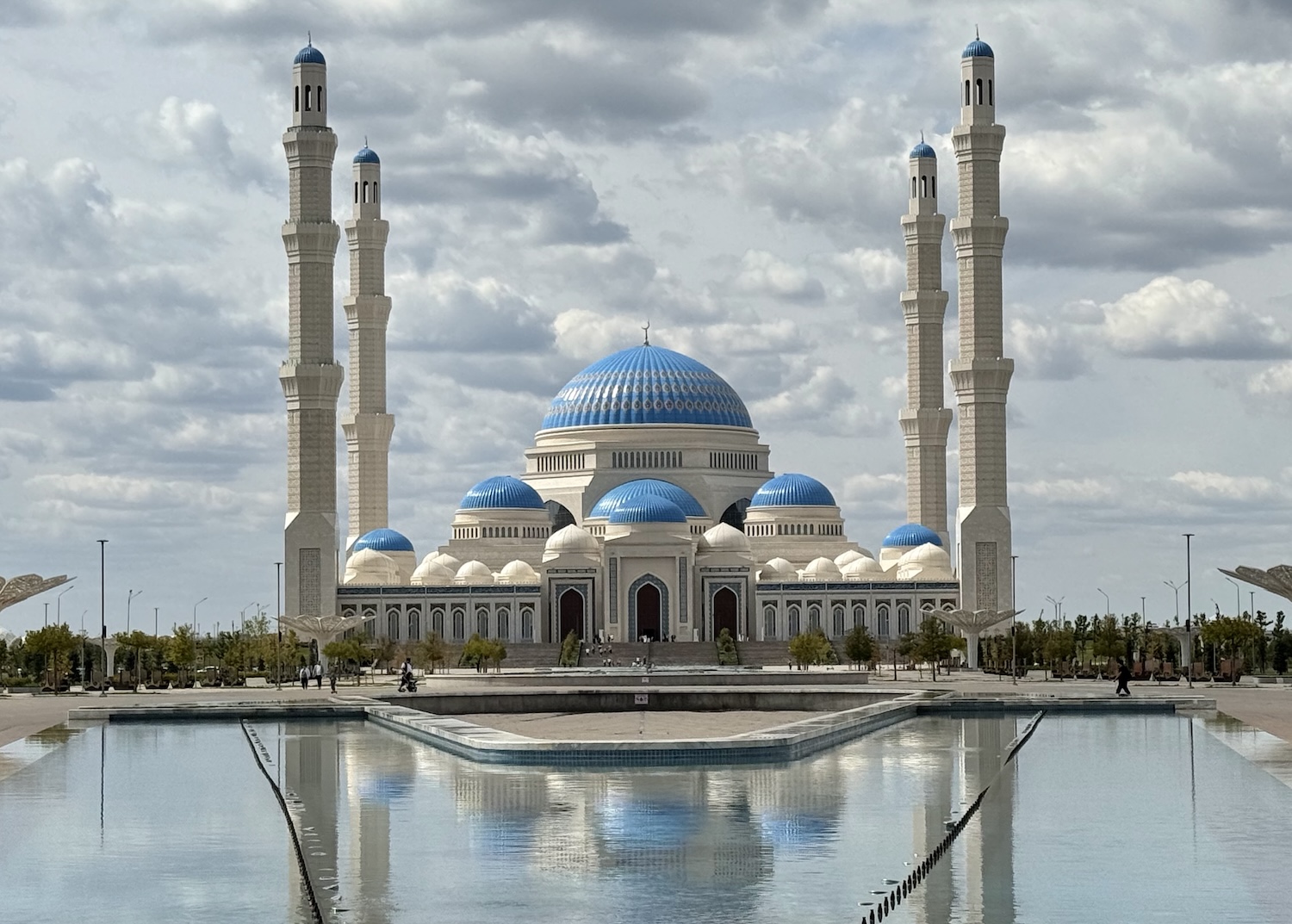
Astana has a much more obviously Russian vibe than other places we have visited in Kazakhstan. Russian not Kazakh seems to be the primary spoken language, for instance, and the influence of Islam seems correspondingly smaller. That said, if you were a dictator building you own Camberwick Green, you would want to make sure it was home to the biggest and bestest mosques in the region, and there are three standouts.
Abu Nasr Al-Farabi Meshiti and Hazrat Sultan Mosque are major landmarks, but the Grand Mosque, opened in 2008, is the largest in Central Asia, and eighth in the world. It is a must-see with a warm reception for non-believers. We – men and women both – are welcome to loll in the main prayer hall, outside prayer times, along with locals and regional pilgrims, and we are encouraged to go up the “tourist minaret” for views down on the central dome.
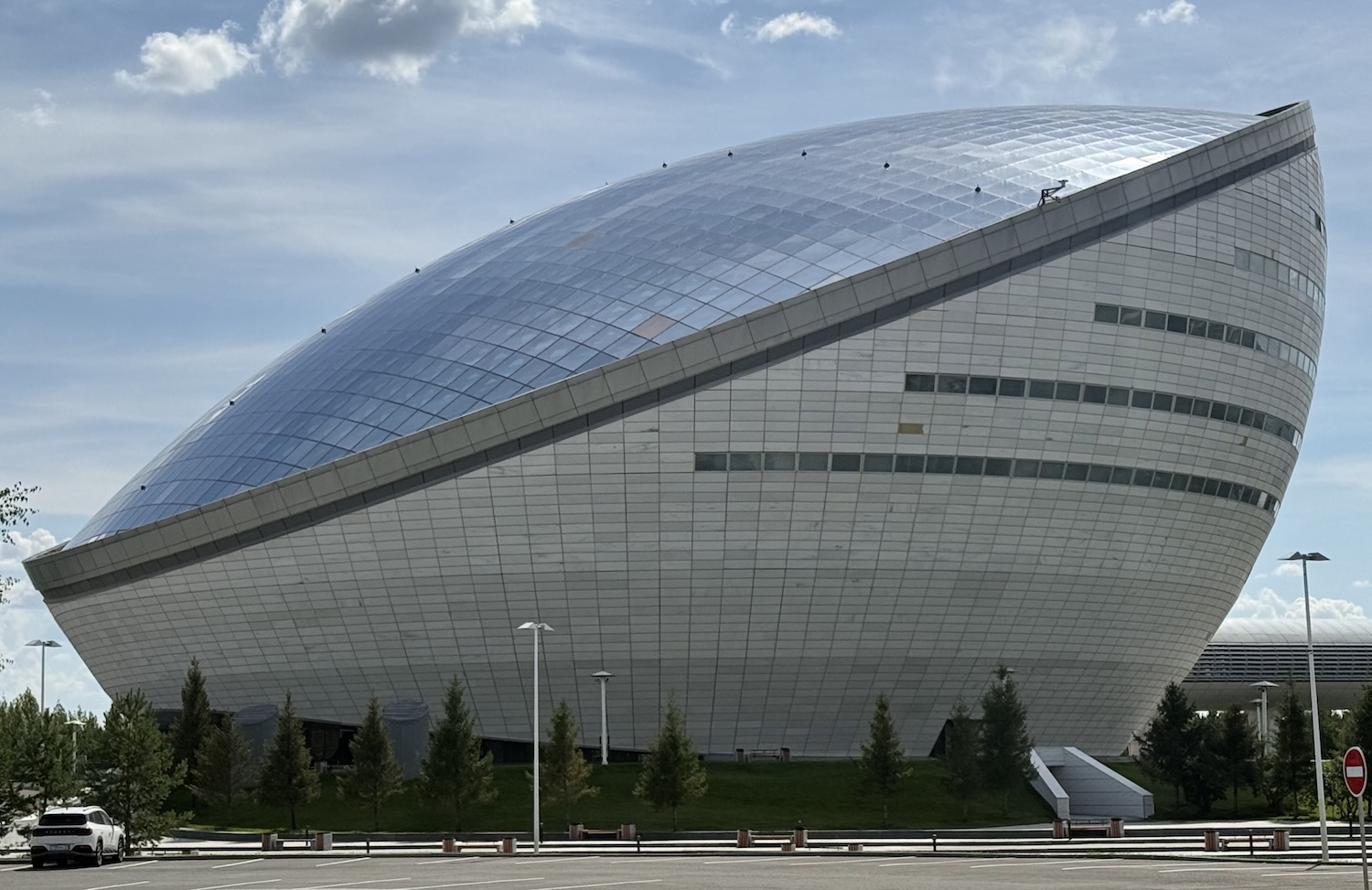
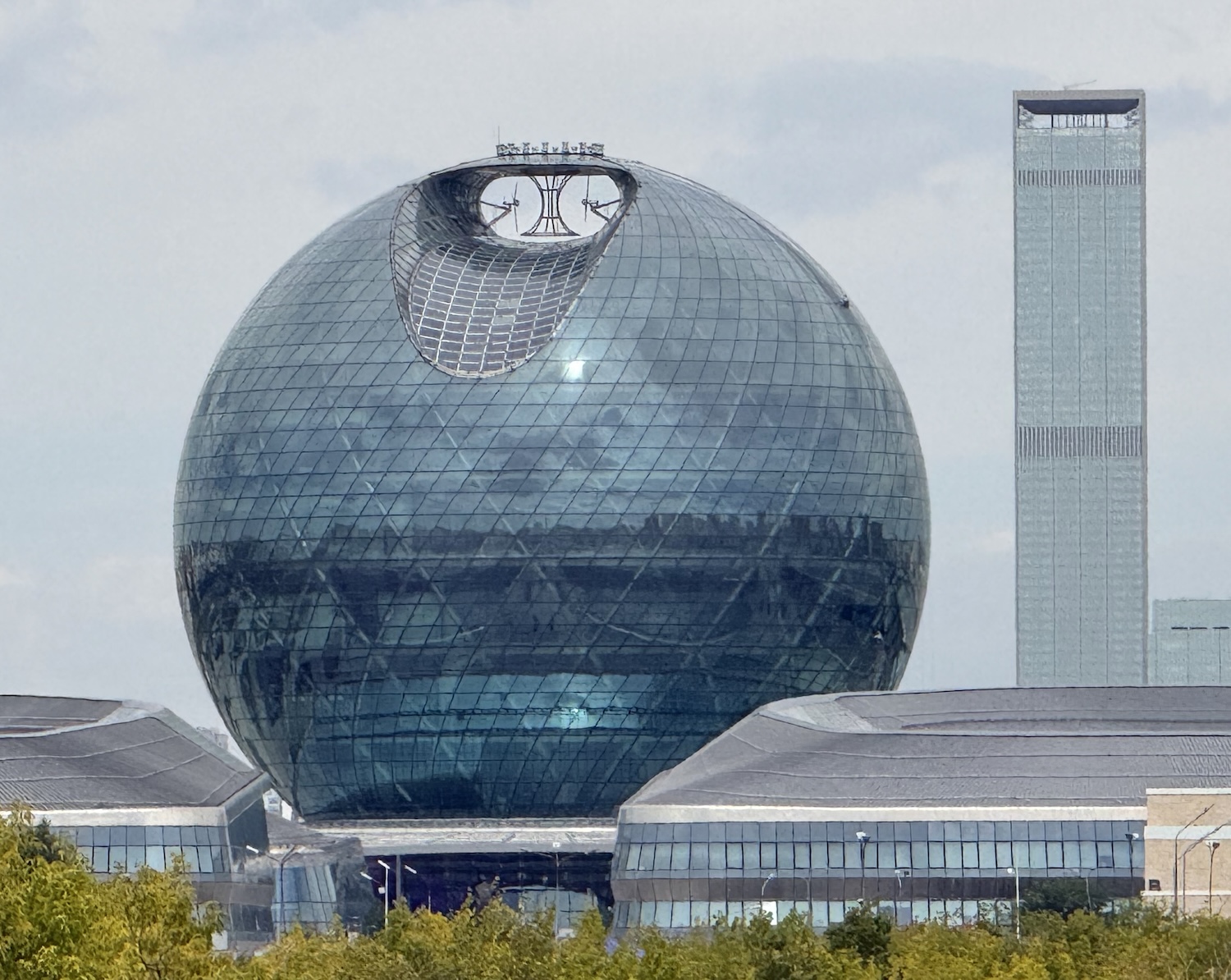
Finally, if you are looking for an example of the madcap architecture people talk about, then you should head to the quixotically titled Nur Alem Museum of Future Energy.
Pubs and cocktail bars are again popular in this city, and there are of course loads of great local restaurants. The one I want to flag is Qazaq Gourmet, which provides an eleven course tasting menu with pairing wines that tells the story of how young Kazakh lovers get it on, introduce each other to their families, and settle down to make babies. According to this telling, when a Kazakh boy brings his new girlfriend home to meet his parents for the first time, she is supposed even today to cover her face, even though she will have almost certainly already been seen behaving like young women do everywhere in the world on Instagram.
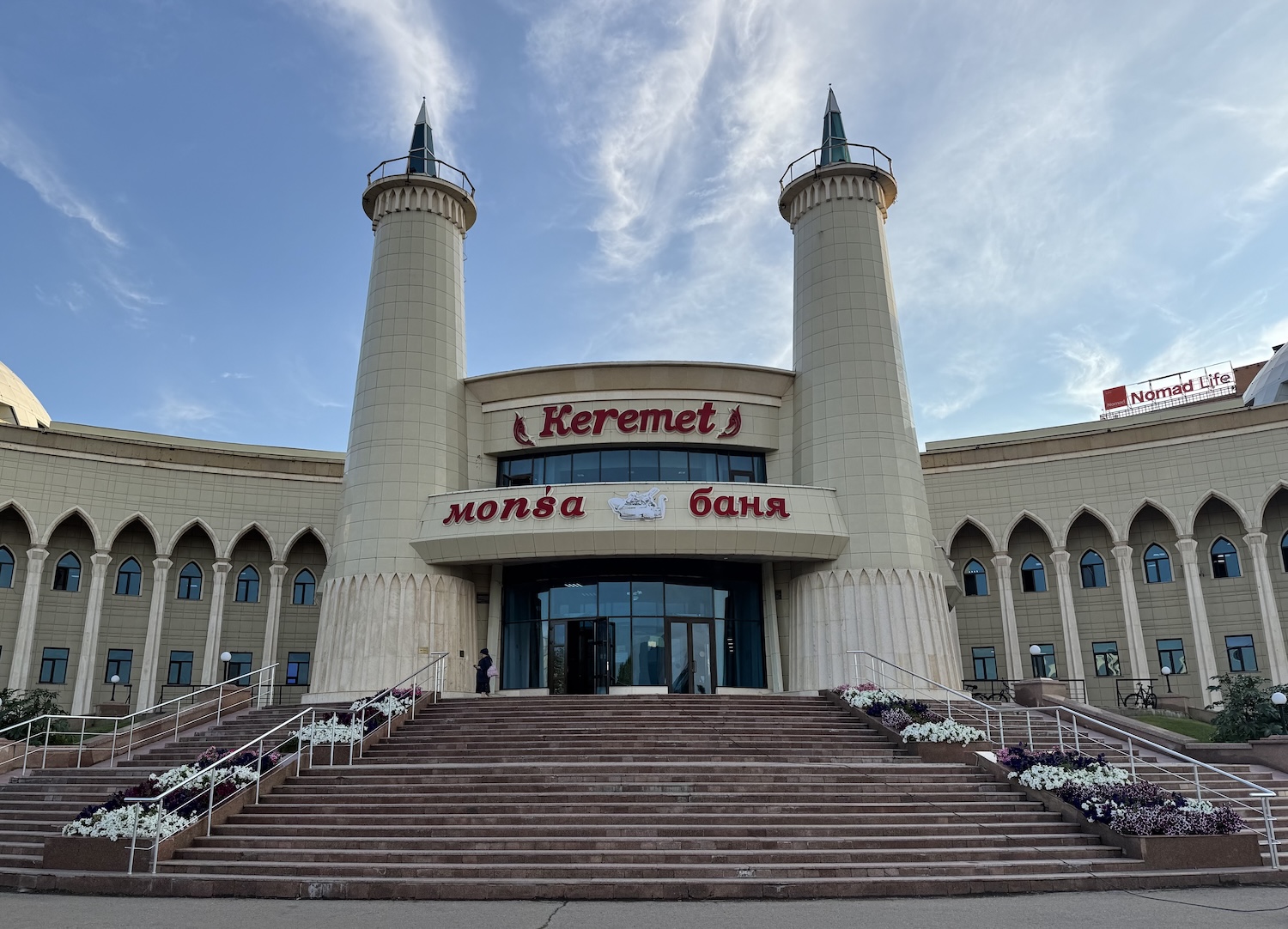
As in Almaty, there is an old-skool Russian hammam to wash away the sins of food and drink: Keremet Banya is a great place for a steam, a scrub and a massage.
There is no metro system in Astana, though there is a brand-new light-rail line that loops from the airport in the south into the centre and out to the train station in the east.
The outstanding hotels downtown are the Ritz-Carlton, above the Talan Gallery Mall of your Guccis and Pradas and Louis Vuitons, with the lovely Mokki Terrace overlooking the Baiterek Tower, as well as the Rixos and the Sheraton.
The St Regis is a few minutes north, by the huge national flag and another Norman Foster creation, a pedestrian bridge across the Yesil River where little cruise boats start their tours. This is the Old Town, the only buildings on this patch of steppe built before the 1990s. A few remain, including a handful of nineteenth-century merchant houses and some Soviet structures and murals, and an Arbat Walking Street for shopping and nightlife has been added. Also here, to bring us full circle from Almaty, are more not-very-lifelike statues honouring the Beatles.
Akmol
Kazakhstan is the southern neighbour of Siberia, and it was in both of these dark and austere regions that the USSR constructed their infamous gulags to incarcerate political prisoners in the 1930s, 40s and 50s.
About 40km west of Astana, in the little village of Akmol, in 1937 they established the Alzhir Gulag specially for what were called “family members to traitors of (the) Motherland”.
As many as 18,000 women from all over the Soviet Union were sent to this Gulag. After it finally closed in 1950 it was reported that 1,507 of them had given birth as a result of rape by their guards.
Some were wives of purged party leaders, such as to the People’s Commissar of Internal Affairs in Kazakhstan, while others were married to more humble workers, including one to an “equipment supervisor at (a) Second Car Repairs Plant”.
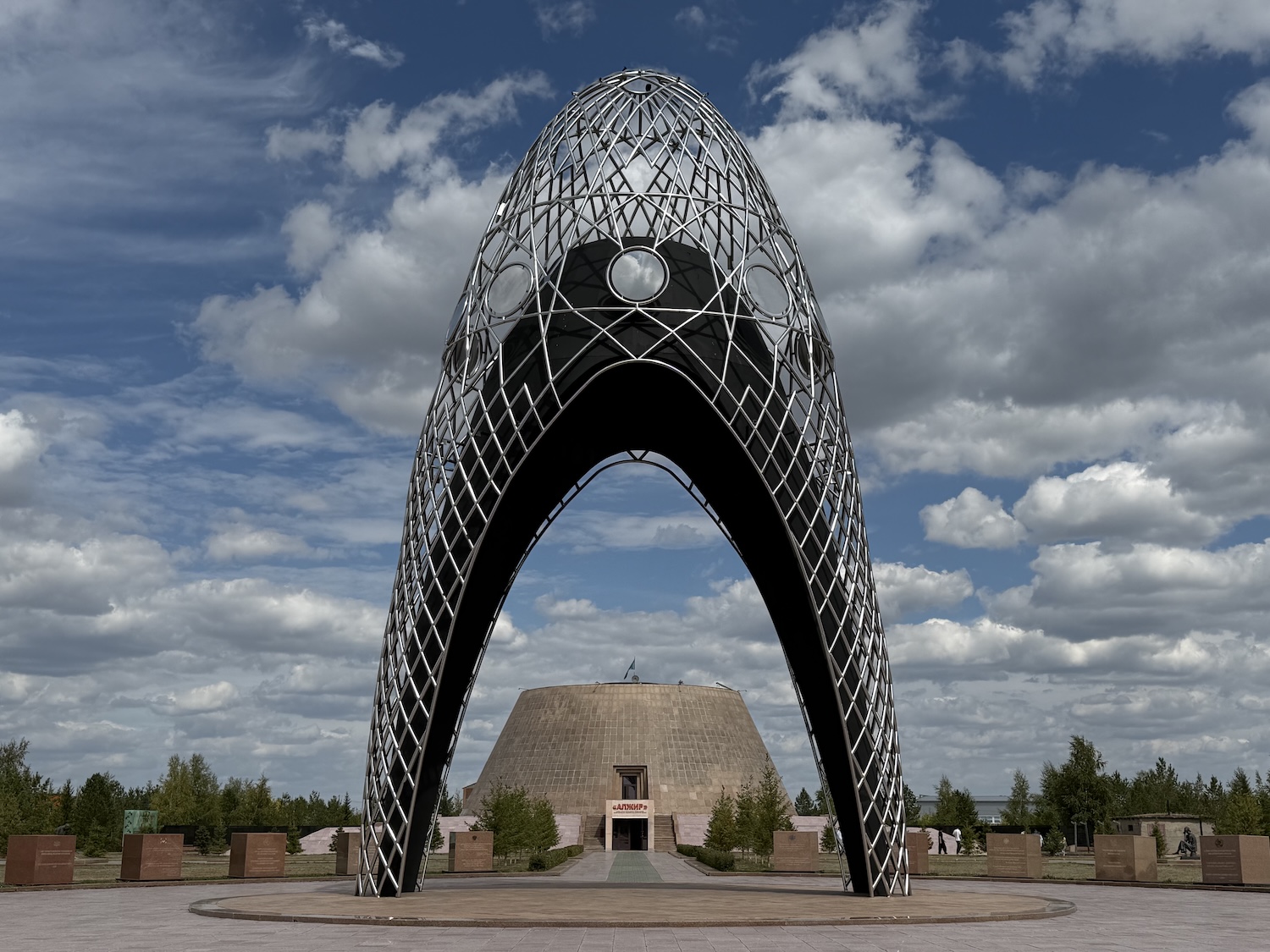
There is nothing left of the Alzhir Gulag now, but Akmol is well worth a half-day of your time. There is a lovely Memorial, called the Arch of Sorrow, several moving sculptures, with titles such as Despair and Powerlessness, and a long wall of names of many of those who suffered here.
There is also an excellent Museum of Victims of Repression, which situates the suffering of these women in the context of Soviet brutality in Kazakhstan as we have witnessed it on our journey around the country: the Great Famine, the Great Terror, nuclear testing, the War in Afghanistan and the Jeltoqsan Uprising of 1986.
Many explanations are in English, and these sentences seems to summarise what we learn: “Undoubtedly the history of Gulag is the shattered destinies of people, the loss of loved ones…the soul of the people was subjected to horrific violence and decomposition”.
Karaganda
Gulags were not just vicious prisons, they were a system of forced labour, often conscripted to enforce the collectivisation of agriculture and advance the planned industrialisation of the Soviet empire. Work ranged from constructing transport and industrial infrastructure to sewing army uniforms.
In Kazakhstan there were twenty-four separate camps, and one of the largest clusters was administered from the Karlag Gulag near the city of Karaganda, a coal mining area 220km southeast of Astana.
There is an airport, though we caught the four-hour train, a journey that proved the perfect opportunity for a preparatory reading of Alexander Solzhenityn’s One Day In The Life Of Ivan Denisovich.
About 40km southwest of Karaganda in the village of Dolinka, in 1931 the USSR founded one of its largest gulags, holding 66,000 inmates at a time on 18,000km² of steppe. By the time it closed in 1959, when Khruschev sought to end some of the worst of Stalinism, it is estimated that a total of more than a million had been imprisoned here.
Today, there is not much left of the gulags themselves, but the Administration Building of the Karlag Gulag has been turned into an intense Museum of Political Repression Victim’s Memory. Upstairs are the actual General’s Office, the Officers’ Rooms, hospital, police station and bays for women and children. Downstairs there are reproductions of the cells, torture chambers and execution rooms.
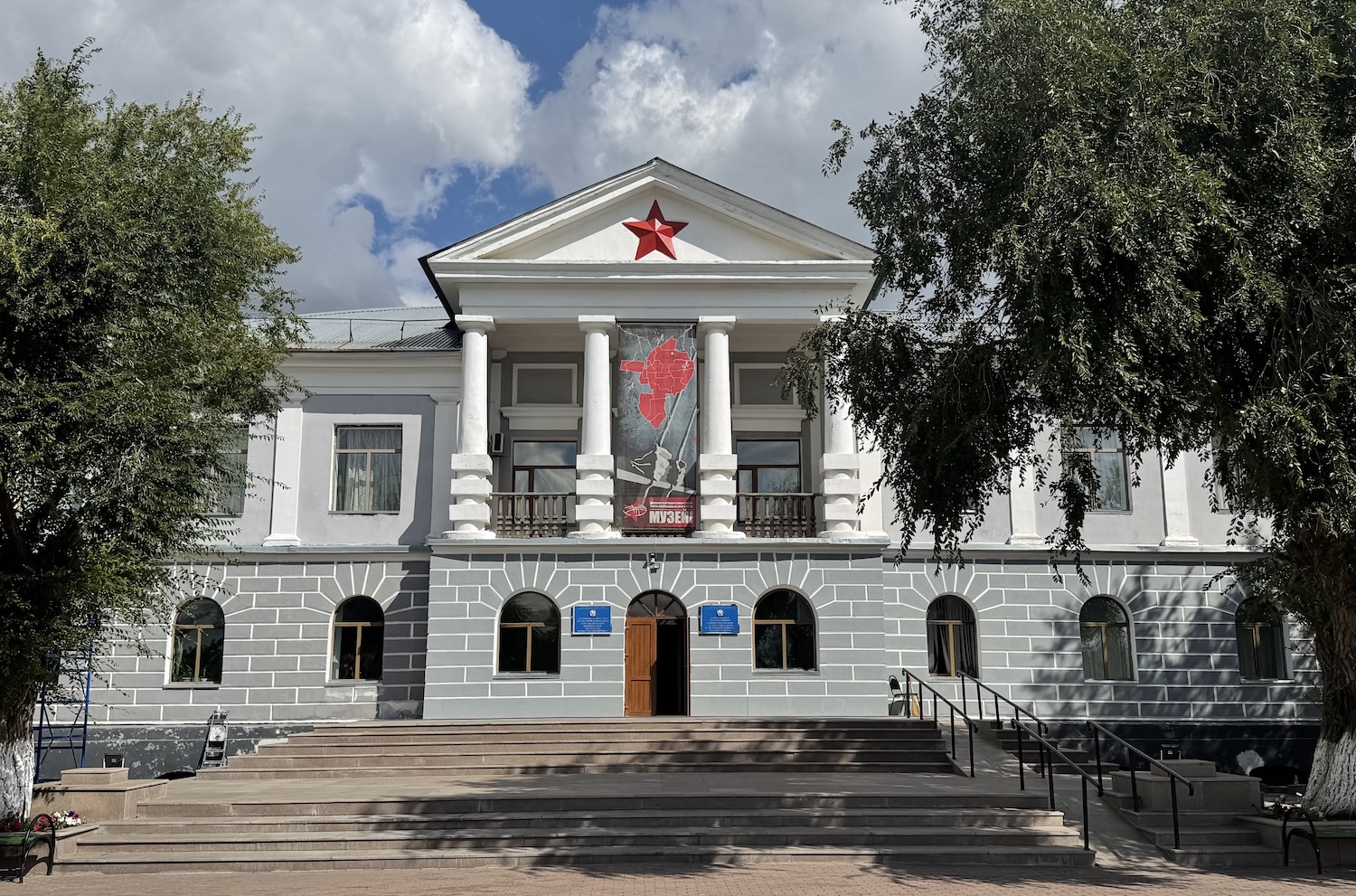
While the rare possibility of seeing and feeling an important part of a major gulag makes this a crucial site to visit, the museum itself is a mixed affair. There is some explanatory labelling in English, and if you can manage to call a day or two ahead of your visit you may be able to book an English-speaking guide. However, the tone veers from detailing the grotesque to comical wax effigies to pride in the work rate and artistic endeavours of inmates.
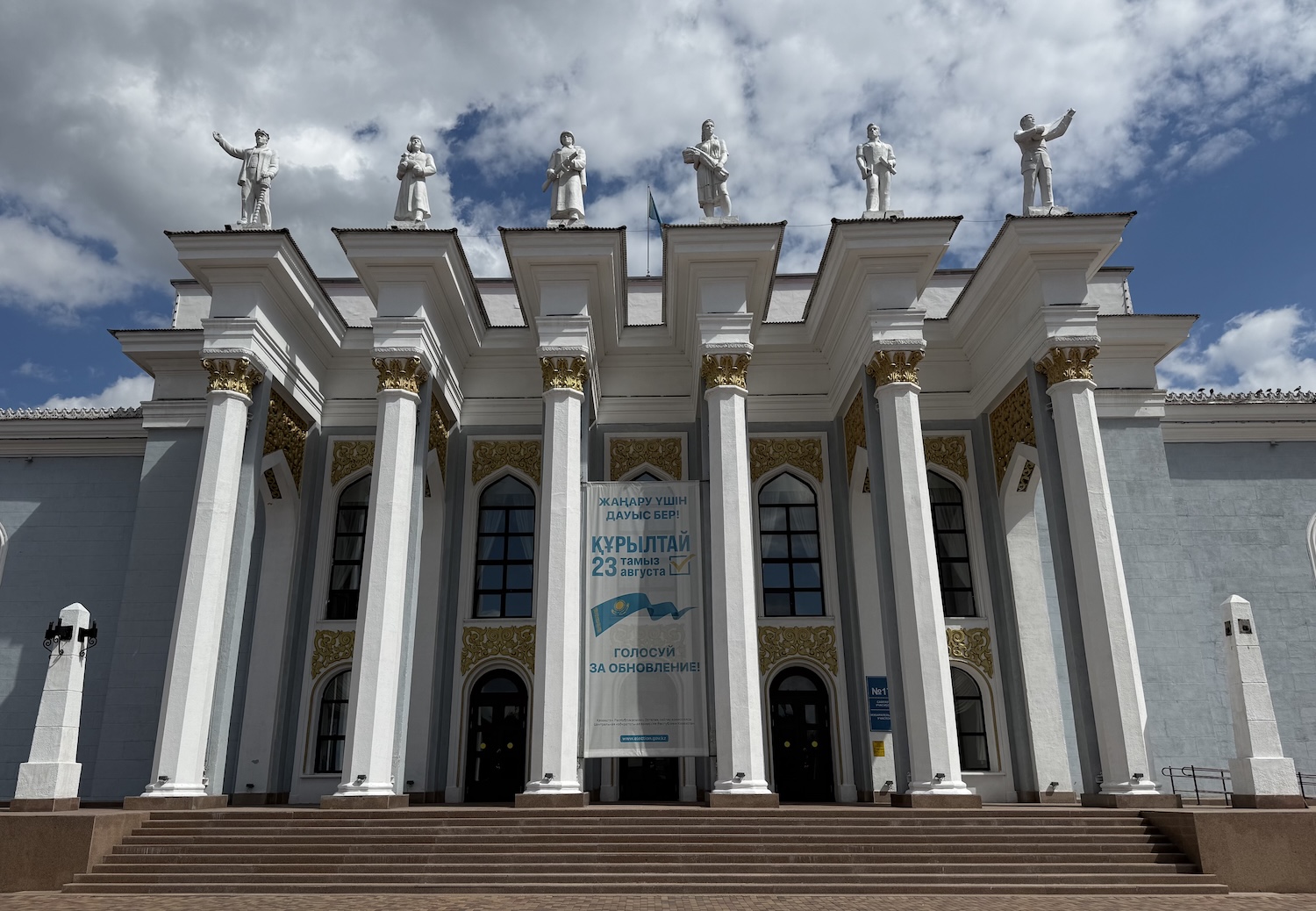
One of the reasons Karaganda was selected for this major gulag is it was an emerging industrial city where the coal mines were deemed in need of free labour to boost production. Today, this is still the coal capital of the country, and in the town centre there is an elaborate Palace of Miners’ Culture Centre (built by forced labour, of course) and a Glory to Miners Monument amid the remnants of Soviet murals.
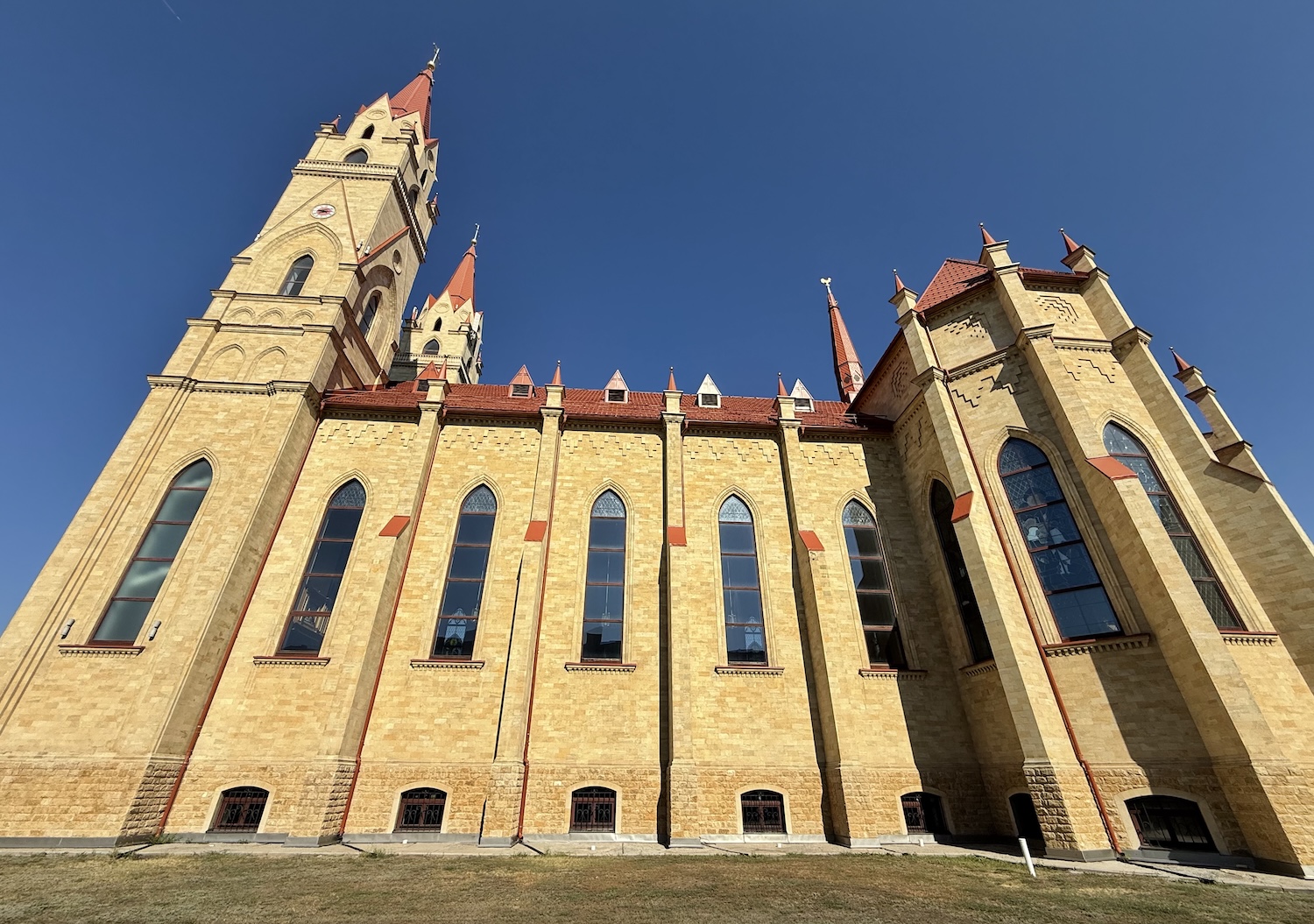
Also in Karaganda is the Cathedral of Our Lady of Fatima, consecrated in neo-Gothic style in 2012. It is the largest Catholic church in the country, and was partly funded by Germany in recognition that many of those taken to Karlag were its citizens captured in the Second World War.
There are two well reviewed hotels in Karaganda, the Cosmonaut, which I can vouch is surprisingly excellent, and the Senator. In addition, the three-star Hotel Chaika is worth a look as it is one of the places where Soviet cosmonauts were received after their trips to space from Baikonur, further south.
And on that bomshell, our time in this country draws to a close. Saw boliniz, Kazakhstan, it has been a wonderful three weeks getting to know you, and we have had some incredible adventures together. It is way past time for more adventure travellers to come see what you have got. Raxmet.